The US can live with the status quo, but Iran can’t

http://www.thenational.ae/opinion/the-us-can-live-with-the-status-quo-but-iran-cant

The US can live with the status quo, but Iran can’t
Iranian foreign minister Mohammad Javad Zarif gathers with other Iranian diplomats on a balcony at the Palais Coburg Hotel, where the Iran nuclear talks meetings are being held in Vienna. Joe Klamar / AFP


The brinkmanship exhibited at the nuclear negotiations between Iran and the P5 +1 international consortium is breathtaking, and suggests, for the first time in several months, the actual possibility of failure. There’s too much invested by all parties to make walking away appealing, but the United States reminding Iran that this remains a possibility emerged as a key factor last week.

Perhaps the most dramatic example of this was the American suggestion that the talks could simply continue on a lower-level and open-ended basis into the foreseeable future. The grounds for that would be an extension of the interim accord. This was a not particularly subtle way for the American side to say to the Iranian one: “We can live with the status quo a lot more easily than you can.”

After all, the interim accord provides very limited sanctions relief to Iran and yet commits Tehran to some significant measures to reduce its low-enriched uranium stockpile and other steps that roll back its nuclear programme.

At the same time, Iran has not been able to extricate itself from the diplomatic, industrial and financial box that the last wave of intense sanctions managed to construct. The American message was designed to remind Iran about the difficulties they continue to face as a result of the sanctions regime.

In the final analysis, Washington’s proposal in this regard is not serious. How could it possibly be in Iran’s interests to agree to make the interim agreement less temporary? It’s conceivable that they could agree to such an arrangement, but only to buy time. But there is simply no way that Tehran could live with the interim arrangement as a long-term formula.

This might well have played into the widely-reported and uncharacteristic outburst of anger by Iranian foreign minister Mohammad Javad Zarif who reportedly shouted at his interlocutors: “Never threaten an Iranian!” Most speculation focused on the heavy attention this remark got in Iran’s domestic media, suggesting that the whole thing was a play for public opinion. And certainly all sides are doing their best to try to look tough to assuage domestic hardliners.

But the possibility that the outburst was genuine and meaningful should not be dismissed. If it was, what was the threat in question? The major threat coming from the American side has to do precisely with the idea that the talks could be mothballed in favour of an indefinite extension of the interim agreement arrangements. And that would indeed be enough to make any Iranian diplomat lose his temper.

The American side has also been provoked of late by Iran’s demands that any nuclear agreement should also involve a lifting of the UN arms embargo. This suggestion didn’t provoke an outburst, but it did produce a strong reaction from the outgoing chairman of the US joint chiefs of staff, General Martin Dempsey.

He told a Congressional hearing that “under no circumstances should we relieve pressure on Iran relative to ballistic missile capabilities and arms trafficking,” seemingly ruling out any support for an American agreement to lift the embargo.

Russia and China, however, are reportedly strongly backing the new Iranian demand. This is hardly surprising, given that they are Tehran’s primary weapon suppliers. But it does mean that Iran has found a wedge issue dividing the P5+1 group, which has otherwise been surprisingly coherent across a variety of potentially difficult issues.

The Russians apparently also could not resist getting involved in the outrage game. “Or a Russian,” foreign minister Sergey Lavrov reportedly chimed in after Mr Zarif upbraided his interlocutors about threatening Iranians. The newfound Russian-Iranian common cause on not being threatened apparently came after European Union foreign policy head Federica Mogherini suggested that the talks might break down precisely because of Iran’s refusal to compromise on the arms embargo.

It’s entirely possible that Mr Zarif was basically playing tough for a domestic audience in preparation for unveiling an agreement that includes significant concessions to the West. But it’s also possible that his remarks, and those of Mr Lavrov, are actually public positioning in anticipation of a potential breakdown in negotiations. Either way, the uncharacteristic outbursts bear all the hallmarks of political manoeuvring before a major development.

It’s still far more likely that a deal will be achieved in the coming days than not, primarily because the core outlines of a deal were already laid down in the interim agreement: Iran will continue to enrich uranium but on a small scale and subject to intensive international inspections, in exchange for a lifting of sanctions. This would hold for 15 years, after which the issues would have to be revisited in some other context. Yet for both sides the devil is in the detail.

But as the United States has finally got around to reminding Iran in recent days, it can live with the status quo, including as laid out in the interim agreement, much more comfortably than Tehran can. And that ought to be enough to give the United States sufficient leverage to ensure that the details break largely in its favour. Or, everyone is now on notice, they really might just walk away after all.

The accusations will begin once a deal is reached

http://www.thenational.ae/opinion/comment/the-accusations-will-begin-once-a-deal-is-reached

The accusations will begin once a deal is reached
Iranian Foreign Minister Mohammad Javad Zarif (3-L), Austrian President Heinz Fischer (2-R) and Austrian Foreign Minister Sebastian Kurz (3-R) in a meeting in Vienna on 03 July 2015. Georg Hochmuth / EPA


With the international negotiations with Iran entering their final stage, all parties are reading from the same script in terms of managing expectations. The consistent message is that although there are numerous issues still unresolved, everyone is determined to finalise an agreement.

The second half of that statement is even more true than the first. Some of the toughest issues – including details of the inspection regime, the nature and timing of sanctions relief and what kind of nuclear research and development Iran would be allowed under an accord – are still not fully agreed. And while the parties have extended their deadline until at least July 7, they are clearly running out of time. If they do not have a deal by the end of the month, they are unlikely to ever get there.

But given the political investment in achieving an agreement by all the governments in question, especially in Washington and Tehran, failure is almost unimaginable. The parties may, in theory at least, still be willing to walk away from the table. And, if the other side is recalcitrant enough, they probably would. But, in reality, they are all loathe to do so, and they all know how invested the other is in success.

This has given both sides considerable leverage. But Iran appears to have so far put that opportunity to much better use than the US and its allies. The delicate balance in Vienna has produced a series of reciprocal but unequal concessions. It seems that Iran has been able to gain an upper hand by exchanging tactical, immediate concessions on its part for strategic, long-range concessions on the American side.

According to the Associated Press, a confidential International Atomic Energy Agency report issued Wednesday confirmed that Iran has made considerable progress in meeting its commitments to transform much of its existing enriched uranium stockpile into forms that are essentially not of military value. And, the report adds, this material is not being added to Iran’s store of low- enriched uranium that could be processed into weapons-grade fuel in the future. So, Iran is already held to be in compliance with its commitments under the interim agreement.

Meanwhile, the American side has adjusted its position on inspections, publicly agreeing that not all military sites will be subject to the regime. And Obama administration rhetoric is raising the prospect that most, if not all, of the sanctions – including those imposed on Iran due to its support for terrorism and other non-nuclear issues – will be lifted in short order after the agreement. The administration appears to put more stock in sanctions “snapback” than in maintenance. But many others doubt that sanctions, once lifted, can easily be reimposed, and think that therefore the true key is when and how they are eased.

Nonetheless, the overwhelming likelihood is that there will be an agreement this month, because it is in the interests of all parties that one is achieved. And, indeed, given the progress that has been made and the chance, admittedly slight, that an accord could lead to a lasting solution to the Iranian nuclear question, perhaps there really is no other viable, realistic option than trying to see what, in practice, an agreement can produce.

But no one should assume that a deal this summer will really restructure the strategic equation. It might. But there is every chance that, rather than ushering in a new era of harmony and cooperation between Tehran and its allies and Washington and the rest of the West, an agreement might quickly give way to an endless and increasingly bitter exchange of accusations over implementation.

This is especially true since the pressure to finalise a deal might lead the parties to overlook the fact that, while they agree on all of the specific language in an accord, they do not interpret it all in the same way. This is especially likely to emerge in the context of inspections, but also with regard to sanctions relief and other issues of implementation.

Despite the commitment of the two governments to reach a deal, let’s remember, there is still very little common interest between the US and Iran.

Even on the question of ISIL, which many cite as the prime example of how a new era has made Iran and the United States natural allies, there is, in fact, no real common agenda. Anyone who doubts that should look at how Iran’s English-language Press TV propaganda station airs a new segment almost every day asserting that ISIL is a deliberate American creation and puppet.

The United States and Iran are simply not counterintuitive but natural allies the way the United States and China clearly were at the end of the Vietnam War. This is an illusion that many harbour, but cold-eyed realists on both sides know that it’s simply not true. Therefore, an agreement may well be coming, and is probably worth a try. But it may be a lot less potent and meaningful in practice than its proponents hope.

Qatar Changes Course

http://mobile.nytimes.com/2015/06/30/opinion/qatar-changes-course.html?_r=1&referrer=

DOHA, Qatar — The old joke among foreign policy wonks began thus: After the collapse of the Soviet Union and the end of the Cold War, the world was surprised to discover that it still had two superpowers: the United States and … Kuwait. And, it went on, after Kuwait was chastened by the Iraqi invasion and the Persian Gulf war, by the mid-1990s the world again found itself with two superpowers: the United States and … Qatar.

This wisecrack lampoons the attempts of tiny but ultrarich Gulf states to punch above their weight in international relations. Kuwait may have once set the pace, but for the past 20 years Qatar has tried to leverage its vast energy wealth to build and project its influence throughout the Middle East.

Now, however, Qatar’s rulers seem to be adjusting their once-adventurous foreign policy. In particular, the rapprochement between Qatar and its neighbor and former rival, Saudi Arabia, marks a generational shift in strategic thinking.

Qatar’s astonishing wealth underwrote the policies under the previous emir — who ruled from 1995 until his abdication in 2013 — of spending lavishly on making friends and influencing people, Saudi Arabia excepted. For most of the past two decades, Qatar seemed driven by a determination to challenge and outflank its big brother to the West.

Among the most fundamental of Qatar’s numerous investments are the American military installations at Al Udeid Air Base and Camp As Sayliyah. Reportedly, these have been heavily funded by Doha, including more than $1 billion in initial construction costs. Qatar sees these bases as vital guarantors of its national defense.

Qatar’s regional strategy, meanwhile, focused on promoting Muslim Brotherhoodparties throughout the Arab world. But this approach provoked tensions with Saudi Arabia and another Gulf Cooperation Council state, the United Arab Emirates. Both have declared the Brotherhood a terrorist organization.

Qatar’s pro-Brotherhood policies were reflected in the activities of the influential state-owned Al Jazeera television news network, as well as in Doha’s financial support for Brotherhood groups, including Hamas in Gaza. Support like this strained relations with other Gulf Cooperation Council states over the upheavals in Egypt, Libya and other Arab Spring countries.

Tensions finally boiled over at a council summit in March 2014, which led Saudi Arabia, the U.A.E. and Bahrain to withdraw their ambassadors from Doha. The crisis continued until November, when it was finally resolved with the signing of the Riyadh “supplementary agreement.”

The full contents of the agreement have not been disclosed, but the widespread assumption that Qatar agreed to reduce its backing for Muslim Brotherhood movements has been borne out by a de facto shift of policy. Qatar has notablyreduced its support for Hamas, and there has been an exodus of Brotherhoodleaders from Doha.

In country after country, the Brotherhood’s fortunes were already in free fall. Doha clearly concluded that it was making too many enemies while backing a losing side.

The accession of new monarchs has also changed the dynamic between the once-rival states. In 2013, Qatar’s Sheikh Hamad abdicated in favor of his son, Sheikh Tamim bin Hamad al-Thani, and in January, King Salman took power in Saudi Arabia. Salman moved quickly to secure greater unity among the Gulf states, in particular ending the rift with Qatar. That was the prelude for a more assertive regional stance, best exemplified by the intervention in Yemen.

Doha has welcomed Riyadh’s new strategic direction. Qataris involved in the foreign policy debate in Doha now offer a robust defense of Gulf Cooperation Council actions that are harshly criticized outside of the Gulf. Public sympathy here for Saudi policies in Yemen, Iraq and Syria — and resentment of Iran’s role — reflects a level of cooperation between Riyadh and Doha unknown for two decades.

Along with this, there is a palpable sense of relief among Qataris that their leaders now define the national interest in a less arcane manner. These days, almost everyone in Qatar can explain what their country is trying to do and why. That wasn’t always the case, to put it mildly.

Qatar is also by far the most generous donor country investing in Gaza’s reconstruction. Counterintuitively, this has contributed to a thaw in relations with Israel, which cautiously welcomes Qatar’s investments in Gaza and its efforts to broker a long-term cease-fire, especially since they are coupled with reduced political support for Hamas. In March, Qatar’s representative in Gaza, Mohammed al-Emadi, praised Israel for facilitating Gaza reconstruction, the first public recognition of a new Israeli attitude that welcomes Doha’s efforts in the impoverished territory.

None of this is to say that the days of Qatari-Saudi rivalry are completely gone. Some level of competition is bound to continue. The more localized the issue, like an unresolved border dispute, the more likely the two countries are to fall out. And despite moving closer together, Qatar and Saudi Arabia still do not share a common view on several key regional issues.

Doha is less invested in the Muslim Brotherhood than it used to be, and Riyadh less hostile, but it would be an exaggeration to say the two leaderships view the Islamists in the same light. But there are good reasons Qatar seems to have concluded that rivalry with Saudi Arabia is at best pointless and potentially catastrophic.

One is the region’s grave security problems: Iraq, Syria, Libya and Yemen are imploding, and terrorist groups like the Islamic State are on the rise. Another is that with Tehran and Washington moving toward a nuclear agreement, if not a broader rapprochement, Qatar’s interest lies in closer ties with Gulf Cooperation Council allies, rather than going it alone.

This more circumspect foreign policy is a sign that Qatar has decided that coordinating with its Gulf neighbors should yield better results than trying to act like a miniature superpower.


Petty politics bode ill for the future of Palestine

http://www.thenational.ae/opinion/comment/petty-politics-bode-ill-for-the-future-of-palestine#full

Petty politics bode ill for the future of Palestine
Salam Fayyad the Prime Minister of the Palestinian Authority at his office in Ramallah on February 27th 2011. Photo for The National by Ilan Mizrahi


Palestinian president Mahmoud Abbas is 80 years old, an enthusiastic smoker and with a history of health problems. Yet not only has he refused to appoint an heir, one of his most energetic campaigns in recent years has been to systematically foreclose any prospect of the emergence of a successor, let alone a rival. This is the last thing Palestinians need, but it’s the one really successful government policy of late.

In the process, the Palestinian Authority and Fatah have, in one way or another, gone after, exiled, discredited or marginalised dozens of prominent individuals, including many who have no prospect or ambition to succeed Mr Abbas in any of his capacities, and cracked down on a large number of important non-governmental organisations. The main result has been an alarming constriction in the once robust Palestinian civil society and a severe narrowing of inputs into national decision-making.

The latest target of this campaign is former Palestinian prime minister Salam Fayyad and his Future for Palestine development institute. Initially accused of “money laundering”, now toned-down to “using money for political purposes”, the even more preposterous informal accusation against Mr Fayyad is that he has been plotting a “bloodless coup” against Mr Abbas with the ousted Fatah leader Mohammed Dahlan. However, Future for Palestine’s projects focus on developing wells and erecting solar panels for unserved villages – hardly the stuff of subversive intrigue.

On May 18, the anti-money laundering unit at the Palestine Monetary Authority ordered the freezing of two incoming transfers totalling $749,000 to the NGO from the Emirates Red Crescent. These funds were earmarked for two projects that would significantly benefit both the Palestinians directly helped and Palestinian society more broadly.

The first would benefit impoverished Bedouins in Area C, that 60 per cent of the occupied West Bank where the PA generally is prohibited from operating. The second project is dedicated to rehabilitating irrigation wells, some on the “Israeli side” of the “separation barrier,” which is often thought of as constituting an attempted unilateral Israeli de facto border. Palestinian projects “beyond” the wall are therefore even more consequential than those in other parts of Area C.

The two money transfers had already been vetted and approved by the anti-money laundering unit, and credited to the NGO’s bank account a week before the freeze was issued. However, the Authority used various legal provisions to freeze the assets for three, seven and 15 days in succession.

All of the legal powers available to attorney general Abdel Ghani Al Awewy to interfere with the transfer of the funds were exhausted, especially given the lack of any probable cause. The authorities then dropped all pretence, with Mr Al Awewy issuing a further freeze on June 15 affecting all the funds of the organisation and effective until he decides he is finished with his own investigation.

The practical effect of this open-ended freeze is to shut down the operations of Future for Palestine, which would appear to be the whole point of the exercise. Fatah and Mr Abbas do indeed face a mounting political crisis, part of which may involve Mr Dahlan. But it does not involve Mr Fayyad, who has never been a Fatah member and is being driven into the wilderness as the scapegoat du jour.

Mr Fayyad’s real “crime” is being an effective civil society leader independent of Mr Abbas and Fatah. Such figures used to be common and respected in Palestinian society, but increasingly they can expect a concerted effort by the government to shut their operations down. Civil society in Gaza was effectively done away with by Hamas years ago, and in the West Bank the PA is increasingly acting as if it wants to catch up to its Islamist rivals.

This isn’t the first time the PA has targeted Future for Palestine. Last August security forces raided its offices and questioned two employees, in a move widely seen as an intimidation tactic. The Israeli newspaper Haaretz quoted a western diplomat observing: “There’s no doubt that this process was initiated by orders from above. Such things don’t happen just like that.” Neither does the extralegal asset freeze.

The saddest thing is that it wasn’t ever thus. When he first came into office, initially as prime minister under the late Yasser Arafat, and then as president, Mr Abbas did not evince the characteristics of a would-be dictator. Yet if he can’t really be called a dictator these days, it is less that he has failed to develop such instincts and more that between the occupation and his own generally non-confrontational style he simply hasn’t accumulated enough practical authority.

A Palestinian president who thinks and acts like mayor of Ramallah, rather than a true national leader, leaves himself with limited scope for despotism, along with everything else. But as the scandal over Mr Fayyad’s NGO demonstrates, it can certainly be enough to do serious damage to the interests of Palestine, both in its present condition and its future prospects.

It’s not too late for Mr Abbas, who ought to consider his legacy, to recapture the spirit of his initial period in national leadership. Reversing the travesty over Mr Fayyad’s organisation would be an important step in the right direction.

Racial hysteria blights modern American culture

http://www.thenational.ae/opinion/comment/racial-hysteria-blights-modern-american-culture

Racial hysteria blights modern American culture
Much of not most of American culture continues to view issues of “race” as centred on a black-white binary. Brendan Smialowski / AFP

Of all the false, misleading and philosophically invalid identity categories that are seemingly inherent to modernity, concepts of “race” are probably the most persistent and damaging, particularly in the United States. Virtually everyone now knows enough to understand, if they stop and think about it, that “race” is an arbitrary and almost meaningless social construct. Yet it continues to dominate notions of identity, self and the other. As with any insidious neurotic symptom, understanding how racialised thinking functions does nothing to reduce its power.

An additional irony is that, uncritically accepting for a moment the received racial and ethnic categories, the relative percentages of both black and white Americans are in mutual decline. For most of the past few centuries, “white” and “black” people made up the two main “racial” categories of the American population, and hovered at about 80 and 20 per cent, respectively.

Depending on how one does the maths, it is either a short or moderate period of time before “white” Americans become a minority for the first time, with the aggregate of all “non-white” categories collectively making the majority. And it’s already possible to calculate, again depending on all kinds of variables, that African-Americans have already been superseded by Latinos as the largest minority in the country.

Nonetheless, much if not most of American culture continues to view issues of “race” as centred on a black-white binary. And all too often the beliefs at play are negative, hostile or angry.

The brutal murder of nine churchgoers at the Emanuel AME Church in Charleston, South Carolina last week is only the most dramatic and tragic in a recent string of reminders about the enduring power of racism and racial violence against African-Americans.

When Barack Obama was elected president many rushed to the conclusion that racism had been dealt a fatal blow. Others, including several outspoken Arab-American academics, went to the opposite extreme by preposterously declaring that Mr Obama himself, by serving as the chief executive officer of an “inherently racist system”, became himself a de facto anti-black racist.

Neither of these positions is remotely sustainable. Mr Obama’s election certainly marks a turning point for African-Americans, but hardly the elimination of both structural, built-in patterns of racism that continue to pervade American society.

Over the past year or so, American society has been exposed to so many examples of the extent to which black people in the United States, especially young black men, are especially vulnerable to violence, both at the hands of the authorities, especially police officers (themselves often black), and marauding violent racists. The most notorious incidents were in Ferguson, Missouri and Baltimore, Maryland. But everyone who pays attention understands that those causes célèbres are merely the tip of a very ugly and huge iceberg.

And there is a particularly disturbing and persistent tendency for the media to try to blame the victims in these cases, often for the most mundane of reasons.

These incidents have become so disturbing that a major trope in American discourse now is the new slogan “black lives matter”.

It’s exceptionally disturbing that such a phrase would have so much resonance in 2015, but it does because the evidence that this value needs to be affirmed and respected, because it is so often violated, is simply overwhelming.

Last week’s church massacre is particularly evocative because of the history of violence against Southern black churches, both the infamous, such as the 1963 Ku Klux Klan bombing of a church in Birmingham that killed four little girls, and the long-forgotten. In the 1990s there was a rash of still controversial church fires throughout the South that, in many cases at least, were almost certainly the result of racist arson. This particular church was the first African Methodist Episcopal church in the American South, cofounded in 1818 by the leader of a failed slave revolt. It was burnt to the ground in 1822.

Needless to say, sadly, the culprit in this case (there is really no need to use the term suspect, because there is no doubt of his responsibility) is not being described as a “terrorist,” or the crime as an act of “terrorism”, by either the state and local police or federal government officials.

The reticence to use this term, when the available evidence strongly suggests that the motivation was to try to provoke a generalised “race war”, would be mystifying if it were not consistent with a broad pattern.

Both the identities of the killer (an angry young white man) and the victims (random, innocent African-Americans) make such a designation unfortunately unlikely.

American culture has entered a phase in which the designation of crimes as “terrorism” and culprits as “terrorists” depends, more than anything else, on the question of identity with white American culprits least likely to be so designated, particularly when their victims are not white.

It’s a cliché to note that, from even long before its founding, “race” has been the savage underbelly of American culture.

For all the undoubted progress that has been made in the half-century since the civil rights movement, and even with an African-American president in the White House, the ugliest side of American culture is still defined by delusional racial thinking and, indeed, hysteria.

ISIL’s strategy in Saudi is the height of cynicism

http://www.thenational.ae/opinion/comment/isils-strategy-in-saudi-is-the-height-of-cynicism#full

ISIL’s strategy in Saudi is the height of cynicism

Members of the Saudi security services inspect the site of a car bomb attack targetting Shiite Saudis attending Friday prayers at a mosque in Dammam, Saudi Arabia. EPA

ISIL’s two suicide bomb attacks against Shiite mosques in eastern Saudi Arabia in the past week are, perhaps, even more disturbing than its recent territorial gains in Iraq and Syria. These attacks are intended to put Saudi Arabia in a no-win situation, and a position in which its responses will inevitably play into the hands of the terrorists.

Obviously the attacks are designed to communicate that ISIL is able to operate effectively on Saudi soil. The terrorist group openly boasts that it has demonstrated this capability in spite of the heightened security at Shiite mosques across the country following the first attack, last Friday, in Al Qudeeh that killed 21 people.

So the challenge to Saudi government authority and sovereignty reflected in the attacks is unambiguous. It is also an attempt to take advantage of, or rather to sabotage, Saudi foreign policy. The sectarian nature of the atrocities arises in the context of the Saudi-led intervention in Yemen against the Zaydi Shiite Houthi militia, and a concomitant rise in both implicit and explicit anti-Shiite rhetoric in some parts of Saudi discourse.

Saudi Arabia’s intervention in Yemen was a significant political blow to ISIL, since the extremist group always tries to position itself as the Sunni vanguard against all expressions of Shiite power. Although this was not Riyadh’s motivation, its intervention against the Houthis undermined ISIL’s claims to be that unchallenged spearhead. So, ISIL now seeks to stoke sectarian tensions inside Saudi Arabia in an effort to regain control of a narrative in which it is always leading the battle against “the atheist rafida” (as ISIL’s derogatory anti-Shiite terminology puts it).

ISIL’s strategy is the height of cynicism. If the Saudi government cracks down on the terrorist group inside the country and moves strongly and effectively to protect its Shiite citizens, ISIL will denounce the Kingdom for supporting “impure infidels” (another favourite ISIL insult for Shiites). ISIL will also present itself as leading the battle to “purify the land of the two shrines” from this “impure” presence. If, on the other hand, the Saudi government is either too restrained or unsuccessful in its efforts to crush the terrorists, ISIL may succeed in fomenting dangerous new levels of sectarian tension in Saudi Arabia, and particularly in its strategic and oil-rich Eastern Province governorate.

Since its earlier incarnation as Al Qaeda in Iraq, ISIL’s stock in trade has been the fomenting and exploitation of Sunni-Shiite tensions and its concomitant efforts to present itself as the most powerful, effective and uncompromising enemy of Shiites and defender of Sunnis. ISIL’s success in the Syrian conflict was a direct and immediate consequence of the fact that the Assad dictatorship sought to use precisely the same strategy, but in reverse, to hold on to power.

Even in the early days of the uprising, when it was facing little more than unarmed and nonsectarian demonstrators, the Syrian regime sought to present itself as the defenders of Alawites, Christians and all non-Sunnis against an alleged, and at the time fictional, jihadist onslaught. The dynamic the regime carefully crafted played perfectly into the hands of ISIL, which, in turn, was exactly the kind of extremist enemy the dictatorship wanted to dominate the rebellion.

Both the dictatorship and ISIL became perceived in large parts of Syrian society as precisely the kind of monstrous sectarian enemy that allowed each to present themselves as saviours, no matter how otherwise distasteful, to their existentially-threatened constituencies.

The dynamic in Iraq has been similar, particularly insofar as the power of sectarian Shiite militias and political organisations has alienated, and even terrified, large portions of the Iraqi Sunni Arab population. As in Syria, this has allowed ISIL in Iraq to outrageously, but effectively, pose as that community’s last line of defence.

Al Qaeda in Iraq pursued a long-standing policy of ruthless massacres and atrocities against Shiite targets in a conscious and deliberate effort to radicalise Shiite fighters and foment bitter sectarian divisions. It was characterised precisely by spectacular suicide bomb attacks against Shiite mosques, such as that targeting the Golden Mosque in Samarra in 2006. The attack itself did not cause any deaths, but it led to the killing of at least 1,000 people in brutal sectarian reprisals in the subsequent days.

ISIL’s strategy has always been to seek to provoke sectarian conflict, and sectarian atrocities, to allow it to rationalise its extremism, justify its abuses and pose as defenders of the Sunnis. The effectiveness of this strategy in both Iraq and Syria, wittingly or unwittingly abetted by sectarian extremists on the other side in both countries, continues to this day.

Saudi Arabia is, therefore, on full notice of the exact nature of the severe threat posed by ISIL’s attacks against Shiite mosques. To avoid this trap it must find a delicate and precise balance that allows it to successfully protect and reassure its own Shiite population while minimising the ability of ISIL operatives to carry out further sectarian atrocities. King Salman has said the authorities will pursue the perpetrators and efforts to combat extremism will not stop. To be successful, Saudi policies are going to have to ensure that Saudi Shiites do not feel abandoned or unprotected, and that Saudi Sunnis understand that they are the real targets of ISIL’s terrorism.


After Ramadi, the US must be honest about its goals

http://www.thenational.ae/opinion/comment/after-ramadi-the-us-must-be-honest-about-its-goals

After Ramadi, the US must be honest about its goals
Displaced Iraqis from Ramadi cross the Bzebiz bridge fleeing fighting in Ramadi (AP Photo/ Karim Kadim)


The fall of Ramadi to ISIL was an alarming setback. But it exposed an underlying reality that was being ignored, and seems to have prompted a badly needed new atmosphere of introspection, and greater public frankness, in the Obama administration.

It has focused attention on the shortcomings of the strategy being pursued by the anti-ISIL coalition in both Iraq and Syria, and the need for a serious expansion and rethinking of the policy.

And it reminded all observers that the current approach – both in terms of how the campaign is being waged and the disturbing gap between the goals that have been set and the resources being allocated to trying to achieve them – is poised precariously between a policy that seeks to severely damage and marginalise (“destroy”) ISIL versus one that, in effect, seeks to contain it.

The fall of Ramadi once again demonstrates the profound weakness of the Iraqi armed forces, at least when operating against ISIL and in Sunni-majority areas of the country.

As on several other key occasions in the past, particularly during the fall of Mosul, Iraqi troops simply scattered. It raises the question not merely of the martial capability of these forces, but also of their willingness to fight against ferocious and determined opposition and retain control of areas of the country with which they may not fully identify.

ISIL again demonstrated that its strategy of intensively softening up a targeted area with major suicide bomb attacks before moving in to take advantage of the chaos with lightning speed is disturbingly effective.

The Iraqi military does not appear to have developed any tactical response to this method of attack. The coalition approach relyies on ground forces that frequently are simply not up to the task of combating ISIL.

All too often, sectarian Shiite militias, many of which have been implicated in serious massacres and other abuses, have taken the lead in government efforts to retake ISIL-controlled territory. This, of course, plays directly into the hands of the terrorists, allowing them to pose as the protectors of local Sunni communities, and casting the anti-ISIL campaign as, in effect, an extension of Iran in Iraq, and Bashar Al Assad in Syria.

ISIL has a well-earned reputation for effective messaging. But as long as images of Iranian Revolutionary Guard general Qassem Soleimani overseeing fighters in the field arrayed against ISIL emerge from every battleground, its most potent propaganda is being provided by others, gratis. Unless and until Sunni fighters, under whatever rubric, begin taking the lead in the battle against ISIL in Iraq, sustained success is unlikely.

Finally, the loss of Ramadi yet again underscores another obvious, and eventually potentially fatal, flaw in the coalition approach, which is not having an integrated strategy in both Iraq and Syria. Until now, attacks against ISIL in Syria have been seen as a kind of appendage of the main campaign, which is centred on Iraq.

The reasons why the coalition has focused almost entirely on Iraq, and viewed its actions in Syria as simply supportive of the Iraqi campaign, are far less important than the fact that this distinction virtually ensures the failure of the effort.

ISIL cannot be combated piecemeal, and only where it is politically convenient. Either the effort to “degrade and ultimately destroy” the terrorist group is a thoroughgoing and serious one, or the real mission will be simply to drive it out of Iraq. This can only be described as a policy of containment, far different from the stated goals of the operation.

Much of this has been obvious for a long time, but was being papered over by increasingly anodyne, vague and even misleading official US government statements about the campaign in recent months.

However, a May 20 State Department background briefing was refreshingly frank and informative, and suggests that the setback in Ramadi may have shaken up at least parts of the Obama administration and prompted a greater willingness to publicly assess the difficulties and shortcomings of the campaign.

The unnamed senior State Department official identifies ISIL as “a formidable, enormous threat,” and says that it will take at least three years merely to “degrade” the group, let alone “destroy” it. The official admits the US government doesn’t know how many fighters ISIL has overall, or how many of them were deployed in overrunning Ramadi. And the official also admits, “you would have to be delusional not to take something like this [turn of events] and say, ‘What went wrong?’”

But, as military and security expert Anthony Cordesman has correctly noted, the coalition, and particularly the United States, have now reached a point in the struggle against ISIL “where more action is needed than simply addressing one defeat with a new degree of honesty and depth”.

The US and its partners are either going to have to start committing the kind of resources, and taking the kind of risks, necessary to inflict serious and sustained damage on ISIL, or publicly admit that the real policy is a containment strategy that accepts ISIL as a part of the Middle Eastern political landscape into the foreseeable future.

After Ramadi, the US must be honest about its goals

http://www.thenational.ae/opinion/comment/after-ramadi-the-us-must-be-honest-about-its-goals

After Ramadi, the US must be honest about its goals


The fall of Ramadi to ISIL was an alarming setback. But it exposed an underlying reality that was being ignored, and seems to have prompted a badly needed new atmosphere of introspection, and greater public frankness, in the Obama administration.

It has focused attention on the shortcomings of the strategy being pursued by the anti-ISIL coalition in both Iraq and Syria, and the need for a serious expansion and rethinking of the policy.

And it reminded all observers that the current approach – both in terms of how the campaign is being waged and the disturbing gap between the goals that have been set and the resources being allocated to trying to achieve them – is poised precariously between a policy that seeks to severely damage and marginalise (“destroy”) ISIL versus one that, in effect, seeks to contain it.

The fall of Ramadi once again demonstrates the profound weakness of the Iraqi armed forces, at least when operating against ISIL and in Sunni-majority areas of the country.

As on several other key occasions in the past, particularly during the fall of Mosul, Iraqi troops simply scattered. It raises the question not merely of the martial capability of these forces, but also of their willingness to fight against ferocious and determined opposition and retain control of areas of the country with which they may not fully identify.

ISIL again demonstrated that its strategy of intensively softening up a targeted area with major suicide bomb attacks before moving in to take advantage of the chaos with lightning speed is disturbingly effective.

The Iraqi military does not appear to have developed any tactical response to this method of attack. The coalition approach relyies on ground forces that frequently are simply not up to the task of combating ISIL.

All too often, sectarian Shiite militias, many of which have been implicated in serious massacres and other abuses, have taken the lead in government efforts to retake ISIL-controlled territory. This, of course, plays directly into the hands of the terrorists, allowing them to pose as the protectors of local Sunni communities, and casting the anti-ISIL campaign as, in effect, an extension of Iran in Iraq, and Bashar Al Assad in Syria.

ISIL has a well-earned reputation for effective messaging. But as long as images of Iranian Revolutionary Guard general Qassem Soleimani overseeing fighters in the field arrayed against ISIL emerge from every battleground, its most potent propaganda is being provided by others, gratis. Unless and until Sunni fighters, under whatever rubric, begin taking the lead in the battle against ISIL in Iraq, sustained success is unlikely.

Finally, the loss of Ramadi yet again underscores another obvious, and eventually potentially fatal, flaw in the coalition approach, which is not having an integrated strategy in both Iraq and Syria. Until now, attacks against ISIL in Syria have been seen as a kind of appendage of the main campaign, which is centred on Iraq.

The reasons why the coalition has focused almost entirely on Iraq, and viewed its actions in Syria as simply supportive of the Iraqi campaign, are far less important than the fact that this distinction virtually ensures the failure of the effort.

ISIL cannot be combated piecemeal, and only where it is politically convenient. Either the effort to “degrade and ultimately destroy” the terrorist group is a thoroughgoing and serious one, or the real mission will be simply to drive it out of Iraq. This can only be described as a policy of containment, far different from the stated goals of the operation.

Much of this has been obvious for a long time, but was being papered over by increasingly anodyne, vague and even misleading official US government statements about the campaign in recent months.

However, a May 20 State Department background briefing was refreshingly frank and informative, and suggests that the setback in Ramadi may have shaken up at least parts of the Obama administration and prompted a greater willingness to publicly assess the difficulties and shortcomings of the campaign.

The unnamed senior State Department official identifies ISIL as “a formidable, enormous threat,” and says that it will take at least three years merely to “degrade” the group, let alone “destroy” it. The official admits the US government doesn’t know how many fighters ISIL has overall, or how many of them were deployed in overrunning Ramadi. And the official also admits, “you would have to be delusional not to take something like this [turn of events] and say, ‘What went wrong?’”

But, as military and security expert Anthony Cordesman has correctly noted, the coalition, and particularly the United States, have now reached a point in the struggle against ISIL “where more action is needed than simply addressing one defeat with a new degree of honesty and depth”.

The US and its partners are either going to have to start committing the kind of resources, and taking the kind of risks, necessary to inflict serious and sustained damage on ISIL, or publicly admit that the real policy is a containment strategy that accepts ISIL as a part of the Middle Eastern political landscape into the foreseeable future.

Narrowing the Gulf: U.S. and GCC Revamp Relations at Camp David Summit

http://www.agsiw.org/wp-content/uploads/2015/05/Ibish_Camp-David.pdf
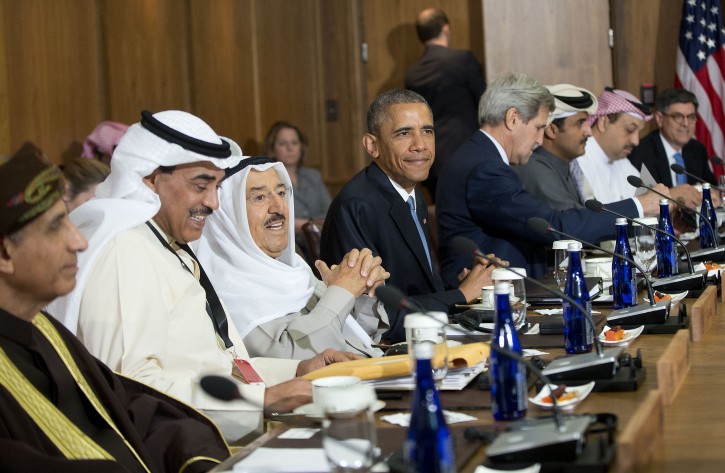
President Barack Obama sits with Kuwaiti Emir Sheikh Sabah Al-Ahmad Al-Sabah, Secretary of State John Kerry, center right, and Gulf Cooperation Council leaders and delegations at Camp David, Md., Thursday, May 14, 2015.(AP Photo/Pablo Martinez Monsivais)

Executive Summary

 Following several years of strained relations, the May 13 to 14 U.S.-Gulf Cooperation Council (GCC) summit in Washington and Camp David provided the parties with a crucial opportunity to reset their partnership. Despite numerous predictions of “failure” and the absence of four of the six GCC heads of state, the talks achieved significant results for both parties, including:

  • A clear restatement of the U.S. commitment to Gulf security modeled after the 1980 “Carter Doctrine.”
  • A clear statement of GCC support for the nuclear negotiations with Iran, and greater understanding among Gulf states of U.S. policies toward Iran.
  • A mutual commitment to develop and enhance joint, self-reliant Gulf and Arab military structures and security measures, including a region-wide ballistic missile defense system.
  • A new set of working groups, committees, and other forums for cooperation, consultation, and coordination, and an emerging timeline for continuing the dialogue, including another summit scheduled for 2016.
  • A common approach to dealing with regional security challenges.
  • Stronger mechanisms for meeting asymmetrical threats.

While numerous issues remain not fully resolved, and there is some way to go before the U.S.-GCC relationship is fully restored to previous levels of consultation, coordination, and trust, the new understandings and structures developed at the summit provide a clear and coherent framework for strengthening the partnership across the board in coming months and years.

Background

When U.S. President Barack Obama announced on April 2 that the international negotiating consortium known as the P5+1 (the five permanent members of the United Nations Security Council and Germany) had concluded a framework with Iran outlining a potential agreement on its nuclear program, to be achieved by June 30, he expressed concern about opposition from traditional U.S. allies. He said he had already spoken with Saudi Arabia’s King Salman and intended to invite the heads of state of the six members of the Gulf Cooperation Council (GCC) to meetings later that spring “to discuss how we can further strengthen our security cooperation while resolving the multiple conflicts that have caused so much hardship and instability throughout the Middle East.” The invitations were subsequently issued for a dinner at the White House on May 13 followed by meetings at Camp David on May 14.

Saudi and some other Gulf states’ concerns about the drift of U.S. policy date back to the January 2011 Egyptian uprising against former President Hosni Mubarak, and the perceived American willingness to “abandon” a long-standing ally. Although their views and policies on some issues are not homogeneous – with Qatar taking a different view of events in Egypt, for example – doubts among most GCC member states about U.S. policy were greatly exacerbated in subsequent years. The proximate cause and immediate context for the summit were the international negotiations with Iran, which were the subject of open and undisguised anxiety on the part of several key Gulf states, which feared that Iran’s regional hand could be strengthened not only by an agreement, but potentially even by the enhanced legitimacy conferred by the negotiations themselves. They also feared a shift in U.S. policy in the context of an effort to achieve an agreement with Iran on the nuclear file, and possibly a broader Washington rapprochement with Tehran that could take the form of either a loose and de facto U.S.-Iranian alliance or, more plausibly, a new U.S. policy to seek a “balance” between Arab Sunni and pro-Iranian forces in the region.

These concerns were based on a negative interpretation of both American words and deeds in the second Obama term. A number of U.S. policy decisions fueled speculation that the administration was seeking to appease Iran in the context of the nuclear talks. Particularly damaging was the perception that U.S. policy in Syria was being shaped by a desire in Washington not to be seen as threatening a de facto Iranian sphere of influence. These suspicions were exacerbated by a series of statements, mostly in interviews, by Obama that have been interpreted as indicating a new American attitude toward Iran and its ambitions at the expense of Arab interests.

In a January 2014 interview with David Remnick of The New Yorker, Obama appeared to endorse the idea that a balance of power between “predominantly Sunni, Gulf states and Iran” is the key to stability. A March 2014 interview with Jeffrey Goldberg of Bloomberg was widely interpreted as suggesting that Obama sees Shiite Muslims, even extremists, as fundamentally rational while implying that Sunni Muslims, or at least Sunni extremists, don’t share that rationalistic perspective. In April Obama told Thomas Friedman of The New York Times that, “The biggest threats that they [U.S. Gulf Arab allies] face may not be coming from Iran invading. It’s going to be from dissatisfaction inside their own countries.”

These comments, especially to Friedman, appeared to downplay the threat from Iran’s destabilizing activities and suggested that, insofar as they are threatened by instability, the Gulf states have only themselves to blame. The president’s remarks played in Gulf societies much as comments that seemed to blame U.S. foreign policy for the September 11, 2001 terrorist attacks did in the United States. However, Obama’s remarks did articulate widespread American concerns that Islamist extremists are supported by Gulf financing, if not from governments then certainly by charities, wealthy individuals, and other non-governmental entities operating with or without the knowledge of the authorities. At a minimum, many Americans believe governments in the Gulf could do more to curtail financing and rhetorical support for extremists.

As alienation grew between the United States and its Gulf partners, by 2013 GCC states began actively implementing more independent foreign and national security policies. In late 2014, the GCC states began planning a joint military command for the organization. And in March the Arab League agreed to create a unified Arab military force for intervention against non-state actors or to preserve the stability of member states requesting assistance. This last decision was adopted during the Saudi-led intervention in Yemen designed to push back the advance of the Iranian-supported Houthi rebels. The U.S.-GCC summit was convened in the context of these mutual doubts and suspicions, and increasingly divergent perspectives on key policy issues, especially the nuclear talks and other U.S. policies toward Iran. The aim of both sides was a reset in relations, to stop the drift away from each other, and to develop new understandings to inform greater cooperation, especially on security-related issues. 

Major Issues and Accomplishments at the U.S.-GCC Summit

Against this backdrop, and despite widespread predictions of failure for the summit, the meetings were surprisingly successful. Critics made much of the fact that four of the six GCC heads of state did not attend the meeting. The “missing” leaders included United Arab Emirates President Khalifa bin Zayed al-Nahyan, Omani Sultan Qaboos bin Said al-Said, Bahrain’s King Hamad bin Isa al-Khalifa and, most notably, Saudi King Salman bin Abdulaziz. These absences, especially that of Salman, were widely interpreted as a “snub” by the GCC leaders to the United States. This interpretation is difficult to sustain given the relative success of the summit, and the very high level of the Saudi delegation that did attend, led by Crown Prince Mohammed bin Nayef and Deputy Crown Prince Mohammed bin Salman. The king may well have wanted his first visit to the United States, and major trip outside of Saudi Arabia, as monarch to be focused on his own role rather than being part of a larger group. Some of the other missing leaders were not expected to attend due to health reasons. Despite the absences, both sides appeared to achieve what they primarily hoped to get out of the meetings. Most importantly, they set the stage for a thematically and chronologically structured continuing dialogue on a wide range of issues of mutual concern.

U.S. Commitment to Gulf Security

One of the most significant of the summit’s accomplishments was the strong U.S. restatement of its “ironclad” commitment to Gulf security against external threats. While some GCC states, particularly the UAE, have strongly hinted they would like a formal mutual defense treaty with the United States, U.S. officials made it clear in the run-up to the summit that no such new treaty obligation is on the table. Apart from the administration’s own reservations, Congress is unlikely to approve, and the public is likely to strongly oppose, new U.S. military obligations in the Middle East. Therefore, according to all reports, the question of a mutual defense treaty was not raised by either side at the summit. Instead, the United States strongly reiterated its long-standing informal, policy-based commitment to Gulf security.

The summit joint statement includes the following key passage: “The United States policy to use all elements of power to secure our core interests in the Gulf region, and to deter and confront external aggression against our allies and partners, as we did in the Gulf War, is unequivocal.” This is essentially a restatement of the 1980 “Carter Doctrine” introduced in President Jimmy Carter’s January 23, 1980 State of the Union address. Carter declared that, “An attempt by any outside force to gain control of the Persian Gulf region will be regarded as an assault on the vital interests of the United States of America, and such an assault will be repelled by any means necessary, including military force.” The summit statement reiterates this commitment, while also pointing to the crucial example of the 1990-91 Gulf War, in which the United States led the coalition that expelled Iraqi troops from Kuwait.

A New Framework for Ongoing Dialogue

Perhaps the most important achievement of the summit was the accomplishment of a detailed framework that will structure the ongoing dialogue between the two sides both thematically and chronologically. The parties established a series of committees and working groups, some of which will operate within the already-established U.S.-GCC Strategic Cooperation Forum, and some of which add a new dimension to the conversation. A Forum Working Group, for example, will be tasked with developing joint efforts to ensure border security, prevent terrorism financing, promote cyber-security, and ensure critical infrastructure protection. The parties also established a senior working group to examine potential U.S. cooperation with the Arab League plan to establish a “unified Arab force” to deal with peacekeeping and stabilization efforts in member states that request assistance.

These plans are probably the most significant outcome of the summit because they give form and structure to the U.S.-GCC dialogue, ensuring that the conversation is not ad hoc or haphazard. Some of the new structures go well beyond the existing forum, and have their most significant iteration in the commitment of the two sides to “meet again in a similar high level format in 2016,” reportedly somewhere to be determined in the Gulf region. These commitments send a number of clear messages. The United States, by formalizing and giving even greater structure to the dialogue, is acknowledging the importance and centrality of this partnership.

The Gulf states may be sending an even greater message of renewed confidence in the administration. The parties had been due to hold another summit in two years, when the Obama presidency would be over. Since the 2016 summit will be held in the Gulf, it is virtually certain that bringing the meeting forward by a year was an initiative from the GCC states, since they had to issue the invitation. This suggests that the Gulf states are no longer content with a timeline that could allow them to “wait out” the end of the Obama administration and hope for a better relationship with his successor. To the contrary, the upcoming meeting, being brought forward by one year, suggests a strong interest in maintaining an intensive and high-level dialogue with this administration. It is therefore a significant vote of confidence in Obama himself, as well as his administration.

In addition to the chronological significance of the timeline, much of the thematic content of the structured dialogue demonstrates a convergence of U.S. and GCC agendas around developing the military capabilities of the GCC states, both individually and as a collective. The United States and the Gulf states have found a common purpose in building these capabilities, which simultaneously reflects both the U.S. desire to, where possible, draw down its military commitments in the Middle East and the determination of the Gulf states to become more self-reliant in the protection of their national security. In particular, both parties are interested in promoting integrated self-defense systems, especially ballistic missile defense, and greater interoperability among Gulf, and other Arab, military establishments.

Weapon Sales and Military Technology Transfer

Among the contentious issues in the run-up to the summit were certain requests for high-level military technology transfer and weapon sales by GCC states that have not been approved by the United States. Saudi Arabia and others have sought access to the cutting-edge American fifth-generation fighter jet, the Lockheed Martin F-35 Lightning II, without success. While the Gulf states are seeking a “qualitative military edge” (QME) over Iran, Israel seeks to maintain a QME over any potential group of regional adversaries, including the Gulf states. The U.S., and especially congressional, commitment to Israel’s broad regional QME is probably the single biggest factor impeding the transfer of F-35 jets and similar next-generation weaponry to Gulf states. Similarly, the UAE is set to receive a consignment of Predator drones, but they will remain unarmed until further notice. However, all reports from the summit indicate that rather than bickering about F-35s or other weapons systems understood to be “off the table” for now, the parties focused on a range of defense systems enhancements for the Gulf states. In a largely symbolic move, in December 2014 Washington decided to allow weapon sales to the GCC as an organization, much as it does with NATO and the African Union. This step could eventually allow for potentially greater integration and interoperability promoted by American weapons sales to GCC states, both individually and collectively.

The summit joint statement commits the United States to helping the GCC “develop a region-wide ballistic missile defense capability, including through the development of a ballistic missile early warning system.” Washington has promised to fast-track weapons deliveries to GCC states, and is dispatching a group of experts in the coming weeks to manage the details. The system will require a central command-and-control platform that will undoubtedly be produced by key American defense contractors such as Lockheed Martin, Raytheon, or Northrop Grumman. Raytheon’s Patriot missile systems in the Gulf are being upgraded to incorporate the new PAC-3 missiles manufactured in conjunction with Lockheed. In addition to the existing Patriots, there is also already an American-made AN-TPY-2 missile-scanning radar system deployed in the region.

New systems will be region-wide and longer-range, including Lockheed’s Terminal High Altitude Area Defense (THAAD) system that identifies potential threats by heat pattern. According to Reuters, Gulf states are requesting access to Aegis combat systems, including Raytheon’s SM-3 missiles, but the United States apparently believes Aegis systems are unnecessary for current Gulf security because they focus on threats from beyond the earth’s atmosphere. Iran is not capable of mounting such a threat. Experts have suggested that the SM-6 missile, which counters threats both inside and beyond the atmosphere, could be a potential compromise. The UAE has already contracted to buy two THAAD batteries, in addition to its Patriot PAC-3 systems. Saudi Arabia is also upgrading from PAC-2 to PAC-3. So is Kuwait, which contracted to buy two more PAC-3 batteries in 2013. Qatar has ordered THAAD batteries and requested PAC-3 ones, and is in the process of developing an early warning facility with the United States. Oman has Patriot PAC-3 systems in place. These GCC installations are augmented by the two American Aegis-equipped destroyers in the Gulf waters, plus those being deployed in Rota, Spain in 2015, as well as U.S.-run Patriot PAC-2 and -3 batteries in Bahrain.

As hardware and software for such a region-wide ballistic missile defense system is developed, there will also have to be a detailed understanding within the GCC states, and between them and the United States, about the rules of engagement for identifying and dealing with any potential missile threat. Such understandings do not currently exist, raising the potential for mistakes, misidentification, and the possible targeting of friendly aircraft. Moreover, extensive U.S. training will be required to ensure that the systems work effectively and optimally, while avoiding mishaps. Joint exercises with the United States – especially, experts say, “Track 1” or “Track 1.5” multilateral scenario-based exercises – will be crucial in preparing the way for such a system. Existing American hubs such as the U.S. Combined Air Operations Center, Integrated Air and Missile Defense Center, and Gulf Air Warfare Center can be integrated into the emerging system to promote interoperability.

U.S. officials and experts, however, stress that in order for the integrated ballistic missile defense system to be effective, Gulf states must commit to a new level of information-sharing, particularly on early-warning and tracking data. This necessarily involves not only cooperation, but also some surrender of national autonomy regarding the nature of the data to be shared. This will be a difficult step for the Gulf states to take. However, these mutual understandings are particularly important given that warning time in the Gulf region for a ballistic missile threat could be as little as four minutes. Therefore, common threat assessments, desired operational outcomes and objectives, and information sharing systems are indispensable.

Iran’s Regional Role

The issue that prompted the United States to organize the summit, the nuclear negotiations with Iran, remains the biggest, and most defining, issue shaping U.S.-GCC relations, and mutual perceptions. Gulf perceptions of shifting U.S. policies are driven by many factors, but above all is Washington’s opening to Tehran. No topic reportedly received more attention at the summit than Iran’s regional role and policies and the U.S. approach to them. The joint statement adopted a clear stance that identifies Iran as a major destabilizing force in the Middle East and pledged the cooperation of both sides to oppose Iran’s regional ambitions. It states that, “The United States and GCC member states oppose and will work together to counter Iran’s destabilizing activities in the region and stressed the need for Iran to engage the region according to the principles of good neighborliness, strict non-interference in domestic affairs, and respect for territorial integrity, consistent with international law and the United Nations Charter, and for Iran to take concrete, practical steps to build trust and resolve its differences with neighbors by peaceful means.”

GCC attitudes toward Iran, and some other crucial issues, are neither static and fixed, nor uniform and homogenous. Indeed, one of the most interesting early revelations about the Iran talks is that the essential terms were established in back channel negotiations in Oman, a GCC member state. Over the course of the past few years, Oman’s role evolved from secretly passing messages between the two sides to actively mediating secret negotiations in Vienna and Muscat. Oman’s role surprised many observers, but it indicates the complexity and nuance of the Gulf position on nuclear negotiations with Iran. It’s not simply that Oman has, for a Gulf state, uniquely strong relations with both Iran and the United States. It is also that the general Gulf view of the Iranian negotiations is more complex than most observers tend to think.

The anxieties described earlier in this paper are very real, and are the dominant and majority Gulf reaction to the negotiations. However, many Gulf actors are simultaneously anxious and optimistic about the prospect of an agreement, and are open to viewing it as a positive and beneficial development. The Gulf states understand that they have to live with Iran, and that it will be a major player in their region and factor in their strategic calculations. Even Saudi Arabia has tried to maintain cordial relations with Tehran, despite the rivalry between the two and their incompatible positions on numerous regional and global issues.

Oman has significant trade links with Iran, and a wide range of close relations that date back to before the fall of the Shah. Given the sultanate’s close relations with Iran, it’s perhaps not surprising that, unlike its GCC partners, Oman has no record of expressing concern regarding Iran’s nuclear program, and has said that it fully believes Iran’s assurances that its program is entirely peaceful and civilian. Nonetheless, Oman remains a core GCC member state and a close ally of the United States, putting it in a unique position in the political and strategic landscape of the Gulf region. Moreover, Oman’s independent foreign policy has not been the source of considerable tensions within the GCC unlike disagreements between the UAE and Saudi Arabia on the one hand and Qatar on the other. Its GCC partners apparently think Muscat’s quiet, careful diplomacy strengthens their hand as a group and gives them access and influence they would otherwise lack.

Oman’s approach to Iran is not driven by a fundamentally different analysis than the other GCC member states. It clearly believes that Iran is the primary potential regional threat to its interests, sovereignty, and territorial integrity. But its approach to dealing with the same perceived threat differs somewhat from some of its council partners, emphasizing the use of diplomacy and cultivation of good relations to mitigate any potential threat. However, Oman is by no means alone in using this approach, even if it has placed a greater emphasis on it than its partners. For example, Kuwait has maintained good relations with Iran, and significant diplomatic, military, and economic links. Kuwait welcomed the “Islamic Revolution” and relations with Iran were further enhanced following the Iraqi invasion and occupation of Kuwait in 1990-91. Qatar, too, has maintained friendly relations with Iran following the conclusion of the Iran-Iraq war during which Doha strongly supported and financed Iraq.

Iranian relations with Bahrain, Saudi Arabia, and the UAE have been more difficult. The UAE has a significant territorial dispute with Iran, which is the primary obstacle to better relations between the two countries. Despite close trading ties and a large Iranian expatriate community in Dubai, both countries claim three Gulf Islands: Abu Musa, Greater Tunb, and Lesser Tunb, which are currently under Iranian control. In 1999 the UAE criticized Saudi Arabia’s warming of relations with Iran because of the ongoing dispute over the islands. However, the UAE’s foreign policy in recent years has tended to focus more on the threat from Islamist groups, most notably the Muslim Brotherhood regional movement, and terrorist organizations than Iran. UAE-Iran ties are also enhanced by the joint operation by the two countries of the Salman oilfield, an offshore platform in the Gulf about 90 miles south of Lavan Island. The UAE’s foreign minister officially visited Iran in November 2013. The UAE was among the first of the GCC states to welcome the nuclear framework, expressing strong hopes that it would prove a stabilizing influence in the region and prevent conflict.

Saudi-Iranian relations have been a bumpy affair since the end of the Iran-Iraq war, during which Saudi Arabia strongly backed Iraq. Saudi Arabia accuses Iran of playing a destabilizing sectarian role in the region, particularly in Syria and Iraq, charges that are returned in kind by Tehran. One of the most serious incidents reflecting Saudi-Iranian tensions was a clash between demonstrating Iranian pilgrims and Saudi security forces in Mecca during the Hajj on July 31, 1987. An estimated 400 protesters died in the violence. Mobs in Tehran ransacked the Saudi Embassy and physically assaulted Saudi diplomats in retaliation, killing one. Diplomatic relations were severed for many years. A slow but protracted diplomatic thaw between the countries began at a 1997 meeting of the Organization of the Islamic Conference (OIC) in Iran. However, Saudi-Iranian relations began sharply deteriorating again in the second decade of the 21st century. In 2011, Iranian agents were accused of plotting to assassinate the Saudi ambassador to the United States. Saudi accusations about Iranian hegemony and aggressive policies as the primary threat to regional stability and security inform much of its strategic thinking and diplomatic rhetoric. The intervention in Yemen has been framed by Saudi officials as an effort to roll back the Houthi rebels, who are cast, and perhaps caricatured, as merely Iranian proxies. Saudi Arabia accuses Iran of seeking a nuclear weapon as part of its hegemonic project in the region.

Of all the GCC states, Bahrain has the most difficult historical relationship with Iran, given that Iran has a historical claim on the whole island. This was officially renounced in 1970, and the renunciation codified in a subsequent demarcation agreement between the two countries. Doubts about Iran’s long-term intentions, however, persist. Bahrain’s governments, dominated by the ruling Al Khalifa royal family, which is part of the minority Sunni community, have faced numerous rebellions centered on the country’s Shiite majority. A significant subsection of the Shiite community of Bahrain is of ethnic Iranian origin. Bahrain has consistently accused Iran of being responsible for these periods of unrest, especially the protest movement that began in February 2011. Iran’s role in the instability is hotly contested, with little evidence having been presented to demonstrate the charges, and angry denials from the mainstream Bahraini opposition and Iran. Bahraini courts have sentenced several Iranians to lengthy prison terms on charges of spying on behalf of Iran’s Islamic Revolutionary Guard Corps (IRGC) and promoting sedition.

Bahrain’s Crown Prince Sheikh Salman bin Hamad al-Khalifa has been one of the most outspoken Gulf leaders in accusing Iran of seeking to develop a nuclear weapon. Indeed, his accusation to this effect in November 2007 may have been the first public charge by a Gulf leader that Iran is seeking to become a nuclear weapons power. On the other hand, like all of its GCC partners, even Bahrain supports Iran’s right to have a peaceful and civilian nuclear weapons program. The primary concern of the GCC states is the strengthening of Iran’s regional hand as a nuclear power, through an agreement and possible rapprochement with the United States, or even simply as a consequence of the negotiations themselves. On the other hand, the Gulf states recognize that there is little, if anything, they can do to prevent Iran from going nuclear and that they have few options other than relying on U.S. initiatives to try to prevent this eventuality. They also understand that a conflict over the Iranian nuclear program could have devastating consequences for the region, including their own states. Therefore, an effective and sound agreement that actually prevents Iran from acquiring nuclear weapons is the best plausible outcome from their point of view.

At the summit, Obama and other administration officials reportedly explained in detail what the United States is hoping to accomplish through the negotiations. All accounts suggest that the president insisted that the United States views the negotiations as strictly limited to the nuclear file and is not seeking a wide-ranging rapprochement with Iran. Obama reportedly told the Gulf delegations that he felt misunderstood and that some of his public comments had been misconstrued, particularly in the Arab world. He stressed the U.S. commitment to Gulf security and made the case that the negotiations and the potential agreement with Iran they anticipate, while not perfect, are the best approach to dealing with a difficult problem.

Gulf officials apparently felt reassured that the actual terms of the potential agreement are tougher on Iran than have been generally reported in the press, and that the “breakout time” for Iran to go nuclear in the context of such an agreement would be longer than is widely thought. Like many other observers, the Gulf states believe that there are many issues that need to be clarified in any final agreement. They are particularly concerned about the inspection protocol, verification mechanisms, and the ability of sanctions to “snapback” in the event of Iranian violations. However, it would appear that either the Gulf states have been considerably reassured by what they heard at the summit, or have decided that supporting the negotiating process is the best course of action available to them in spite of their misgivings. Either way, their public position now clearly endorses the negotiations. The joint statement includes the following passage, which constitutes a significant achievement for the United States: “a comprehensive, verifiable deal that fully addresses the regional and international concerns about Iran’s nuclear program is in the security interests of GCC member states as well as the United States and the international community.”

The Gulf states may not be entirely convinced by U.S. reassurances about the status of all aspects of U.S. policies toward the region, but they appear gratified by Washington’s insistence that there is no “tilt” toward Iran involved in the negotiations or offered as a consequence of a successful agreement. Moreover, Gulf officials maintain that their states would “tilt” toward Iran if Tehran were to significantly modify its aggressive policies. The primary Gulf concern was, and still is, that Iran might somehow acquire (or have already acquired) greater U.S. acquiescence (or at least less U.S. opposition) to its ambitious regional policies without having to modify them in any substantive way. But given the range of commitments offered to the GCC states, it has become harder to see the United States as seeking an alliance or understanding with Tehran as a substitute for traditional friendships.

Mutual doubts between the two sides were somewhat assuaged by the meetings and their largely positive outcome, but not yet entirely dispelled. Some Saudis are publicly warning that their country will not watch Iran acquire a nuclear weapon without seeking a deterrent of their own. They note that Pakistan has research and development know-how, and Jordan large uranium reserves, and that they have strong relations with both. Saudi Arabia is indeed moving to establish a peaceful nuclear energy program. But it’s evident that Saudi Arabia would prefer not to get involved in a nuclear arms race with Iran and, for now, the best prospect for avoiding that difficult choice actually lies with the U.S.-led international negotiations with Iran.

Regional Security Concerns

The summit considered the problem of regional conflicts from a relatively integrated perspective, without falsely conflating them into a single issue. The summit joint statement says of such conflicts – specifically including those in Yemen, Syria, Iraq, and Libya – that “there is no military solution” and that they “can only be resolved through political and peaceful means.” The statement says such political solutions must involve “respect for all states’ sovereignty and non-interference in their internal affairs; the need for inclusive governance in conflict-ridden societies; as well as protection of all minorities and of human rights.” Despite their commitments to political solutions, the parties at the summit are almost all involved in military interventions, however limited, in these conflicts. The United States is leading an ongoing intervention against the Islamic State in Syria and the Levant (ISIL) in Syria and Iraq, while Saudi Arabia is leading a campaign against the Houthi militia and its allies in Yemen, and Egypt, which is allied with both the United States and the Gulf states, along with the UAE, has carried out airstrikes against Islamist-allied groups in Libya. With a few exceptions, most summit participants are also involved in arming, training, or funding belligerent parties in one or more of these conflicts.

The joint statement offers an implicit limited endorsement of the Saudi-led intervention in Yemen, but emphasizes “the need to rapidly shift from military operations to a political process.” It praises the five-day “humanitarian cease-fire” and calls for a longer and more extensive cessation of hostilities. The statement also “underscored the imperative of collective efforts to counter Al-Qa’ida in the Arabian Peninsula,” and strongly endorsed measures to “prevent the resupply of Houthi forces and their allies in contravention of UN Security Council Resolution 2216.” The annex to the joint statement goes further in emphasizing U.S. support for GCC measures to “defend themselves against external threats emanating from Yemen,” and for “Saudi Arabia’s territorial integrity.”

The language on Iraq in the joint statement is cautious, emphasizing the role of the Iraqi government in fighting ISIL. It touches delicately on the role of sectarian Shiite militias in the conflict, urging the Iraqi government to ensure that “all armed groups operate under the strict control of the Iraqi state,” and only hints at the critical problem of Sunni Arab alienation by calling on the Iraqi government to urgently address “the legitimate grievances of all components of Iraqi society.” The annex commits the GCC states to “reestablishing a diplomatic presence in Baghdad.” The parties did not refer in any of their public comments to urgently required efforts to create new National Guard or other Iraqi forces designed to bring the Iraqi Sunni Arab community into the fight against ISIL in a systematic or formal manner. It does not appear that this subject was a significant factor in the conversations.

The joint statement language on Syria includes a clear-cut passage in which the parties “reaffirmed that Assad has lost all legitimacy and has no role in Syria’s future.” This is reflective of formal U.S. policy since the country spiraled out of control following the 2011 uprising. However, during most of his second term, Obama has tended to avoid questions involving President Bashar al-Assad’s future, leaving such blunt comments to subordinate officials, most notably Special Presidential Envoy for the Global Coalition to Counter ISIL General John Allen. It is, therefore, noteworthy that the summit joint statement involves such unequivocal language regarding the Syrian regime.

The joint statement also refers to the conflict in Libya, challenges facing Lebanon, and the need to resolve the Israeli-Palestinian conflict. It calls for power sharing in Libya, strengthening the Lebanese state (especially against the challenge from ISIL), and a two-state solution between Israel and the Palestinians. It reiterates the “enduring importance” of the 2002 Arab Peace Initiative to resolving the Israeli-Palestinian conflict, recommitting the GCC to this as-yet unrequited but crucial Arab overture to Israel. It may be that there are, or at least have been until recently, more divisions within the GCC than between most GCC states and the United States on Libya and Palestine. Qatar has a history of supporting Libyan Islamist groups and Hamas, while Saudi Arabia and the UAE have supported Libyan nationalists and the mainstream Palestinian leadership.

These divisions appear to have been receding since the accession of the new emir of Qatar, Tamim bin Hamad al-Thani, who has adjusted his country’s foreign policy by reducing support for the regional Muslim Brotherhood movement, initiating a rapprochement with Egypt and distancing Doha from Hamas. There are also indications that Saudi Arabia, under King Salman, has become less categorical in its opposition to the Brotherhood movement, which has suffered a series of devastating defeats since the 2013 ouster of former Egyptian President Mohamed Morsi, and may be perceived as less of a regional power and, hence, less of a threat. With both these states adjusting their policies toward regional Islamists, especially of the Muslim Brotherhood variety, differences within the GCC, particularly between Saudi Arabia and Qatar, may also have eased.

As its complex attitude toward the Yemen intervention suggests, the United States may be finding itself in an ambivalent posture toward greater Arab, GCC, and Saudi (in that order of specificity) regional political and military assertiveness. On the one hand, the United States has always favored burden sharing and, therefore, a greater self-reliance on the part of the Gulf states. This impulse has been strengthened in recent years as a consequence of the negative experiences with the war in Iraq and the nation-building program in Afghanistan. There is widespread political support in Congress and among the American people for a reduced U.S. military role in, and commitment to, the Middle East. And, finally, administration policy continues to look toward a gradual “pivot to Asia,” and implicitly away from the Middle East and Europe, whereby U.S. military and diplomatic assets will be shifted toward East Asia. All of these factors militate in favor of U.S. encouragement of, and practical support for, Arab self-reliance on defense and security.

In practice, however, this inevitably involves some lessening of influence over Arab national security decision-making. The Obama administration was far more cautious, if not anxious, about the Saudi-led intervention in Yemen than its public positions overtly indicated. It felt obliged to support the intervention even while it doubted its wisdom or efficacy. This dynamic is likely to increase in the coming years as the GCC, and perhaps even the Arab League, continue to develop their integrated military structures and, presumably, engage in more “peacekeeping and stabilization” (as the joint statement puts it) missions in the region. Its Arab allies will expect U.S. support, especially given Washington’s burden sharing rhetoric, whether or not the United States fully shares the policy analysis that informs these specific missions. At a minimum, these new realities will involve a period of adjustment, particularly in terms of American expectations and the United States’ sense of its own role in the Middle East. The new dialogue about the U.S. role in helping to develop and expand a new level of self-reliant Gulf and Arab national security capabilities initiated at the summit, and carefully structured for further dialogue, cooperation, and consultation is the best way to manage this transition. It maximizes the prospects for cooperation and minimizes the possibility of misunderstanding or miscommunication.

Asymmetric Threats 

Asymmetric threats reportedly played a significant role in the dialogue at the summit. The more self-reliant GCC and Arab forces will be mainly aimed at dealing with asymmetrical threats and non-state actors such as terrorist groups, militias, pirates, criminal gangs, and similar destabilizing elements. U.S.-GCC cooperation on security into the future will likely focus on combating such asymmetrical threats, including emerging concerns such as cyber and maritime security. Counterterrorism, in its various forms, is a major feature of both the joint statement and its annex, and the dialogue at the meeting itself. It is also one of the main focal points of the working groups and committees.

Counterterrorism cooperation between the parties will crucially include counter-radicalization messaging, under the rubric of “counter violent extremism” (CVE), preventing the recruitment of foreign fighters by extremist groups, cutting off terrorism financing, and finding political solutions to regional conflicts. New levels of cooperation with the United States on cyber-security and critical infrastructure protection provide additional opportunities for security enhancement in the Gulf states. Maritime security and interdiction is another key emerging area of mutual concern, and requires the enhancement of cooperation, coordination, and information-sharing between GCC member states, as well as with the United States. Indeed, maritime security may involve the need to create joint patrol and interdiction forces among GCC members, promoting military integration and interoperability, which is emerging as a major policy goal and requirement for the Gulf states with regard to a wide range of security concerns.

Another major issue at the summit was counter-terrorist financing, underscored by the participation of Treasury Secretary Jacob Lew. Lew joined the conversations to address that issue and also the impact of sanctions on the Iranian economy. Lew reportedly stressed that combating terrorism financing would curb Iranian influence and promoted greater regional stability. And Lew and other senior officials explained how sanctions would work in the context of a nuclear deal with Iran. In November 2014 Treasury Under Secretary David Cohen told a congressional hearing that Qatar and Kuwait are “the two jurisdictions in the Gulf where additional steps could be taken” to curb the illicit transfer of funds to ISIL. He said that the funding of terrorist groups is best combated by interrupting revenue streams, restricting access to international financial institutions, and imposing sanctions on leaders and key supporters.

Insofar as the GCC can enhance its counterterrorism credentials with not only the White House, but also Congress and the American public, it will greatly strengthen its partnership with the United States and dispel negative impressions that persist in American society. For the Gulf states counterterrorism is not only a matter of vital self defense and national security, and practical cooperation with its U.S. partners, it also includes a strong element of public diplomacy. Perhaps the biggest challenge in the long run to strengthening and securing close relations with the United States is the need for the Gulf states to be perceived by most Americans, not only in the government but also in the policy community and general public, as crucial partners in the battle against terrorism and violent extremism. The initiatives and frameworks developed at the summit provide new and important opportunities to promote national security and strengthen the alliance by creating, implementing, and publicizing effective counterterrorism and counter-radicalization efforts.

Conclusion

While some important issues remain unresolved and strains persist in the U.S.-GCC partnership, an unexpected amount of progress was made at the recent summit to repairing relations and creating a new framework for stronger future cooperation. Washington and its Gulf Arab partners appear to have developed an important set of structures for moving forward through both existing and enhanced new forums for dialogue, timelines, working groups and committees, and other formats that have given a new shape and specificity to their dialogue. Moreover, in mutually embracing the agenda of developing independent and self-reliant Gulf and Arab defense and national security mechanisms and military institutions, the United States and the GCC countries have identified a guiding principle around which to organize their long-standing project of ensuring Gulf security.

Along with the important restatement of the U.S. commitment to Gulf security, and, in effect, reiteration of the “Carter Doctrine,” the development of these thematic, institutional, and chronological frameworks for ongoing dialogue is, perhaps, the most significant achievement of the summit. The decision by the Gulf states to seek another summit meeting in one, rather than two, years sends a strong signal that the GCC came away from the meetings with a more positive view of Obama and his administration than they may have previously held. The new depth, breadth, and detail of the frameworks for dialogue, coordination, and cooperation established at the summit give the U.S.-GCC relationship a solid framework for developing into the foreseeable future.

After the Camp David talks, the dialogue has just begun

http://www.thenational.ae/opinion/comment/after-the-camp-david-talks-the-dialogue-has-just-begun#full

After the Camp David talks, the dialogue has just begun


It may not have been a massive breakthrough, but in defiance of most predictions, last week’s summit meeting between American president Barack Obama and leaders of the Gulf Cooperation Council countries proved a significant success. Both sides appear to have achieved their basic aims. And, most importantly, the stage is set for a much longer and broader conversation that should restore a crucial, albeit frayed, strategic relationship.

The American side initiated the meeting when, on April 2, Mr Obama announced the framework for an agreement on Iran’s nuclear programme. Washington clearly sought to reassure its anxious Gulf allies and explain what, precisely, it is and is not doing in the negotiations with Iran.

The Gulf countries may not be entirely convinced yet, but it seems Mr Obama made considerable progress. He was reportedly adamant that the Iran talks are only about the nuclear file and do not constitute a “grand bargain” or broader rapprochement that would allow Tehran to pursue an aggressive regional agenda with less American opposition, let alone blessings.

The mood among Gulf officials regarding the Iran negotiations seemed to ease after the meetings. They appear more open to the possibility that their countries might benefit from the talks, and even an agreement. They seem increasingly receptive to the Obama administration’s arguments that an agreement, while not perfect, may be the best available arrangement, and will be tougher on Iran than most reports suggest. The Gulf countries even insist that they, too, would “tilt” towards Tehran if Iran significantly softens its regional policies.

Much has been made of the fact that four of the six GCC heads of state did not attend the meetings. Saudi Arabia’s King Salman’s sudden withdrawal may have sent a subtle message, but it didn’t rise to the level of a rebuff, as some western observers speculated, especially given how senior the Saudi delegation ended up being.

Moreover, there is now an explicit assurance that further high-level dialogue will be continuing. From the Gulf, and possibly also the American, perspective, perhaps the biggest net positive is the creation of a new set of structures and timelines for further crucial US-GCC meetings and consultations.

The parties established a whole range of new committees and working groups to look at a wide array of vital issues – including missile defence, cyber security, maritime security and interdiction, battling piracy, counter-terrorism, critical infrastructure protection, special forces training, meeting asymmetrical threats and American support for the Arab League’s proposed “unified Arab force” – some of which build on existing dialogue at the US-GCC Strategic Cooperation Forum, and others that significantly expand it.

Most significantly, the parties agreed to hold another summit next year in the Gulf region. That announcement is another key indication of how successful the Gulf countries feel last week’s meetings were.

Mr Obama apparently explained to his guests that he feels misunderstood in the Arab world on a range of issues which he addressed point by point. Along with a number of crucial assurances at the meetings and in the joint statement – including a strong reiteration of the American commitment to Gulf security formerly embodied in the 1980 “Carter Doctrine” and the insistence that Bashar Al Assad “has no role in Syria’s future” – this personal appeal by the American president appears to have struck a chord.

The two sides had been scheduled to hold another summit meeting in two years. The Gulf side must have initiated the new summit meeting for next year, having had to issue the invitation. So, rather than waiting out the rest of Mr Obama’s term, they would now rather continue to deal with him intensively and at the highest level. That’s the clearest indication of the summit’s success from both perspectives. An emerging area of convergence is the shared interest in developing self-reliant Gulf security capabilities. Americans want to draw down their direct military presence and commitments in the Middle East. Gulf and other Arab countries are working on a range of new individual and joint military capabilities.

In the context of the “unequivocal” American commitment in the joint statement “to deter and confront external aggression” aimed at its GCC partners, the parties can focus on building those capabilities. In December, Washington moved to allow arms sales to the GCC as an organisation, potentially greatly facilitating the development of badly-needed integration and interoperability.

As with all aspects of this vital and delicate relationship, developing and sustaining systematic American support for strengthened and integrated Gulf and Arab security capabilities will take years of sustained and focused effort. The “region-wide ballistic missile defence capability”, which is referred to in the joint statement annexe and being pursued actively by both sides, alone is a significant challenge. But it is precisely this kind of far-reaching strategic project that ought to characterise the “new era of cooperation” between the United States and its GCC partners that Mr Obama says was initiated at last week’s summit.