The Gulf and US need a reset – and each other

http://www.thenational.ae/opinion/comment/the-gulf-and-us-need-a-reset–and-each-other#full

The Gulf and US need a reset – and each other


At this week’s summit at Camp David, both American and Gulf Cooperation Council (GCC) leaders will be genuinely hoping for a reset in their recently frayed relations. The challenges are difficult, but hardly insurmountable.

The single most important issue is international nuclear negotiations with Iran. Washington initiated the meeting explicitly as a means of addressing the concerns of Gulf Arab states regarding the talks with Iran. The American side will try to explain what, precisely, Washington is trying to accomplish, and how all the states in the region will benefit from a nuclear agreement.

The Americans will undoubtedly point out that such negotiations are the only viable means short of a conflict to prevent Iran from gaining nuclear weapons. They will say that a conflict would be potentially devastating to all parties, including the Arab Gulf states. They will make the case that gaining leverage with Iran allows the United States to pursue a whole range of concerns in order to modify Tehran’s behaviour and curb its excesses.

The GCC states are a willing, but somewhat sceptical, audience on these points. Their concerns do not lie entirely, or even mainly, in the problem of whether or not Iran will eventually acquire a nuclear weapon. Instead, they tend to focus on the spread of Iran’s regional influence and its foothold in Arab countries such as Syria, Iraq, Lebanon and Yemen. And what they fear, above all, is that, for one reason or another, American policy is beginning to “tilt” towards Tehran and away from traditional US allies in the region.

Even if the United States and its negotiating partners secure an agreement with Iran that ultimately prevents the development of a “Persian bomb”, a nightmare scenario for the Arab states might still emerge. If, as part of an elaborate quid pro quo, the traditional American opposition to Iran’s expanded influence in the region were to be dropped or reduced in importance without a significant alteration of Iranian policies that would be a disaster from a GCC perspective.

As the United States insists that it’s not “tilting” towards Tehran, the GCC states will seek corroborative evidence through deeds rather than words. In particular, they will want to see how far the United States is willing to go in rolling back the influence of Iran and its allies in Syria, Iraq and/or Yemen. There is particular dissatisfaction with the increasingly ambiguous American stance towards Syrian dictator Bashar Al Assad, and the widespread impression, right or wrong, that Washington has discarded its former position that he must go. But in the Obama administration there is little appetite for a more assertive Syria policy, beyond the campaign against ISIL.

The Gulf states will also be looking for enhanced security arrangements and guarantees. Specifically, as the UAE ambassador to Washington Youssef Al Otaiba put it last week: “We need something in writing.” But the administration is not even going to try to sell Congress and the American public on new strategic treaty obligations towards the Gulf countries that would mandate a greater commitment in the Middle East. On the contrary, the dominant American political sentiment at almost all levels of society is to reduce rather than expand Middle East deployments, obligations and entanglements.

The Arab side may have to settle for a little less than what they hope for on multiple fronts.

Instead of a new formal security treaty, they might be able to secure, in writing, something like a reiteration of the 1980 Carter Doctrine, which pledged to defend Gulf security from any external threats. And they might be able to establish a consultative mechanism for urgent strategic threats, perhaps loosely modelled on Nato’s Article 4 process that allows signatories to convene emergency meetings.

Just as the Gulf seeks a qualitative military edge over Iran, Israel seeks to maintain one over the Arab states, and this complicates GCC requests. So, instead of the very highest level of military technology transfer, such as F-35 fifth-generation fighter jets, they may get other forms of new technology such as the (initially unarmed) Predator drones due to be sold to the UAE. New high-tech weapons sales can be backed-up with greater intelligence sharing and coordination and joint military exercises.

And instead of being placed under a direct and automatic American “nuclear umbrella”, the Gulf states are reportedly likely to be offered American assistance in developing their own, joint missile-defence programme.

If the GCC states press the Americans too hard, and possibly even if they don’t, they could find themselves answering some pointed questions themselves. The American side might not only raise familiar concerns about intolerant rhetoric among clerics and others and financial support for extremists by wealthy individuals. They might also pursue Mr Obama’s idea that the “biggest threat” US Arab allies face is “dissatisfaction inside their own countries”.

But the frank airing of concerns by both sides at the meetings should pose no obstacle to a reset. There are ample grounds for significant progress because the US and GCC members have numerous shared vital interests.The summit should be just the beginning of a much longer, intensified dialogue between two parts of the world that, like it or not, still need each other as much as ever.

Stakes have rarely been higher for US-Gulf relations

https://now.mmedia.me/lb/en/commentary/565234-stakes-have-rarely-been-higher-for-us-gulf-relations

The GCC summit sets the stage for US meetings next week

Secretary General of the Gulf Cooperation Council (GCC) for the Arab States of the Gulf, Abdul Latif Bin Rashid Al Zayani, Kuwaiti Emir Sheikh Sabah al-Ahmed al-Sabah, Qatar

The 5th Gulf Cooperation Council (GCC) Consultative Summit held yesterday in Saudi Arabia is one of the most significant and noteworthy ever. The stakes have rarely been higher in the Gulf region, or GCC policies more in play. Many key themes came together at the Riyadh meeting, showing where the Gulf states are in their strategic thinking and what their priorities are, in the run-up to the crucial summit meeting with President Barack Obama in Washington and Camp David later next week.

Indeed, one of the purposes of the Riyadh meeting was preparation for the upcoming summit with the United States. And that meant rallying all six states around the new, more assertive and interventionist regional policies that are being promoted most actively by Saudi Arabia. Indeed, King Salman’s overhaul of Saudi foreign policy was tacitly ratified at the Riyadh meeting. This policy has been most dramatically embodied in the intervention in Yemen, but also reflected in the national security-oriented reshuffle at the top of the Saudi government, with the key supporters of the more assertive Gulf stance now occupying the positions of Crown Prince, Deputy Crown Prince and Foreign Minister.

The most unusual feature of the meeting was the presence of French President Francois Hollande, who is the first Western leader to address a GCC summit. It’s probably overstating matters to suggest that his participation constitutes a “snub” to Washington by the Gulf, but it is an unmistakable signal that the Arab states do have allies other than Washington. France has said it plans to upgrade its security arrangements with Saudi Arabia in the coming weeks.

The GCC knows very well that France cannot substitute for the United States, and certainly not fully. Nonetheless, welcoming the French leader to Riyadh underscores the importance the Gulf states are placing on a new independence of action when it comes to their collective and individual national security issues. France is increasingly emerging as a major arms supplier to the GCC states and some of their allies, including Lebanon. Most noteworthy, perhaps, is a $7 billion contract for 24 French Rafael fighter jets to be sold to Qatar.

The Hollande invitation was prompted in large measure by the emergence of France as the most ‘hawkish’ of the Western states when it comes to power projection in the Middle East, beginning with the campaign in Libya which was driven by Britain and France, and France’s role as the toughest negotiator among the P5+1 with Iran. France, in other words, is seen as the Western state that is closest in thinking to the Gulf states, and especially Saudi Arabia, in implicit contrast to the Americans.

But the United States, even as the intended recipient of such a message, remains central to the strategic calculation of the Gulf states. The initial impulse of Saudi Arabia and most of its GCC partners was to look for a new strategic relationship—in the form of a full security treaty—with the United States that amounted to the provision of a nuclear shield or umbrella. Washington has subtly made it clear that this is not likely, so Gulf thinking has shifted to increased levels of military technology transfer.

They will be very interested in exploring the reported willingness of the Obama administration to help GCC states construct a missile-defense system, as well as potential enhanced security commitments, more arms sales and further joint military exercises with the United States. But American officials have suggested that, in order to secure American help in constructing a GCC missile-defense system, the Gulf states must demonstrate greater unity and cooperation and resolve internal splits, particularly those between the United Arab Emirates and Qatar.

American interest in such a program also requires greater GCC military integration. This dovetails with initiatives to create a joint military command for the GCC that was launched at the end of last year, and more recent proposals to create an Arab League joint military force that are currently being explored by the Arab military chiefs of staff.

The Riyadh meeting will also focus heavily on the intervention in Yemen. While the intervention has not succeeded in its publicly-stated goal of restoring the former Yemeni government, it has succeeded in more minimal, unstated aims of degrading the military capability of the Houthi rebels, particularly with regard to missiles, and ensuring that the conflict in Yemen is contained in that country and does not spill over into Saudi Arabia. Despite a reported missile attack earlier this week across the border into Saudi Arabia, both those goals appear to been met.

But the intervention has prompted a great deal of international criticism and humanitarian concerns. The United Nations has been pressing Saudi Arabia and its allies to agree to various measures to facilitate aid to civilians, steps that were undoubtedly seriously considered at the summit. At the same time, the broader goal of continuing to roll back the Houthi militia without getting sucked into a quagmire will require new and innovative approaches.

The centrality of the GCC summit to relations with the United States and as a preparation for the summit meeting next week is underscored by the visit to Riyadh today, in the immediate aftermath of the meeting, by US Secretary of State John Kerry. Gulf expert David Ottaway of the Woodrow Wilson International Center for Scholars told The Wall Street Journal: “I expect Obama will come up with a renewed version of the Carter Doctrine, declared in January 1980 and aimed at assuring America’s Arab Gulf allies and partners of U.S. protection against any outside threat or attack.”

Even if that happens—and that’s a big if—it’s unclear if such a declaration would suffice to fully allay the Gulf states concerns about the drift of US policy, the consequences of a nuclear agreement with Iran, and the future of their own national security strategies. For that, a real sense that the United States is willing to proactively engage with them to try to contain or even reverse the expansion of Iran’s influence in the Middle East will probably be necessary. And to secure that, American doubts about the reliability and effectiveness of the GCC states as American allies, and their internal unity and coherence as a regional alliance, will have to be assuaged as well.

It’s a tall order. But it looks increasingly as if both sides are serious in trying to reset and recalibrate US-Gulf relations in a positive way, even as nuclear negotiations with Iran proceed towards a potential agreement. The meetings next week will be crucial, and perhaps the stakes have never been higher for relations between the United States and its Gulf allies.

A United Army for the Arab World?

http://www.nytimes.com/2015/05/04/opinion/a-united-army-for-the-arab-world.html?ref=international&_r=0

WASHINGTON — When, at its March summit meeting, the Arab League announced that it intended to create a unified command for a joint Arab military force, eyes rolled. Given how divided the Arab states are, and how poorly most historical efforts at Arab military coordination have fared, this was widely assumed to be another empty rhetorical gesture.

Yet Arab governments are persisting in laying the foundation for this joint force. On April 22, the chiefs of staff of the Arab militaries met in Cairo to begin formalizing its precise makeup, rules of engagement and budget. Their proposals are to be ratified by the heads of state within three months.

Despite how ambitious this program is, and the numerous pitfalls that could derail it, the Arab states appear determined to make it work. If such a force emerges, even if it could be deployed only under limited circumstances, it would transform the regional strategic landscape and redefine relations between Arab nations.

The impulse to create a joint force originates in a yearning for greater Arab unity that has haunted Middle Eastern political culture since the short-lived Arab Kingdom of Syria was crushed by the French in 1920, in the aftermath of World War I. The idea of a united Arab force also promises to bring together the financial resources of the Persian Gulf states with the manpower of Egypt, Jordan and Morocco. This responds to traditional Arab frustrations about the separation of large populations from major oil revenues (except in Iraq).

There is a profound appeal to the prospect of the sophisticated air forces and high-tech weaponry of the gulf states being combined with Egyptian infantry and mechanized units, along with Jordanian special forces, to defend Arab interests. But the plan is primarily a response to specific recent developments.

The rise of the Islamic State and — perhaps even more alarming — the expansion of Iran’s influence in the Arab world through clients and proxies in Iraq, Syria, Lebanon, Yemen and beyond have created a rare consensus among Sunni Arab governments. They agree that they face an intolerable crisis and that it is no longer possible to rely on American intervention. The Arab states have apparently concluded that if they do not unite to meet these twin challenges, they could well find themselves at the mercy of jihadist radicals or Persian imperialists, or both.

The joint Arab force has been championed by Saudi Arabia, which has led an intervention in Yemen, and by Egypt, which is focused on Libya and the Sinai insurgency. The Associated Press reported in November that those two governments, along with the United Arab Emirates and Kuwait, were already discussing a plan. Both Riyadh and Cairo had separately expressed dissatisfaction with American policies and speculated about the need to move beyond a reliance on Washington’s protection.

Nevertheless, the United States defense secretary, Ashton B. Carter, has called the proposal “a good thing.” As Egypt’s foreign minister, Sameh Shukri, put it, the force would undertake “quick and effective missions” with the permission of the relevant national government. So it seems primarily aimed at substate actors like the Islamic State or the Houthi rebels in Yemen.

Yet the obstacles are enormous. Coordination and integration will be difficult, given disparities at every level in the communications systems, logistics, doctrines, procedures and even basic supplies and ammunition used by various Arab militaries. Nonetheless, Egypt and the gulf states have been trying to overcome this for more than a year through joint military exercises on the Saudi-Iraqi border and as part of the Saudi-led aerial and naval intervention in Yemen.

Worse, the Arab states are divided on many core issues that might limit the effectiveness of such a force. Egypt and Saudi Arabia do not share a common position on the Syrian conflict. Oman and Qatar each have distinct views of Iran and the Muslim Brotherhood that differ sharply from those of other Gulf Cooperation Council members. Arab states don’t even share a working definition of what constitutes terrorism (supposedly the primary target of the joint force): whether the Muslim Brotherhood, for example, is a terrorist group or not.

Arab states will also have to overcome not just political differences but a fundamental lack of trust that has divided them for decades. Even at this early stage, Iraq, a Shiite-majority state with strong ties to Iran, has expressed deep unease about the proposal. One of the most significant and widespread objections is the fear that the force will inevitably be Sunni-dominated, exacerbating sectarian tensions in the region.

There will have to be a significant transformation of relations between Arab governments. Otherwise, as wags have already noted, the joint Arab force could be seen as a “triple oxymoron.” Not “joint,” because of divisions among its members. Not “Arab,” because of sectarian differences, as well as significant numbers of Pakistani, Turkish or other non-Arab troops. And not a “force,” because it either can’t be deployed or proves ineffective.

Even if the plan cannot immediately be implemented, however, the fact that key Arab states are pursuing it demonstrates how gravely they view their strategic situation. After becoming over-reliant on the United States, they fear the Middle East is entering a “post-American” period. So they must move quickly to try to defend their interests.

Several Arab commentators have concluded that since there is “no alternative,” military integration is “inevitable.” The members of the Arab League are clearly serious about trying. Whether they will prove capable of creating and deploying a joint military force remains to be seen.

Is the US really willing to use force to stop Iran nuke?

http://www.thenational.ae/opinion/comment/as-the-nuclear-deal-shows-the-old-order-is-changing

As the nuclear deal shows, the old order is changing


Is the United States really willing to use military action to stop Iran from acquiring a nuclear weapon? Under Barack Obama that has been the oft-repeated US policy, but several developments allowed the question to fade into the background.

Progress in nuclear negotiations with Iran, particularly the recently announced framework, has created an atmosphere of peaceful resolution and dimmed the prospect of conflict over them.

This has been compounded by the administration’s risk-averse attitude towards the use of force in the Middle East. Above all, the sudden reversal in 2013 on Syria’s use of chemical weapons calls into question the American willingness to use force, even when there is an explicit policy in a specific case to do precisely that.

This week, US vice president Joe Biden resurrected the question by insisting that “we’re prepared to use … force”, and “if required, it will happen. It is a risk that we may yet have to take should Iran rush to a bomb”. Ash Carter, the US defence secretary, and Josh Earnest, a White House spokesman, both repeated the point.

How seriously should we take it? If negotiations collapsed and Iran began sprinting towards a bomb, the Obama administration would undoubtedly feel compelled to act. But that’s not likely to happen. Despite the many problems with the framework – for instance that it doesn’t really seem to exist on paper or that American and Iranian officials completely disagree on key provisions, including lifting sanctions – it’s likely some agreement will be reached.

If it isn’t, Iran’s response will almost certainly be cautious enough not to prompt an American attack.

Neither side relishes the idea of a conflict and they will certainly be able to avoid one, at least until the end of the Obama administration.

Even if there is an agreement, the question doesn’t go away. On the contrary, it then becomes the only real issue left.

Almost everyone agrees that if there is a deal, Iran would face few practical obstacles to progressing its nuclear programme in the not too distant future. Indeed, a central claim of the administration is that, as Mr Biden put it: “Iran could get there now if they walked away in two to three months without a deal.” An agreement, US officials insist, for 10 or 15 years would keep Iran at least one year away from nuclear power status.

But after that, it would appear that only American force would effectively prevent Iran from going nuclear, if even that would work.

The framework agreement’s main virtue, according to its advocates, is precisely that it buys time. They like to speculate about how different Iran might be in 10 or 15 years – and then perhaps either wouldn’t want a bomb or have become much more trustworthy – even though it hasn’t changed much in the past 35 years.

What they don’t say, but is nonetheless obvious, is that this will kick the can so far down the road that even Mr Obama’s first, and possibly his second, successor wouldn’t be confronted with the problem. So, in fact, there is really no way of knowing how seriously to take the idea that the United States is committed to using force if necessary to prevent Iran from becoming a nuclear power.

From an American point of view, especially 10 years from now, containment could be preferable to conflict. After all, North Korea has been successfully contained. Why not Iran?

But America’s Arab allies don’t look at it that way. They aren’t that worried about Iran using nuclear weapons. They worry more about a dominant Iran using its nuclear status, or even a rapprochement with the United States, to flex its muscles in a new and assertive manner.

The American calculation and that of its Arab allies used to appear quite compatible. But they are looking increasingly divergent. Gulf Cooperation Council states will be going to a summit with the Americans in mid-May. At this stage, how much confidence do they retain that the United States would use force in a decade or more to stop Iran from becoming a nuclear power – or even that a nuclear agreement wouldn’t greatly strengthen Iran’s regional hand right away?

Their original impulse to look for a new security arrangement involving an American nuclear umbrella has been nixed. They know they’re not going to get that. So instead they’ll be looking for extensive weapons sales and a new level of military technology transfer to give them a qualitative military edge. They will also be looking for the United States to act to help counter Iran’s growing influence in the Arab world through proxies in countries like Syria, Lebanon, Iraq and Yemen.

But it’s unclear what, if anything, they will get, besides tea and sympathy. They may merely be offered promises that the United States will remain willing to use force to keep Iran from becoming a nuclear power, and reassurances that Washington remains opposed to an expanded Iranian role in the Middle East. If so, their determination to look beyond simply relying on an alliance with the United States for their security will surely be intensified.

King’s Gambit

https://now.mmedia.me/lb/en/commentary/565208-kings-gambit

All key Saudi positions are now held by Sudairis or non-royals

King Salman. (AFP)


King Salman’s dramatic shake-up of the Saudi cabinet ensures that his branch of the royal family controls the Kingdom into the foreseeable future. But the move is risky as there is now no one to share the blame if things go badly.

Those political junkies who miss the “good old days” of the cold war, and especially the obscure and dark art of Kremlinology—the study of how the closed system of committees that ruled the Soviet Union functioned behind its very firmly closed doors—are once again reminded that present-day Saudi Arabian politics can more than feed their need for mystery and intrigue.

The process of Saudi decision-making at the highest level has been slightly clarified by the creation of the “Allegiance Council,” a committee of senior royals, a few years ago. But still, for the most part, those who say they know how Saudi decision-making works are plainly guessing at best, and those who actually do know won’t say.

But every now and then there are far-reaching and sudden changes that can be explained and interpreted with a fair degree of confidence. The royal reshuffle just engineered by the new King Salman is a useful case-in-point. His dramatic shakeup at the top of the Saudi pecking order has a strong, overriding significance and signification that are impossible to miss. He has placed his own Sudairi branch of the royal family in total control of the key posts at the apex of Saudi governance and, more important still, succession.

Unless there are further changes, which seems very unlikely at present, he has ensured Sudairi dominance in the Kingdom for countless decades into the future. This bold move has an obvious pay-off in terms of power and control. But it is also risky and, if things go badly, such a concentration of power could potentially risk the future power of that wing of the royal family rather than consolidating it.

King Salman has appointed his son, Prince Mohammed bin Salman, to the post of deputy crown prince, having earlier elevated him to defense minister. This young man—estimates of his age run from 29 to 34—was previously unknown outside of royal circles and has enjoyed a meteoric rise since his father’s accession to the throne a few months ago.

He did not have much of a political or administrative career before becoming defense minister and does not seem to have been educated, or spent much time, in the West, or anywhere outside of Saudi Arabia for that matter.

He is, therefore, an unknown quantity to most observers and concerns about his sudden elevation to a key position in charge of the Saudi defense establishment at a very young age and without much experience were exacerbated by fears that he might have had a parochial upbringing without much exposure to the wider world. All of these concerns are naturally heightened now that he is second-in-line to the throne.

The fretting about Mohammed bin Salman was most evident in recently regarding the Saudi-led Arab intervention in Yemen. Doubts about the strategic wisdom of the operation and/or the effectiveness of its operational tactics dovetailed with speculation about a youthful and enigmatic figure in charge of it all. Some observers were plainly imagining a young zealot making rash and inexplicable decisions in a high-tech war room, as if playing with the world’s most elaborate video game, while professional officers and experienced administrators bit their lips and balled their fists while mumbling pained affirmations to his majesty.

This attitude was totally unfair, given that it is baseless, but it illustrates the extent to which Mohammed bin Salman was and is a mysterious figure. We do not even know for sure how old he is, except that in the eyes of many in the West and beyond he is widely considered “too young” for the roles into which he has recent been catapulted. He will not remain an enigma for long, though, now that he represents the long-term future leadership of Saudi Arabia and the generation that will inherit the Kingdom soon enough.

There are, by contrast, no real questions or doubts about his cousin, the new crown prince, Mohammed bin Nayef. His age, for the record, is agreed by all to be 55. He replaces Prince Muqrin, who was widely considered to have been a “placeholder” for someone else all along. Many doubted that Muqrin would ever become king, and indeed he will not.

Mohammed bin Nayef is another Sudairi, and is very close to both the Americans and conservative factions in the Kingdom. He has made a practice out of being on good terms with as many constituencies as possible, which of course is the hallmark of any effective politician. The radical Islamists, though, do not like him since he was a tough and fairly effective Saudi counterterrorism czar. Indeed, they have made several efforts to assassinate him, especially a serious 2009 attempt on his life by al Qaeda.

Between them, Mohammed bin Nayef and Mohammed bin Salman have been made leaders of the next two generations of Saudi royals and, barring mishap or misadventure, the next two kings. This means that Salman has arranged for many decades of Sudairi rule in the Kingdom. His wing of the family stands to dominate Saudi Arabia in an unprecedented manner—should all go well.

But the move is risky. There are many pressures that will confront the Saudi government in the coming years and decades that are obvious, and many more that we cannot now foresee. Terrorism and extremism, economic stress, uncertainty about the future of the oil market, sectarian tensions, chaotic borders with Iraq and Yemen, and much more are all going to take their toll on Saudi society.

If any or several of these stressors are seen as getting out of control, there is now no one, even within the royal family, to share the blame. And it will be possible for other royals, in the context of a crisis, to argue within the court and with the general public that the concentration of power in Sudairi hands was somehow the proximate cause of the crisis and that reversing that is the preferred solution. It’s possible that this will not impress those who might blame the system as a whole. But it’s also possible that this branch of the family might take the fall for the larger whole and find itself scapegoated and disempowered.

It’s also possible that Mohammed bin Nayef and Mohammed bin Salman could find themselves at odds over various issues. Mohammed bin Nayef remains interior minister, which means he controls the National Guard, which is by far the most effective and professional of the Saudi armed forces. Mohammed bin Salman, as defense minister, has authority over the much larger, but usually reckoned to be much less competent, regular military forces.

In addition, the new crown prince had been the main player in Saudi Arabia’s Yemen policies, which is now no longer the case since the new deputy crown prince, as defense minister, is overseeing the ongoing intervention in that country. And, of course, since the crown prince is only 55, the deputy crown prince must be prepared for a long wait before he is likely to become king. This, too, could lead to some tensions and disputes.

Overall, King Salman’s move concentrates his own power and that of his Sudairi relatives for the foreseeable future. Other key positions—such as that of foreign minister, which will now be held by the long-serving ambassador to the United States, Adel al-Jubeir—are manned by non-royals who are much more easily controlled or overruled than some other royals might be. Some risks are obvious and others will no doubt emerge over time. But King Salman’s determination to stamp his authority on his new kingdom is striking and unmistakable.

Royal Reshuffle: Saudi Shakeup Consolidates King’s Power

http://www.agsiw.org/royal-reshuffle-saudi-shakeup-consolidates-kings-power/

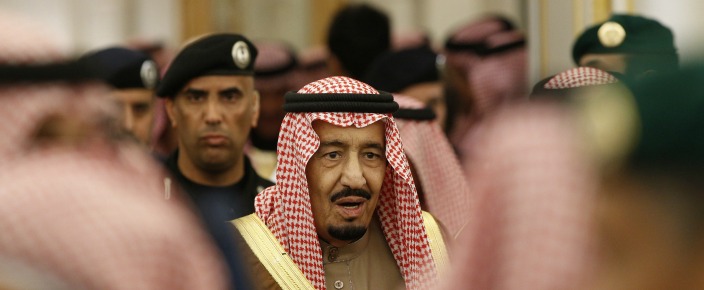
Saudi Arabia's new King Salman attends a ceremony at the Diwan royal palace in Riyadh on January 24, 2015, following the death of Saudi King Abdullah bin Abdulaziz al-Saud. Dignitaries and leaders from around the world were to arrive in Saudi Arabia today to offer their condolences to its new King Salman, a day after the death of his half-brother King Abdullah. AFP PHOTO / POOL / YOAN VALAT (Photo credit should read YOAN VALAT/AFP/Getty Images)

King Salman’s recent shakeup of the highest levels of government in Saudi Arabia has several clear and important themes. First, the new king is moving to further establish his authority and make an early mark on the administration of the kingdom through personnel and, indeed, policy changes. Moreover, he is ensuring that his own immediate relatives and branch of the royal family are firmly empowered. Second, the king’s new appointments reflect a continued focus on, and development of, Saudi Arabia’s security concerns as the highest priority of government policy. And, third, and not least, almost all of the new appointments bode well for the United States and for U.S.-Saudi relations.

Salman has named his nephew, the country’s Interior Minister Prince Mohammed bin Nayef, as the new crown prince, replacing Prince Muqrin bin Abdulaziz. He has also appointed his son, Prince Mohammed bin Salman, who is reportedly in his early 30s, deputy crown prince. And, also highly significantly, the long-serving Foreign Minister Prince Saud al-Faisal – who reportedly asked to be relieved of his post due to health problems – has been replaced by Saudi Ambassador to the United States Adel al-Jubeir. Some of the other Cabinet changes are harder to interpret, but these three major appointments each convey clear signals to the Saudi public and the world at large.

Salman’s shakeup ensures that the most important government posts in Saudi Arabia are now occupied by either his own Sudairi wing of the royal family or by non-royals who are more easily controlled or overruled than would likely be possible with other royals. This branch of the family was established by one of the wives of King Abdulaziz, the founder of modern Saudi Arabia. Hassa bint Ahmed al-Sudairi, a scion of the prominent Al Sudairi clan of Najd, the same part of the Arabian Peninsula that the Al Sauds are from, had seven sons with King Abdulaziz. Among them is the new king, Salman bin Abdulaziz al-Saud. These brothers collectively became known as the “Sudairi Seven,” and along with their sons and close relatives they constitute what traditionally has been, and currently is now, a very powerful wing of the royal family.

The promotion of Prince Mohammed bin Salman to deputy crown prince is one of the most dramatic moves by the new king to establish not only his own authority, but that of his nuclear family, on Saudi royal dynamics. Mohammed bin Salman is now effectively second in line for succession, at least in theory and to all appearances. The next generation of Saudi royals is now positioned to come to power in the foreseeable future and in an orderly manner. Mohammed bin Salman has been unequivocally placed at the forefront of this next generation of leadership in Saudi Arabia.

He had already been promoted at a strikingly young age to the post of defense minister shortly after the accession of his father to the throne. From that position, Mohammed bin Salman has been heavily involved in, and identified with, the Saudi-led intervention against Houthi rebels in Yemen and a series of other moves designed to enhance the Saudi posture in the region such as plans to create a joint Arab League military force. He is therefore a symbol of, as well as a key player in, the new policies of more proactive and assertive Saudi leadership. His elevation to, in effect, the role of crown-prince-in-waiting strongly indicates that this new, more robust defense and security posture is being consolidated and can be expected to continue and quite possibly expand.

The elevation of Mohammed bin Nayef sends a similar message on the Saudi approach to national security. As the former Saudi counter-terrorism chief, he is widely credited with having led the fight against al-Qaeda and other extremist groups. He will reportedly retain his position as interior minister, meaning that he will retain command over the most effective and competent of the Saudi security and armed forces. He was educated in the United States and is well-regarded in Washington, where he is seen as a very pragmatic and strategic thinker.

His accession to the role of crown prince also marks a significant generational change, although not one as dramatic as that of Mohammed bin Salman. At 55, Mohammed bin Nayef, should he become king as he is now poised to do, would be the first Saudi monarch who is a grandson, rather than a son, of Saudi Arabia’s founding monarch, King Abdulaziz, or Ibn Saud. Mohammed bin Nayef is noted for maintaining strong relations with most political factions in Saudi Arabia, including conservatives, while presiding over strong anti-extremist and anti-terrorism policies as counter-terrorism chief and interior minister. He was the subject of an attempted assassination by al-Qaeda in 2009 as a consequence of his crackdown on violent radicals, and several other attempts on his life by Islamist extremists.

These two key appointments, however, may lead to some tension between the new crown prince and deputy crown prince. Despite his youth, Mohammed bin Salman is reputed to have been ambitious for advancement within the Saudi system for some time. And while the deputy crown prince is young, the crown prince himself can also look forward to a long time as monarch, since he is only 55. Ambition, if it remains strong in the younger prince, may therefore be tempered by the need for a considerable period as the anointed successor. On the other hand, the new crown prince has been a key player on a number of policy fronts – for example, Yemen – that are now much more in the domain of the new deputy crown prince. This again raises the prospect for some competition, or even tension, between the second and third highest-ranking figures in the Saudi government.

Finally, the promotion of Adel al-Jubeir to the post of foreign minister further solidifies the national security and U.S.-oriented aspects of the new Saudi shakeup. He is only the second non-royal to serve as foreign minister, after representing the kingdom in Washington since 2007. Among other things, Jubeir’s non-royal status suggests a further consolidation of power by King Salman, as he will not have the same degree of influence or independence of action on foreign affairs as did Faisal, or likely would any royal family member. In future policy disputes, it is likely that Foreign Minister Jubeir could be fairly easily overruled by the king, or even the crown prince or deputy crown prince.

Jubeir is noted as a strong proponent of the intervention in Yemen and other aspects of the more assertive approach to Saudi national security initiated by Salman. But even more, his promotion reflects a clear desire on the part of Riyadh to have at the helm of its diplomatic corps someone who is highly qualified to present Saudi policies and perspectives to an American audience. Jubeir was educated in the United States and spent most of his diplomatic career dealing closely with Americans in one capacity or another. He is well-liked and respected in Washington and has been a frequent and effective spokesman for Saudi Arabia on U.S. television and other media. He was allegedly the target of a plot by Iranian agents to assassinate him by bombing a restaurant in Washington in 2011.

Jubeir can therefore communicate Saudi views to Western, particularly U.S., officials in a manner that to many will be familiar and, hence, reassuring, even when views may diverge. Even more than the other changes, his new role suggests a strong desire to communicate effectively with the United States, and that relations with Washington are being given a new emphasis in Saudi national security and diplomatic strategy.

At a time of stress in the U.S.-Saudi relationship, and in the run-up to the Camp David U.S.-Gulf Cooperation Council summit in May, this emphasis is welcome indeed and should prompt serious reflection in U.S. policy circles. The changes at the top in Saudi Arabia also came on the same day that Saudi security reported that it arrested some 93 suspects who were allegedly planning to bomb the U.S. Embassy on behalf of the Islamic State in Iraq and the Levant (ISIL). Little else is known about the alleged conspiracy.

The timing of the announcement, however, could be linked to a broader effort to send a clear message to Washington and the rest of the world: Saudi Arabia is more proactive in its own defense, both at home and regionally, than ever before, but that it values its allies, especially the United States, and will defend their interests as well. The threat of terrorism is one of the clearest and most important of the common interests shared between the two countries. But there are other shared concerns, including containing Iranian hegemony; ensuring the freedom of shipping in the Gulf and other key regional waterways; managing the petroleum and other energy markets; and ensuring Middle Eastern regional stability and security, which involves preventing new conflicts from erupting and finding political solutions to existing ones.

The U.S.-Saudi alliance is decades old and time-tested. It arises from these concrete, irreducible shared interests that have not changed for decades and are highly unlikely to for the foreseeable future. Saudi Arabia and the United States have needed each other in the past and they will certainly need each other, for the self-same reasons, in the future.

This does not mean that there are not real differences or disputes that need to be resolved. There are valid U.S. concerns about intolerant discourse among Saudi clerics and others, support for extremism by private citizens, women’s and other human rights issues, and more. Saudi Arabia joins others in the Arab world in wondering about the U.S. commitment to its regional allies, concern about the direction of U.S. policy toward Iran, and dissatisfaction with U.S. policies toward Israel and the Palestinians that have failed to resolve the conflict.

Nonetheless, the Saudi-U.S. relationship remains vital to both states, and to the stability and security of the Middle East in general and the Gulf region in particular. That the recent changes in the Saudi government seem to be sending, loudly and clearly, very positive messages on regional security, the fight against extremism, and the importance that Saudi Arabia places on its relationship with the United States can only be a welcome development. While Washington cannot precisely reciprocate these gestures, the United States should receive these messages warmly and, in its own interests, provide Saudi Arabia with appropriate – and timely – reassurances.

US boycott law will further damage the peace process

http://www.thenational.ae/opinion/comment/us-boycott-law-will-further-damage-the-peace-process

US boycott law will further damage the peace process

Israel and its allies are playing a dangerous game regarding settlements and the boycott divestment and sanctions (BDS) movement. It stands to backfire on them very badly.

This miscalculation could force individuals, organisations and even states to take positions more hostile to Israel than they would prefer. But Israel’s government and its allies are leaving them no choice. And in the process, further damage is being done to the prospects for peace and a two-state solution, which is the only viable means of ending the conflict.

Legislation is moving through the US Congress that conflates Israel with the occupied territories, and attempts to penalise states and other entities that refuse to do business with settlements. Worse still, the legislation as it is currently phrased proposes a legal definition of the BDS movement that is inaccurate and exceptionally dangerous.

The relevant language of the pending legislation is worth considering in full: “The term ‘boycott, divestment from, and sanctions against Israel’ means actions by states, non-member states of the United Nations, international organisations, or affiliated agencies of international organisations that are politically motivated and are intended to penalise or otherwise limit commercial relations specifically with Israel or persons doing business in Israel or in Israeli-controlled territories.”

Under this formula, American law will define BDS as including, without distinction, measures that attempt to boycott and sanction Israel and Israelis in general and those that carefully target only Israel’s illegal and illegitimate settlement activities.

The self-defined BDS movement is very much focused on the first of these approaches. It is mainly supported by those who view a two-state solution as inadequate and insist on a one-state agenda that seeks to eliminate Israel altogether. This movement is almost entirely rhetorical and has met with very little success because there is not much of a constituency in the West for boycotting, let alone eliminating, Israel in its internationally recognised borders.

The real target of the legislation is the boycott project that actually exists and is having an impact. Led by the European Union, this strategy seeks to defend the prospects for peace and the two-state solution by carefully targeting Israel’s settlements and refusing to trade with, or invest in, them.

The European approach meticulously distinguishes between Israel in its internationally recognised boundaries, which is a legitimate UN member state, and Israel’s settlement project which is illegal and illegitimate, and is a human rights violation against the occupied Palestinian people. This approach is gaining ground throughout Europe and is even starting to make inroads in the US.

The European approach highlights the distinction between Israel and the occupation, whereas the BDS agenda conflates them. The pending American legislation, along with official Israeli rhetoric on the topic, complains bitterly about the “delegitimisation” of Israel.

Settlement boycotts do not “delegitimise” Israel at all. On the contrary, they insist on the legitimacy of Israel but also on the illegitimacy of the settlements. The irony is that, following the lead of the Israeli government, actions such as the pending American legislation do, in fact, delegitimise Israel by collapsing the distinction between the legitimate Israeli state and the illegal settlement programme.

By attempting to force, under penalty of law, the same attitude towards Israel and its settlements in occupied territories, this legislation is effectively saying there is no distinction. But if there is no distinction, it will not be the case that Israel’s legitimacy legitimizes the settlements. To the contrary, the illegitimate settlements will undermine the legitimacy of Israel.

The logic of the Israeli manoeuvre is obvious. It seeks to block the European approach of challenging settlement activity by confusing it with the BDS approach. The hope is that because there is little appetite in most of the West at the moment for a generalised boycott of Israel, boycotts of settlements can be undermined and possibly blocked altogether.

There is every likelihood this will backfire. If those who seek to defend the only viable prospect for peace – a two-state solution – are told what they are doing is no different from boycotting Israel, are they really likely to just give up? Or, instead, and especially over time, are they not more likely to, however reluctantly, boycott this undifferentiated greater Israel?

Whose bluff is really being called here?

A few years ago, two Italian supermarket chains, COOP and Nordiconad, decided they no longer wanted to help subsidise Israel’s settlements and asked for labelling of settlement produce. Israel would not comply, so the stores no longer sell any Israeli produce at all.

In the long run, the most plausible paradigm is a widespread repetition of this same pattern. And, amazingly enough, it will be Israel that has not only, and yet again, damaged the prospects for peace, but actually led the delegitimisation, boycott and sanctions campaign against itself.

Signs of hope for Yemen?

https://now.mmedia.me/lb/en/commentary/565164-signs-of-hope-for-yemen

Saudi readjustment suggests potential for a political solution

A Yemeni member of the southern separatist movement, allied to fugitive President Abdrabuh Mansur Hadi, carries ammunition on his shoulder and gestures at checkpoint in the southern city of Aden, on 21 April 2015. (AFP/Saleh al-Obeidi)

Skepticism is helpful. Cynicism isn’t. Skepticism allows that, in spite of the chorus of negativity surrounding them, recent events in Yemen should be properly seen as generally encouraging, although they also point to the difficulties that lie ahead. Cynicism stands off to the side, rolling its world-weary eyes and shaking its jaded head. But to what purpose?

The announcement by Saudi Arabia and its allies that the initial and major part of the aerial intervention in Yemen is over should be welcomed. The Saudis apparently believe that the goals of the air campaign have been largely met. Saudis say that enough of the Houthi militia’s command-and-control centers, ballistic missile launch vehicles and weapons caches have been destroyed to meet the aims of the first and decisive phase of Operation Decisive Storm.

At midnight on Tuesday, Decisive Storm gave way to a second phase of the operation, Restoring Hope. The Saudis say that the purpose of this second part of the intervention is to “protect civilians” and provide ongoing but less aggressive support for the military and other armed forces acting in the name and interests of the internationally-recognized government.

Skepticism prompts us to question the extent to which the largest goals set for Decisive Storm at its outset—the reversal of the Houthi ‘coup’ in early February and the restoration of the government of exiled President Abd Rabbuh Mansur Hadi—have really been met. And, indeed, to ask if they were ever achievable aims, especially given the limitations of what can be accomplished through air power alone.

But only unwarranted cynicism would fail to register that the Saudi announcement of the end of Decisive Storm is a positive development, even if the broadest aims of the campaign remain unfulfilled. The move to scale back the intervention recognizes that a pattern of diminishing returns has set in and that it is wise now to move towards a series of agreements with the Houthis and others in Yemen leading to a managed political transition in the country.

Hopes for peace now focus on the emerging role of Vice President and Prime Minister Khaled Bahah. He is widely seen as the national figure best placed to lead negotiations, as he is trusted, at least to some extent, by most factions in the country. Many observers believe that the fortunes of Bahah and those of a negotiated agreement to end the conflict are closely linked, if not interdependent. They will be viewing the level of his prominence and engagement at the center of national politics as a barometer for the likelihood of a workable deal to end the fighting.

Cynics, of course, were pointing to the resumption of airstrikes and fighting on Wednesday, immediately after the Saudi announcement that Decisive Storm had ended. Bombing raids were aimed at a meeting of Houthi militia leaders at a military headquarters near the old airport southeast of the city of Taiz—a meeting the Saudis claim was a violation of the agreement the two sides had just concluded. There were also raids in Aden, which was the scene of intense street fighting between Houthis and troops loyal to the government that left over a dozen killed.

As White House spokesman Jen Psaki dryly noted: “Obviously, the job is not done.” But neither is the continued bombing and fighting simply a bad sign. The ending of Decisive Storm strongly suggested that Saudi Arabia is aware of the possibility of being sucked into a quagmire in Yemen, but is determined not to allow that to happen. At the same time, the resumed attacks and continued fighting show that the Saudi side is not going to simply walk away or allow the Houthis or others to carry on as they please and that it reserves the right to act.

Instead, there is reason to be hopeful that what is being pursued is a sensible two-track approach that seeks, on the one hand, to pull back from the fighting and seriously pursue a political agreement with the Houthis and, on the other hand, to continue to be willing to ensure that the basic interests of the coalition and its Yemeni allies are maintained.

Some Saudi media are proclaiming Decisive Storm to have been an unqualified masterstroke, producing success after success, both on the battlefield and at the negotiating table. There is no basis for such triumphalism. But there is equally no basis for opposite claims in much Western and some Arab media that the intervention in Yemen was a blunder, a disaster for Saudi Arabia, or even a failure. It may one day become any or all of those, but is none of them yet by any means.

And, to the contrary, the apparent willingness of the Saudi-led coalition to restructure the goals and aims of the mission, to pull back from an intensive engagement that did threaten to become a pointless and damaging stalemate on the ground, and to leverage what had been achieved through the air campaign into progress at the negotiating table suggests a more thoughtful and potentially effective approach than many had been willing to concede was plausible.

Yes, there is “much to be done” in Yemen. Yes, there is still fighting and bombing taking place and that is deeply troubling. Yes, there is a long way to go before the Houthis come to a modus vivendi with the rest of Yemeni society and the common battle against Al Qaeda—which has inadvertently been the main beneficiary of the conflict thus far—can once again, and properly, be the focus of military action in the country.

Yet, in spite of all of that, today one can identify real reasons to hope that better judgment is starting to prevail. One can finally begin to discern flashes of light at the end of Yemen’s dark tunnel. Although a cynic can and will not, even the most experienced and committed skeptic can and should recognize hopeful signs when they occasionally begin to sprout.

Al Qaeda expands its toxic footprint in Yemen

http://www.thenational.ae/opinion/comment/al-qaeda-expands-its-toxic-footprint-in-yemen

Al Qaeda expands its toxic footprint in Yemen

As the war in Yemen intensifies, it’s becoming increasingly clear that the big beneficiary has been Al Qaeda in the Arabian Peninsula (Aqap). None of the parties are attempting to strengthen the terrorist group. On the contrary, all of the other principal combatants are clearly concerned about the rising power of the extremists. However, with most other groups involved directly in the growing civil conflict, Aqap is expanding its footprint in parts of Yemen.

This is mainly taking place far away from the rest of the fighting, and in areas where Aqap was already present. The terrorist group overran the city of Al Mukalla, relieving the local bank of its cash and the local prison of its most important prisoners, including a senior Aqap leader. It also seized control of Riyan airport and the adjacent military base near Al Mukalla, which just happens to be the fifth largest in the country. In the process, and in other encounters with the fragmenting Yemeni army, Aqap has reportedly grabbed heavy weaponry including tanks, along with Katyusha rocket launchers and small arms. The cherry on top was a significant oil terminal.

All of this happened while Saudi-led air strikes were targeting the Houthi rebel militia in the country’s major cities including the capital Sanaa, Taiz and Aden, as well as the Houthi stronghold, Saada. After four weeks of bombing, the Arab air intervention does not yet appear to have significantly slowed the Houthi advance, let alone turned the table in favour of troops fighting in support of exiled president Abdrabu Mansur Hadi. But it has inadvertently eased pressure on Aqap in Yemen and created space for the extremists to consolidate and expand their presence in the country.

More dangerous still, United Nations negotiator Jamal Benomar recently told The New York Times that Aqap is taking advantage of the conflict to also strengthen its political standing in Yemen and build alliances.

“For the first time, Al Qaeda is building a strategic alliance with the tribes,” he reportedly said. “It is a strengthened and dangerous Al Qaeda. This is what worries everybody.”

The conflict with the Houthis is being cast by some in sectarian terms, allowing Aqap to falsely pose as champions of the local Sunni Muslim population. The Houthis, for their part, claim that Aqap dominates the forces confronting them on the ground, further cementing a dangerous sectarian narrative which, though essentially false, can nonetheless become a self-fulfilling prophecy.

The strengthened Aqap also appears to be using the conflict in Yemen to its advantage in its burgeoning rivalry with ISIL, a rival terrorist network. ISIL affiliates in Yemen claimed responsibility for the bombing of two Houthi-frequented mosques in Sanaa on March 20 that killed 137 worshippers. But the chaos in Yemen generally appears to be strengthening the hand of Aqap, which may be poised to regain dominance in the terrorist subculture as ISIL finds itself being rolled back territorially in Iraq, facing an increasingly united opposition from regional and international states, and increasingly unpopular in Arab public opinion due to its extreme brutality.

In Al Mukalla, the capital of the Yemeni province Hadramaut, Aqap has established what is generally regarded as the most effective Al Qaeda franchise currently extant in the Middle East, and the only one capable of attempting significant terrorist acts internationally and in the West. Indeed, Aqap claimed responsibility for the January 7 massacre of 11 people at the offices of the French satirical magazine Charlie Hebdo.

As a consequence of this capability, the group has been a frequent target of American drone strikes. On April 14, the group said that one of its senior ideologues and spokespersons, Ibrahim Al Rubeish, a 35-year-old Saudi national who is a former detainee at the US military prison in Guantanamo was killed in a drone attack near Al Mukalla. At least six other senior Aqap figures have reportedly been killed by American drone attacks over the past year. In 2011, the American cleric and terrorist ideologue Anwar Al Awlaki, one of the most important figures produced by Aqap and the leading proponent of “lone wolf” or small-scale terrorist attacks in the West, was killed in a drone attack.

However, any notion that the terrorist group was effectively contained, let alone degraded, has clearly been dissipated given the advances it has made in the context of the expanding war and lawlessness in Yemen. Obviously this outcome is not acceptable, including to the Arab states currently intervening in the conflict.

Stopping the Houthi advance and creating conditions for the restoration of order and political legitimacy in Yemen, and a negotiated peace agreement in the country, are exceptionally important. But they cannot be pursued in a manner that ends up strengthening Aqap, particularly if that is because the approach is insufficient to resolve the conflict and instead creates a stalemate.

A settlement boycott is the least we can do

https://now.mmedia.me/lb/en/commentary/565132-a-settlement-boycott-is-the-least-we-can-do

Everyone who cares about peace should boycott settlements

Israeli security forces hold a position during clashes with Palestinian youths from the Jalazoun refugee camp in the Beit El settlement, north of Ramallah, following a protest against Israeli settlements in the West Bank on 13 March 2015. (AFP/Abbas Momani)

With Israeli-Palestinian diplomacy, the peace process and the viability of the only workable formula for peace—a two-state solution—on life support following the reelection of Israeli Prime Minister Benjamin Netanyahu on a platform of opposing the creation of a Palestinian state, the world cannot simply throw up its hands and walk away. The temptation may be overwhelming, but the irresponsibility of “benign neglect” of the Israeli-Palestinian conflict will become painfully evident sooner rather than later. History shows that the issue does not remain quiet for long—it has an impeccable track record of erupting without warning in an extremely dangerous and destabilizing manner.

Among the numerous measures that ought to be employed by the international community to salvage the prospects for an eventual peace—without which the parties in the region are doomed to interminable conflict which will simply get more violent and intractable over time—one of the most obvious and indispensable is a thoroughgoing international economic boycott of Israel’s illegal settlements in the occupied Palestinian territories. The settlements are a direct violation of black letter international law, most notably Article 49 of the Fourth Geneva Convention. They are prohibited because they are a human rights violation against people living under occupation, who have a right not to be forcibly colonized by a foreign military power. This principle was not controversial in the immediate aftermath of the Second World War, when the Convention was drafted and approved.

Moreover, the settlements are by far the most damaging of all of the destabilizing elements that threaten short-term calm and long-term peace. They, alone, fundamentally alter the strategic landscape and basic reality that define relations between the occupying power, Israel, and the occupied Palestinian people. With every new settlement home, the Jewish Israeli constituency with a vested interest against making the compromises necessary for peace is enlarged and strengthened. From a Palestinian point of view, Israel’s aggressive settlement activity makes a mockery of negotiations by systematically prejudicing the future of key areas that are, or theoretically should be, the subject of peace talks, and would be indispensable parts of a future Palestinian state.

One obvious example of the kind of settlement activity that, even with a few structures, radically changes the political map in the occupied territories was announced on 30 March when Israel said it intends to build 143 new settlement housing units in an area it calls “Har Homa.” Building in this area has been strategically planned in order to create a ring of continuous Jewish Israeli settlements around the periphery of Israel’s definition of the municipal borders of Jerusalem, cutting the city off from the rest of the West Bank. The purpose is clear: to consolidate and perpetuate Israeli control over Jerusalem and undermine the prospects of a meaningful compromise on Jerusalem, which is an essential element of any peace agreement.

American opposition has frequently restrained Israel from completing plans in such sensitive areas, but it has also sometimes failed. And when that happens, there are no consequences. Under the current circumstances, it’s easy to imagine that Netanyahu and his colleagues decided to go ahead with this and other highly damaging settlement projects without being very concerned about the reaction of the Obama administration. A recent report by the European Union found that in addition to this kind of highly-provocative settlement activity, home demolitions, the evictions of Palestinian families, and other repressive Israeli actions have created a highly-volatile atmosphere in Jerusalem. The report says that Jerusalem has now reached a “boiling point of ‘polarization and violence’ not seen since the end of the second Intifada in 2005.”

In addition, a new report by Human Rights Watch, “Ripe for Abuse: Palestinian Child Labor in Israeli Agricultural Settlements in the West Bank,” outlines the exploitation of Palestinian child labor by Israeli settlements. It claims that Palestinian children are subjected to low wages and dangerous working conditions that violate international standards. The practices documented in the report would be illegal in Israel itself, but these child labor laws and other protections are not enforced against Israeli settlements.

A great deal of the agricultural produce grown in Israeli settlements, with or without the exploitation of Palestinian child labor, is slated for exportation, much of it to Europe. European states, though, are slowly but steadily moving towards a prohibition against the importation of Israeli settlement goods. Sixteen of the 28 European Union foreign ministers, including those of Britain and France, have recently signed a letter to EU foreign policy chief Federica Mogherini asking her to coordinate policies insisting on the clear labeling of settlement goods.

The ministers said the measure was necessary “in relation to the preservation of the two-state solution” since “continued expansion of Israeli illegal settlements in the Occupied Palestinian Territory, and other territories occupied by Israel since 1967, threatens the prospect of a just and final peace agreement.” Israel’s continued settlement activity is also reportedly threatening its long-standing efforts to join the EU Horizon 2020 research and innovation program.

The United States does not appear to oppose these European moves, but, unfortunately, shows no signs of following suit for now. On the contrary, the current interpretation of the US-Israel Free Trade Agreement in effect provides preferential treatment for Israeli settlement goods. But a settlement boycott—and not just a refusal to buy settlement-produced goods but a prohibition on investing or financially underwriting settlement activity and industries—are really the least that any state or society that sincerely believes in the need for an eventual two-state solution can and should do.

A settlement boycott isn’t going to transform the strategic landscape between Israel and the Palestinians. Even a full-scale boycott of Israel, reminiscent of that which was imposed on apartheid-era South Africa, wouldn’t do that (and it is almost certainly not achievable, particularly in the United States). But it would send a crucial signal to Israel that, because of its commitment to peace, the international community does not accept Israel’s settlements as legitimate. And because the settlements are illegitimate, their products are also illegitimate. As such, the respectable countries of the world decline to buy illegitimate products. It should be a small part of a whole string of actions designed to shore up the two-state solution and making sure Israelis understand there is a real cost to unacceptable policies such as aggressive settlement expansion.

It’s really not asking for much. And if we actually care about peace, it really is the very least we can do. But, under the present circumstances, it may not be achievable in the United States without considerable groundwork. This is why the European states need to be strongly encouraged to continue to develop these policies and blaze the trail for others to follow.