Author Archives: Hussein Ibish

Is Bahrain Creating a New Terrorist Threat?

http://www.foreignpolicy.com/articles/2011/04/14/is_bahrain_creating_a_new_terrorist_threat

On April 4, the Saudi cabinet issued a statement claiming that “peace and stability” had returned to Bahrain “as a result of the wisdom of its leadership in dealing with its internal matters and because of its people giving priority to national interests.” Nearly three weeks earlier, the Saudi-dominated Gulf Cooperation Council (GCC) had sent some 1,200 troops across the 16-mile causeway linking the two countries. Their official mission was to secure key government facilities from the thousands of protesters who had taken to the streets since Feb. 17. Unofficially, they were there to send a chilling, unequivocal message: Game over.

Since then, the government of Bahrain has instituted a total crackdown, beating teenagers in the streets, clamping down on press freedoms, and hauling online activists in for questioning. The daily demonstrations, overwhelmingly by Shiite protesters demanding equal political and civil rights, have indeed stopped. Yet, far from ensuring “peace and stability” in Bahrain, by apparently eliminating all other political options, the ruling Al Khalifa family has established the conditions for a potential outbreak of urban terrorism by Shiite extremists. Long-standing Gulf Sunni fears of a sectarian rebellion in Bahrain and the possibility of major Iranian interference in the island nation have informed an extreme overreaction that is developing all the signs of becoming a self-fulfilling prophecy. This can’t end well.

It’s virtually impossible to overstate the totality of the closure of political space in Bahrain. It didn’t have to be this way. Initially, protests were not entirely sectarian and seemed amenable to reforms toward a constitutional monarchy. Crown Prince Salman bin Hamad Al Khalifa attempted to initiate a productive dialogue, but the opposition was not forthcoming and hard-liners within the regime centered on his uncle, Prime Minister Khalifa bin Salman Al Khalifa, clearly won out. The more the regime responded to peaceful political demands with violence, the more both government and opposition extremists gained the upper hand.

Shortly after the GCC troops intervened, Shiite opposition figures from the mainstream al-Wefaq organization were arrested, along with more extreme sectarians such as Hassan Mushaima of its rival, al-Haq. (Mushaima has been categorical about the need for a full-blown revolution, saying, “The dictator fell in Tunisia, the dictator fell in Egypt, and the dictator should fall here.”) On March 8, al-Haq and two other groups crossed a red line by announcing the formation of a “Coalition for a Bahraini Republic” — a move that was understood, correctly or not, by Sunnis throughout the region as a commitment not only to the removal of the royal family but also the establishment of an Iranian-style Shiite “Islamic Republic.” Between such provocative opposition statements and the GCC intervention, the crisis in Bahrain became irrevocably polarized along sectarian lines, with Sunnis and Shiites throughout the region taking sides with the government or the opposition based on religious identity.

The political crackdown is so complete it has extended to the nonsectarian and social democratic reformist organization al-Waad, whose moderate leader Ibrahim Sharif was also rounded up. In recent days, al-Waad has joined other groups in warning against Iranian interference in Bahrain, but the government’s response has been to arrest another of its leaders, Abdulhamid Al Murad, and shut down its website and its two main offices.

Without question, however, the crackdown has largely focused on the Shiite opposition and community in general. The government and its allies have framed the protest movement as an Iranian plot, though to date there is scant evidence to demonstrate this. Opposition newspapers have been shut, though Al Wasat was reopened “under new management” after its main editors resigned, and journalists from that paper and others have been hounded and questioned by the authorities. Opposition leaders, both moderate and extreme, are in prison. Medical services have been targeted, injured patients rounded up in hospitals and often denied medical care, and doctors arrested. The Pearl Monument — the focal point of the protests and the main landmark of the capital Manama — has been demolished. A draconian emergency law was put in place that bans all protests, allows for arbitrary arrests, and imposes martial law for at least three months. At least 400 people have been arrested and at least 25 killed during the protests, as well as four deaths in custody that bear all the hallmarks of torture according to Human Rights Watch and other NGOs. A wide-scale crackdownon various economic sectors, including public employees and professional organizations, is under way, including mass firings, especially of Shiites. The big picture is extremely clear: There is no room for dissent of any kind in Bahrain anymore, above all if it comes from the Shiite majority.

Saudi Arabia and the rest of the GCC may be genuinely deluding themselves that “peace and stability” have actually been restored by this violent despotism and the fact that until now only one side — the government and its allies — has been using arms. But historical experience suggests that in any society this extent of repression, especially when directed against a disenfranchised majority with legitimate and historical grievances, is simply untenable, as evinced by examples as disparate as South Africa, Northern Ireland, and the Basque Country. If there is no space for nonsectarian reformists like al-Waad, moderate sectarian Shiite groups like al-Wefaq, or more militant but nonviolent ones like al-Haq, and no tolerance for dissent of any kind, how long can it be before a group of extremists, no matter how small, decides that “fire must be met with fire” and turns to violent resistance? (The crown prince continues to call for dialogue, but the basis for it seems completely absent. In the same breath he calls for reforms but vows “no leniency with anyone who seeks to split our society into two halves.” The government’s most recent move is to seek to legally dissolve al-Wefaq and another Shiite group, Islamic Action. So prospects for meaningful reform and dialogue therefore seem remote at best.)

A campaign of violence by opposition extremists might seek and receive support from Iran or other regional Shiite powers such as the Lebanese militant group Hezbollah. But it would not require it. Iran and Hezbollah might, for their own reasons, strongly urge any Bahraini Shiites considering such action to restrain themselves. But would all of them heed such a call? Modern urban terrorism only requires a tiny handful of people with rudimentary knowledge, armed with a combination of readily available household items and both deep ruthlessness and extreme recklessness, to begin the process.

Such a movement need not initially be particularly ambitious in its destructive acts to have a powerful impact. A handful of people with crude devices acting around the same time in strategic locations is capable of stoking extreme panic. The goal of a modest opening salvo of urban terrorism is typically to provoke an overreaction on the part of the authorities, and in this case that seems virtually guaranteed. The calculus would then be that the overreaction would seem to justify these violent acts in the eyes of many people who otherwise might have been disapproving, allowing the movement to gain strength and develop over time to the point that it becomes a real threat to national security and political stability. The Bahraini government and its allies have already succeeded in turning what should have been a manageable political situation into an unmanageable one. How likely is it that they would react in a more rational and prudent manner to a violent security threat, however limited and symbolic?

The total crackdown in Bahrain has plainly opened the door for just such a scenario. If this situation continues for an extended period of time, it is probably more a matter of when rather than if some group eventually walks through that door. Largely because of their own actions, all the worst fears of Bahrain’s royal family and the Sunnis of both the island and the rest of the Gulf are perfectly positioned to begin to come true, and the opportunity to avoid this is dwindling by the day.

Arabs yearn to move on and enjoy genuine peace

http://www.dailystar.com.lb/Apr/11/Arabs-yearn-to-move-on-and-enjoy-genuine-peace.ashx

Probably the most important clause in the Arab Peace Initiative, first adopted by the Arab League at the Beirut summit in 2002 and reaffirmed on several occasions including in 2007, is its commitment to “establish normal relations with Israel in the context of [a] comprehensive peace.”

This clause represented the culmination of decades of evolution of Arab thinking regarding relations with Israel, and the final repudiation of the Khartoum resolution of 1967, which insisted the Arabs would allow “no peace with Israel, no recognition of Israel, no negotiations with it.”

In other words, rather than being surrounded by an Arab world that generally, if not unanimously, rejected the idea of accepting Israel as a permanent and legitimate presence in the Middle East, for almost a decade now Israel has been facing a united Arab world that has repeatedly made clear its willingness to make a permanent and normalized peace with the Jewish state.

The importance of this clause is that it affirms that at the end of negotiations with the Palestinians, Israel can expect recognition and acceptance in the region, not just from the Palestinians but from the other Arab states as well.

Its endorsement by the Organization of the Islamic Conference suggests an even broader reconciliation with the larger Muslim world as well. In effect, this clause in the initiative presents Israel with a simple choice: It can continue the occupation and the illegal colonization of territories occupied in 1967, or it can agree to end the occupation and permit the establishment of a Palestinian state, and acquire the peace and regional acceptance that have supposedly been its primary foreign policy goals since 1948.

For the Palestinians, this clause is an extremely important diplomatic tool in pushing for an end to the occupation, since they can point out to Israelis that the result of successful negotiations will be peace and reconciliation not only with them, but with the Arab world in general.

There have been some halfhearted efforts by the Palestinian leadership to promote the initiative, but limited resources and a marked disinterest on the part of Israelis have attenuated these efforts.

Israeli disinterest in the initiative has been truly extraordinary. It would seem to offer them everything they have said they wanted since the establishment of their state, yet very few leaders or opinion makers have recognized its importance, and no Israeli government has ever attempted to test the seriousness of its proposal.

Some Israelis are so committed to maintaining the occupation that they are uninterested in any such compromise. Others suspect it is a diplomatic ruse, but by not testing it in any serious manner this becomes a self-fulfilling prophecy. Of course, the Arab League could and should do more to promote the Arab Peace Initiative, especially with the Israeli public.

Other Israelis are unenthusiastic because they regard peace treaties with Egypt and Jordan as strategically essential but fundamentally unsatisfactory. Israeli bitterness about the “cold peace” with those two countries shows a failure to comprehend that the enduring coldness is the consequence of the continuation of the occupation in Palestine.

Obviously, Arabs and Israelis, given their bitter history, are unlikely to become close allies even if the conflict is permanently and irrevocably ended. However, Israelis need to understand that the “cold” nature of the treaties with Egypt and Jordan stems from popular outrage about the continued occupation in Palestine.

If that were resolved, as the Arab initiative anticipates, the potential for Arab-Israel reconciliation at the cultural and emotional level, which is otherwise impossible, will likely develop over time. Warmth is too much to ask at first, but without occupation, both peace and reconciliation become achievable.

The Palestinian citizens of Israel are likely to play a crucial role in such a reconciliation. The end of the Israeli-Palestinian conflict would do more than anything imaginable to normalize their status as Israeli citizens, and they are perfectly positioned to become Israel’s economic and cultural ambassadors to the Arab world.

It could transform them from a beleaguered, discriminated-against minority to a crucially positioned and empowered group that can broker economic and cultural exchanges that are mutually beneficial and form the basis for a broader reconciliation.

It’s become quite obvious that while almost all Arabs are still passionate about the plight of the Palestinians and committed to ending the occupation that began in 1967, most Arab states yearn to move past the pointless and exhausting conflict with Israel that began in 1948.

All parties stand to gain from the normalization of relations between Israel and the Arab world, but, as the Arab initiative makes very clear, that can only happen if the occupation is ended and a Palestinian state is established to live alongside Israel in peace and security.

Ibish joins Reason.com roundtable on The War in Libya and the “Arab Spring”

http://reason.com/archives/2011/04/07/the-war-in-libya-and-the-arab/singlepage

Why has there been such a flowering of revolt in the Arab world in North Africa and the Middle East in the past few months? Is there a common root cause to protests and revolts, whether ultimately successful in creating less-oppressive regimes, in Libya, Tunisia, Egypt, Yemen, Syria, Saudi Arabia, and elsewhere?

These uprisings have been brewing in the Arab world for many decades. Almost everyone who carefully observed the region knew that this was going to happen at some point, but nobody knew how or when it would begin. Some narratives attribute the origins to the self-immolation of an underemployed Tunisian fruit seller who was being harassed by the authorities, or the beating death of an ordinary Egyptian in Alexandria at the hands of the police, both of whom became emblems of abuses by autocratic, unaccountable governments and their oppressive internal security forces. Other narratives emphasize social media such as Twitter and Facebook. Honestly, I think the causes for the uprisings are overdetermined and cannot be put down to either specific events or technological developments. For causes that may be analyzable many years from now with hindsight, there was clearly a critical mass that built at the very end of 2010 and has carried through this year with a vengeance.

Of course there are common root causes to most of these revolts: a demand for accountability from leadership; more social and political inclusivity; less corruption and nepotism and arbitrary misadministration by dysfunctional bureaucracies; extreme and growing social and economic inequality; the lack of political freedom; and an overall feeling that the Arab world is stagnating as the rest of the globe marches forward beyond modernity and even postmodernity towards a new and exciting era. I think many Arabs feel they are being left behind, not because they lack the skills or education, but because the governmental, social, and economic systems they lived under prevent them from participating in these global developments. The sense of being treated as a subject rather than a citizen by an unaccountable government, almost always corrupt and very frequently kleptocratic in nature, the lack of any serious space for political and social input through civil society or fundamental democratic processes; and the chronic underemployment of well-educated youth meant that there are a set of grievances that cut right across Arab states that have very different individual characteristics. Of course each society differs in many ways, and there are at least three Gulf states—Qatar, the UAE, and Kuwait—that have so much money and such small populations that they are probably immune to major unrest.

What’s most fascinating about the Arab uprisings is that they have not been ideologically Islamist in character, although the Islamists are clearly hoping to benefit from early elections and the opening of political space. It wasn’t religious identity at all that brought millions of Arabs into the streets demanding their rights and the overthrow of long-standing dictators. It was instead qualities that had been considered moribund if not dead in the Arab world by many observers, both Western and Arab: patriotism, national consciousness, and a sense of fellow feeling based on national and ethnic identity. The “Arab Spring” has produced a fascinating resurgence of a kind of Arab nationalism, or at least Arab ethnic consciousness as opposed to Muslim religious identity consciousness, but it’s very different than the Arab nationalism of the past that quixotically sought to unite disparate Arab states. Instead, the Arab movements are inspiring each other, such that in Tunisia Islamic slogans were ejected in favor of patriotic ones, and the Tunisian flag predominated. In Egypt, the same thing happened, with Muslims and Christians, the devout and the skeptical, the upper middle class and the working poor, all uniting as Egyptians, waving Egyptian flags and symbols, but also Tunisian ones. In Libya and Yemen, national flags have been important but Tunisian and Egyptian flags have also been very present. In other words, people are proud to be Arabs again: They are proud of themselves, and they are proud of each other. They’re sick of being subjects to lifelong dictators and their sons, and resentful of monarchies that resist constitutionalism and parliamentary reform.

So clearly there are root causes that are common, and rather vague, often nonideological, goals that are common as well. But of course there are differences too. Because of their sectarian and ethnic heterogeneity, Iraq and Lebanon have their own dynamics and probably won’t be part of this wave of uprisings, even though a very interesting, but somewhat unrelated, movement is beginning in Lebanon. Bahrain has become almost entirely a sectarian conflict, which might have been avoidable, but due to the gross miscalculations of the government and their Gulf allies, especially Saudi Arabia, and their paranoia about Iranian intentions towards the island kingdom (Iran has a full territorial claim on Bahrain that it has never formally renounced), it has already become virtually a proxy conflict between all the Sunni Arabs of the Gulf and the Shiites of the region, unfortunately led by Iran. In both Libya and Yemen, there is the threat of national disintegration and, potentially, failed-state status. So in all cases, there are unique challenges. But, as I say, there are many common grievances and ambitions that Arabs throughout the region clearly share and that are motivating the “Arab Spring.”

Is the impulse to challenge repressive regimes likely to spread to other countries in the region and, if so, which ones?

As I say, I think there are only three Arab states that are almost certainly immune to revolutionary uprisings: Qatar, the UAE, and Kuwait. All three have small indigenous populations, very large amounts of money to keep people happy, no hesitation in using repression against dissidents (so you’ve got lots and lots of carrots but a few sharp sticks too), and huge numbers of migrant workers from the West, the Arab world, and other developing states who do not have a long-term stake in the future of those societies and are unlikely to risk all for social reform in places they live in only to make money. It’s true that there are Shiite minorities in the UAE and, especially, Kuwait that can prove difficult at times, and are certainly making a fuss about the intervention in Bahrain, but this is almost certainly manageable. Kuwait also has an ongoing problem of undocumented Bedouins who have been protesting for their rights for many decades. But again, this isn’t really part of the generalized Arab uprising and has a fairly easy solution: Normalize their status. Bahrain is a unique case also because it has a strong Shiite majority and an uprising that has become almost entirely sectarian. It’s seen as a flashpoint and redline for the other Sunni-ruled Gulf Cooperation Council members, especially Saudi Arabia, and as a proxy battlefield with Iran.

But other than the three small and hyper-rich Gulf states I mentioned above, I think all Arab countries are potentially liable to see popular unrest and antigovernment demonstrations. Sudan is still shell-shocked from the loss of the South, but it could spread there too. There are signs in Mauritania. It’s already well underway in Yemen, Libya, Jordan, Bahrain, Syria, and elsewhere. Saudi Arabia too is very brittle, with a large and oppressed and disenfranchised Shiite minority in the oil-rich eastern provinces, dormant but potentially resurgent tension between Nejdi and Hijazi identity, large numbers of poor and neglected people in rural provinces, and it’s also very susceptible to negative influences coming from a disintegrating Yemen and sectarian tensions emanating out of Bahrain. In some countries popular monarchs such as the kings of Jordan and Morocco, and some Gulf states as well, might be able to draw a distinction between themselves on the one hand and the governments on the other hand and proceed with reform on that basis.

This is even possible in Syria where Bashar al-Assad has somehow managed to create a very different reputation for himself personally to the deeply unpopular regime that he heads. How long that can be sustained or what he can do with it is very much open to question, and he already missed his first big opportunity in his recent speech in which he did not lift the draconian emergency law (presumably because either the inner circle around him wouldn’t let him do that, or he and all the others fear that it would open the floodgates to a generalized uprising). Syria is especially complicated because it is ruled largely by an Alawite sectarian minority and the potential for bloody vengeance against that community in the case of the fall of the regime is a serious concern. In addition, Syrians have had a very good look at what happened in Iraq (there are huge numbers of Iraqi refugees in Syria at the moment) and would not want to go through a similar period of social disintegration, and the Syrian government has a good deal of experience managing difficult political waters through its hegemonic efforts in Lebanon. So in my view while Syria is certainly vulnerable to the same kind of uprisings we’ve seen elsewhere, and that have begun in that country already, it may well be one of the last dominoes to fall for these reasons, and also because I don’t doubt the willingness of the Syrian army to use massive force at an early stage.

The outcome of all of this is most likely to be shaped by what happens in Egypt, which always has been and remains the bellwether for most of the Arab world. If the Egyptians can succeed in creating an inchoate and fledgling but pluralistic, inclusive democratic system that also protects minority rights, then we probably are seeing the beginnings of an Arab Spring comparable to the democratic transformations in Latin America and Eastern Europe in recent decades.

What should the role of the United States in the region be as events unfold?

I think the United States has to be extremely careful in how it deals with the situation. First of all, it has to seize every opportunity to make it clear to the Arab peoples that we are not the guarantors of an unacceptable status quo—that we are not so addicted to oil supplies, regional stability, our own hegemony, and Israel’s security that we would regard any dramatic or revolutionary change in the Arab world as inherently undesirable. I think the Obama administration finally got it right in Tunisia and Egypt, and although they waited too long to participate in creating a no-fly zone in Libya, that action has helped to communicate the right message to the Arab world. If the United States had acted early, in the immediate aftermath of Col. Qaddafi’s first televised speech after the revolt began, in which he claimed the uprising was a joint Al Qaeda-American plot and threatened to cleanse Libya “house by house” among other bloodcurdling threats, an intervention would have been seen by almost everyone in the Arab world except for the most extreme left-nationalists and radical Islamists as a genuine rescue operation unconnected to self-serving American interests. The fact that we waited several weeks before joining a large coalition probably helped diplomatically in terms of securing Arab League support, a rock-solid UN Security Council resolution, a wide coalition including significant air power from Qatar and the UAE, and other important diplomatic achievements, but I think it also cost a great deal politically and strategically in terms of how this intervention plays out in Libya itself and, even more importantly, is viewed by the majority of Arab public opinion. I think now it looks much more like what it has become, an intervention in a civil war, and it looks much more calculated, self-serving, and reluctant, and hence is much more vulnerable to the specious charge of imperialism and neocolonialism.

I like the way President Obama in his speech on the Libyan intervention framed his criteria (he did not lay out a fatuous “doctrine” as other less sophisticated presidents have tried to do) for international action. He said that when our security is directly threatened, we will act without hesitation, but that even when it is not directly threatened, if there is a convergence between our interests and our values, then we will act. Libya is a perfect case in point, as there was every reason to suspect that as the Qaddafi forces were bearing down on the rebel stronghold of Benghazi, a major massacre was a distinct possibility based entirely on his own rhetoric and threats, not to mention his conduct. This is where it becomes a matter of values. But at the same time, the United States, the international community, and the Arab world had to consider the prospect of a decisive victory by a bloodied, enraged, embittered and still oil-rich Qaddafi stalking the region and the world with a new revenge agenda that undoubtedly goes far beyond Libya and probably beyond the Middle East. In other words, from the point of view of our interests, that outcome was unacceptable. Hence there was a perfect confluence between our values and our interests, and Obama was absolutely right to act, although I wish he had done so earlier when it would have had a much more profound political and cultural impact in the Arab world, and also probably enhanced our ability to shape the outcome of what is ultimately going to be decided by Libyans with some external support.

Obviously there are other instances where our values and interests don’t intersect in the same way. Bahrain is a good example, although the violence inflicted there pales in comparison to what Qaddafi was doing in Libya. However, the overthrow of the royal family in Manama is not acceptable to the United States or its GCC allies because the Fifth Fleet is based there and it is therefore a vital military ally, because of its strategic location, and because of Iran’s thinly disguised designs on the island. Therefore, intervention in Bahrain will be left to the GCC based on the treaty obligations that allow for the kind of intervention those countries have already undertaken. If it were simply a matter of values, we would have already been intervening in Côte d’Ivoire and Congo. If it were simply a matter of interests, we would have supported the crackdown in Bahrain and not criticized the GCC intervention. There is a delicate interplay at work here between values and interests, understanding that when American security is directly threatened, all bets are off.

But I think that rather than establishing any kind of fatuous “doctrine,” what Obama has done is lay out a series of criteria that can help guide when intervention is useful and when it isn’t. I’ve been a supporter of the no-fly zone almost from the earliest stage, and I strongly agree with the case he made for that intervention, although he put much more emphasis on the humanitarian aspects (intelligently appealing to people’s consciences and emotions) and less emphasis on a Qaddafi victory as a politically unacceptable outcome. And he did explain the need to get on the right side of history in terms of the aspirations of the “Arab Spring” when we can do so without compromising our core interests, as we could in this case. It’s really impossible to argue, as some on the far left are desperately trying to do, that this is a neocolonial or imperial intervention designed to split Libya into pieces so that it will be easier to control, and seize the oil wealth of that country. This is absurd! The West had no problem dealing with Qaddafi until the uprising began and he was happily selling all his oil at very reasonable prices to the global marketplace. In fact, both the uprising and the no-fly zone intervention, which has prolonged the war by preventing what seemed as if it might have been an imminent and decisive Qaddafi victory, have driven the price of oil up even further, directly harming the U.S. economy and the economies of most of our allies as well. I’m not saying we are acting altruistically. States don’t do that. But I’m saying that the real calculus bears no resemblance to the faux-Marxist, pseudo-materialist gobbledygook you get out of the knee-jerk, tin can “antiwar” left. The professor and blogger Juan Cole has offered one of the most powerful rebuttals to this nonsense and I urge everyone to read his “open letter to the left.”

When it comes to our allies, obviously we need to push for serious reforms that can answer the legitimate grievances of the Arab peoples before chaos ensues in countries in which we have a major stake. And I think if the Egyptian transition proves effective in moving towards real democracy, that will set the stage for the process to spread in a more orderly, serious manner through much of the Arab world, with the exception of the Gulf, Lebanon, and Iraq, which will require their own solutions because they really are very different in many ways. What I’ve been arguing recently is that most Arabs, including most Islamists, have understood that government legitimacy must be based on elections and the consent of the governed through voting. That debate, it seems to me, is resolved in Arab political culture with the exception of a few ruling and royal families and the most extreme Islamists like Al Qaeda who find voting “un-Islamic.” What I think we ought to focus on, as well as urging orderly reforms and transitions based on the principles of accountability, inclusivity, rule of law, and pluralism, is the flipside of democracy: the limitations of government power. To put it in American terms, I think the Arabs get Jefferson: Government legitimacy depends on the consent of the governed. But I think too few Arabs really get Madison: that democracy depends on a healthy balance between the right of the majority to rule within limits set by the inviolable rights of minorities, individual citizens, and women. In other words, one of the great dangers facing the “Arab Spring,” assuming it really does move in the direction of functional parliamentary democracies, is the emergence of tyrannous majorities, whether Islamist or otherwise.

It’s important for the United States to back off and let the Arabs work things out for themselves with as little interference as possible, but at the same time we really should press our allies to begin the reform process in earnest in order to forestall chaos and civil conflict. More broadly, I think government agencies, and even more importantly nongovernmental organizations, especially those that are already engaged in Middle East research and policy work, Arab-American and Muslim organizations, think tanks, and other such bodies should begin to focus very heavily on the other side of the democratic coin: the limitations of government and majority powers. Arabs need a solid dose of Madisonian insights to balance their present infatuation with Jeffersonian ideals if they are to create well-functioning democracies that allow for majority rule, even by popularly, freely, and fairly elected Islamists (assuming they are peaceful, unarmed, and playing within the rules), that do not threaten the rights of individuals, minorities, and women.

This means empowering the moderates in the Arab world who understand this, and helping to create new orders in which the obviously totalitarian impulses of Islamist parties are restrained by constitutions that do not allow them to act on such impulses even if they become serious political players through elections. It means engaging heavily with practitioners on the ground who have been working towards Arab reform before the uprising in Tunisia suddenly erupted. It means spending money to help ensure that this process goes in that direction rather than the three great pitfalls facing the “Arab Spring”: the rise of new military dictatorships, as could happen in Tunisia and Egypt, that are currently undergoing “transitional periods” under military leadership; the emergence of fragmented or failed states as may be developing in Libya, Yemen, and elsewhere; and the potential rise of tyrannous majorities in unrestrained parliamentary democracies which lack sufficient protections for the rights of individuals, minorities, and women. I think this is an area the United States as a society, and not just the government but even more civil society organizations and NGOs, can be of enormous help. And I think we should start working on that right away, as closely as possible with the practitioners on the ground in all of these societies who understand this and are trying to both explain it to the general public and to the elite, and work towards creating systems that reflect these understandings.
Obama’s “non-doctrine” explained

https://now.mmedia.me/lb/en/commentaryanalysis/obamas_non-doctrine_explained

US President Barack Obama, explaining his Libya policy last week, resisted the temptation to define a fatuous “doctrine” for international intervention. Instead Obama laid out a set of coherent criteria to justify military action. By avoiding any “Obama doctrine” he also emphasized the flexibility required for deploying what is still unique, but decreasing, American power in a world in dramatic flux.

Obama began by asserting that the president will act without hesitation when the security of the United States is directly threatened, an uncontested axiom of American policy. Obama’s gloss on the deployment of American military power internationally was his focus on the convergence of values and interests. The operative sentence of his speech was: “There will be times, though, when our safety is not directly threatened, but our interests and our values are.” And, he added, “In such cases, we should not be afraid to act.”

Obama’s criteria for considering military action when the security of the United States is not directly threatened involve a fairly subtle interplay between what he presented as “values” and what are agreed to be “interests.” Because he was trying to justify a risky and expensive military operation to an American public generally opposed to intervention in Libya, Obama wisely emphasized the “values” element of the equation. He suggested that as Libyan forces advanced toward the rebel stronghold of Benghazi, he “refused to wait for the images of slaughter and mass graves before taking action.”

The White House reportedly anticipated “another Srebrenica,” recalling the massacre in 1995 of thousands of Bosnian Muslims in eastern Bosnia – as United Nations forces stood by powerlessly. No one could have seriously dismissed that prospect given Moammar al-Qaddafi’s own words and deeds as his forces threatened to recapture Benghazi.

However, the “interests” argument was there too, although downplayed. What Obama was trying to communicate was that for the United States, its Arab allies and the international community, the prospect of Benghazi falling and Qaddafi’s reemergence as a vengeful, bloodied, oil-rich and re-empowered menace stalking the region and the globe was simply an unacceptable outcome. The West and the Arabs might be able to live with a prolonged civil war in Libya, and maybe even a stalemate, but not a decisive Qaddafi victory and its consequences, especially given the Libyan leader’s track record.

So, Obama’s speech didn’t simply answer the question: “Why Libya?” It also answered the equally pointed “Why not Ivory Coast or Congo; why not Bahrain, Yemen or Syria?” Why act here, and not elsewhere?

This notion of the confluence of values and interests explains exactly why. American, and indeed universal, values may be affronted in the Ivory Coast and Congo, but fundamental Americans interests are not at stake. American interests in Bahrain – such as its hosting of the Fifth Fleet and apparent Iranian designs on the island kingdom – won’t allow for the overthrow of the royal family, although transition to a constitutional monarchy is undoubtedly desirable.

The situation in Yemen is so volatile and complex it’s almost impossible to imagine how military intervention would advance American interests there. And as for Syria, although regime change might be welcomed in Washington and many other capitals, highly influential Israeli and Saudi voices have warned strongly against the likely alternatives. There are many other examples in which American interests and values simply aren’t converging as in the Libyan case.

In Libya Obama identified this convergence and decided to act. I’ve argued that the hesitation in what was an inevitable intervention has been politically and strategically costly, but Obama powerfully argued that the United States had to act in concert with other states and with international legitimacy. What I still see as hesitation, he suggested was in fact the development of a broad coalition including NATO and Arab forces, and the passage of UN Security Council and Arab League resolutions authorizing the no-fly zone.

Obama’s conditions suggest that under his leadership the United States is not looking for opportunities to act but will be attuned to situations in which action is unavoidable, and inaction more costly or simply unacceptable. He explained these conditions masterfully and persuasively, but explicitly avoided any kind of formulaic “doctrine” that locks the United States into any future interventions.

Most importantly, Obama explicitly recognized that the Libyan action decisively shows the United States standing with Arabs seeking freedom from dictatorship. After all, if it really were about stability and oil, the most logical thing would’ve been to intervene on the side of Qaddafi, who has imposed ruthless stability and provided cheap petroleum. However, this robust intervention in one corner of the developing “Arab Spring” shows Washington clearly making a choice on behalf of dramatic and revolutionary change.

How to include Islamists in real Arab democracies

https://now.mmedia.me/lb/en/commentaryanalysis/who_will_be_the_brothers_keepers

The passage in late March of constitutional amendments allowing for early parliamentary and presidential elections in Egypt has revived concerns about the impact of likely major electoral successes for Islamist parties in emerging Arab democracies.

Some Egyptian reformers had warned that at least a year was needed to allow new political parties to begin to function. As things stand, there are only two well-organized parties in Egypt: the discredited former ruling National Democratic Party and the Muslim Brotherhood. The NDP probably still has some constituency and could remain a presence in the new parliament. But the deeper concern is that the only opposition group well positioned at this early stage to launch an effective nationwide campaign is the Brotherhood.

The demonstrations that ousted President Hosni Mubarak were not driven by Islamist rhetoric or ideology; they were secular, ecumenical and patriotic. However, the Muslim Brotherhood has the national infrastructure to campaign village by village, and it has a history of providing basic social services like health and education that the government has often failed to secure.

Because they have never held power anywhere outside of Gaza, Arab Sunni Islamists can claim the mantle of good governance, invoking the silly but commonplace idea that the devout are, by definition, honest. And while Islamist ideology didn’t carry much sway with the urban demonstrators in Tahrir Square, it might have much broader appeal in villages generally not part of the anti-Mubarak uprising.

So, there is every indication that the Muslim Brotherhood is poised to perform extremely well in early Egyptian elections. But is that a reason for alarm? After all, the religious right will have to be a part of any genuinely democratic order, as long as it is unarmed and plays by constitutional rules. Like all other parties, it has every right to stand for elections and seek a popular mandate for governance.

Some American observers such as Robert Satloff of the Washington Institute for Near East Policy advocate “discriminate democracy,” which he has defined as a “democracy for all but the Islamists.” Washington Post columnist Richard Cohen has bluntly written that the prospect of Islamists coming to power might threaten Israel and therefore Egyptian democracy is to be feared and rejected.

These are ridiculous arguments. There is a robust religious right in Israel, heavily represented in the current Israeli cabinet, that has propagated perfectly outrageous policies regarding the Palestinians, peace and Israeli minority groups. Is that a reason to reject democracy in Israel? There is also a robust and pernicious religious right in the United States, represented by demagogues such as Sarah Palin and Mike Huckabee, but their presence is hardly an argument for scrapping the Constitution.

The concern about Islamists and democracy is wrongly framed as the threat of “one man, one vote, one time,” as if Islamists generally intended to hold only one election, seize power and then shut down the process altogether. I think this is a serious misreading of the actual strategy of the Egyptian Muslim Brotherhood. It appears that most Arabs, including Islamists, have understood that governmental legitimacy requires elections, and that can’t be based on only one election. On the contrary, the Brotherhood seems to have a quiet confidence that it can consistently do well in elections over time, and that this is sufficient to pursue its agenda, at least at this stage.

The real challenge is very different: it is that the other side of the democratic coin – the need to restrain the power of democratically-elected majorities – is far less well understood or accepted. The Muslim Brotherhood, for example, is currently embroiled in a ridiculous debate about whether a woman or a Christian might one day serve as Egyptian president. Other than ruling parties and families, Arabs generally seem to have embraced the idea that elections are essential for legitimacy. But the need to protect the rights of individuals, minorities, women and others from potentially tyrannous majorities has not penetrated sufficiently.

Should democracies featuring regular, free and fair elections take hold in key Arab states such as Egypt, the challenge will probably not be a shutting down of the electoral process. It will be maintaining and enforcing restraint on the powers of potentially tyrannous majorities over individuals, women and minorities. Democracy promotion work in the Arab world, both internal and external, should move quickly away from an already established consensus in favor of elections, and begin to focus on the equally vital need to put clear limitations on the powers of democratically-elected majorities.

Under such circumstances, with strong constitutional limitations on the power of democratically-elected governments in place, backed up by neutral militaries committed to defending the Constitution rather than the regime, it should be possible to reconcile robust Islamist parties with real, functional democracy in the Arab world.

Can a no-fly zone still fly?

https://now.mmedia.me/lb/en/commentaryanalysis/can_a_no-fly_zone_still_fly_today

Call me born-again cautious, but after several weeks of calling for an international no-fly zone over Libya – and as an international consensus for one continues to grow – I find myself wondering if the most important benefits from such an intervention are still actually available. In such matters “if it were done when ‘tis done, then ‘twere well it were done quickly” (to borrow fromMacbeth), and in some important ways it may already be too late.

A no-fly zone imposed weeks ago would have placed the United States and the West squarely on the side not only of the Libyan rebellion, but Arab change in general. It would have made it virtually impossible for anyone to argue with a straight face that the West was so addicted to securing oil supplies and regional stability that it viewed dramatic or revolutionary change in the Arab order as undesirable.

The moment of maximum opportunity to achieve this objective came in the immediate aftermath of Moammar al-Qaddafi’s first televised address to the Libyan people, in which he denounced the revolt as a joint Al-Qaeda-American plot and threatened to cleanse Libya “house by house.” It was a psychotic performance that raised the deepest fears throughout the Arab world about the regime’s willingness to unleash massive force to quell the uprising. Swift action then would have been received among Arabs as a legitimate rescue operation, a humanitarian intervention born of alarm about the potential bloodbath threatened by a mad tyrant and his state apparatus.

Instead of repeating the ill-will generated by the no-fly zones over Iraq, a Libyan no-fly zone imposed at that time would have constituted an implicit American apology for having promoted rebellion in southern Iraq in 1991, only to let it to be crushed by Saddam Hussein’s air power before a no-fly zone was belatedly imposed.

However, now, after so much hesitation, an international no-fly zone will seem calculated, tentative and self-interested, and will come across much more like an intervention in a civil war rather than a humanitarian rescue operation. The Arab League endorsement of the idea does not make it more palatable to most Arabs. On the contrary, the body brings together the regimes that are most threatened by regional change. It may be that concern about the transformations that might be triggered through such intervention has made the option less desirable, and that this hesitation has had the contrary effect of reducing the ability of the West to influence outcomes in Libya.

A few weeks ago, momentum on the battlefield and in Libyan political life seemed to be entirely with the rebellion. A no-fly zone at that stage might have contributed to shaking the confidence of the regime and hindering its ability to counterattack, operate its air power and ferry mercenaries in and out of Libya. Now, the momentum has shifted markedly toward the regime, and Qaddafi’s downfall looks much less imminent, or even likely, than before. Meanwhile, the most dangerous Islamist extremists have either escaped from prison or have been released by the regime, adding a dangerous Salafist-Jihadist element to the mix that was not present a few weeks ago.

Not only does all of this change the political and psychological impact of a no-fly zone project, it greatly strengthens the possibility that such a zone would bring about a protracted civil conflict that leads to the de facto division of Libya into various fiefdoms. One of the greatest threats facing the process of Arab change is the dissolution of some Arab societies into Somalia-style failed states. Yemen is the most likely to head in that direction, but Libya is a candidate as well, presenting a dystopian scenario nobody wants to help promote. The longer the international community hesitates, the more likely a no-fly zone will simply impose a deadlock that assures Libya’s disintegration.

In and of itself, a no-fly zone would never have produced regime change. Part of its appeal was that it would not have undermined the Libyans’ ability to shape their own future. But it did raise the possibility of international boots being deployed on the ground (a very bad idea) if the regime survived over the long-term. Introducing a no-fly zone now will come across as more a strategic than a humanitarian decision, and will raise the same possibility about a foreign military presence, certainly more than it would have weeks ago.

A no-fly zone is still probably the best option. But its benefits would have been infinitely greater had it been introduced at the right moment rather than at this stage – belatedly and with visible reluctance.

Under Western Lies

http://www.bookforum.com/inprint/018_01/7265

The popular uprisings in Arab nations should bury some long-standing Orientalist myths.

Click to enlarge


With the recent wave of popular uprisings in the Middle East, Western observers have had the chance to face up to an important realization: that the oldest of clichés about Middle Eastern politics, “the Arab street,” is both a pernicious myth and a dynamic reality. For decades, Orientalist stereotypes about Arab culture and attitudes imbued this so-called street—a crude and monolithic metaphor for Arab public opinion and popular political sentiment—with almost uniformly negative connotations, which would then segue into dire warnings about the consequences of its eruption. Now the uprisings in Tunisia and Egypt and antigovernment protests in many other Arab states have demonstrated that the Arab street most certainly does exist—but it bears no resemblance to the bogeyman so long cultivated in the Western imagination.

Western commentators supplemented their hand-wringing about the Arab street with anxiety about “our Arab allies,” generally autocrats whose rule was considered vital to American interests in the region: the maximization of US power and influence, the control and pricing of energy, Israeli security, and regional stability. It’s true, of course, that the future complexion of the Arab political landscape remains uncertain, but the character of the rebellions has already been the strongest possible refutation of this traditional calculus and the mythology that misinformed it.

From the moment the Western imagination conjured the Arab street into being, it was populated by mobs of enraged, irrational, violent, and anti-Western religious fanatics, all bent on mayhem. This mythology has deep roots in Western misconceptions about the Arab world, as Edward Said famously demonstrated in his seminal 1978 study, Orientalism. Drawing on Michel Foucault’s investigation of the nexus between knowledge and power, Said argued that there exists an intimate connection between the presumed authority to define a subject and the assumed authority to rule that subject. Said explained that a key “dogma” of Orientalist thought “is that the Orient is at bottom something either to be feared . . . or to be controlled.” Under a carefully tended network of colonial oil fiefdoms and client states, Western strategists have essentially outsourced the task of control to autocratic but US-allied Arab governments. And in turn, these pro-Western autocrats have exploited the mythology of the Arab street to their own ends; the specter of a dangerous mass population barely held at bay helped them to cultivate their own claims to political legitimacy, while underwriting a decadent atmosphere of “Après moi, le déluge.”

Beyond the fairly recent myths of “realist” foreign policy, the Western image of the dangerous Arab masses actually harks back to the Middle Ages—in particular, the era’s religious and political competition between Christendom (the precursor to modern Europe) and Dâr al-Islam (from which the Arab world derives its identity), as Norman Daniel showed in his pioneering 1960 book, Islam and the West: The Making of an Image. Daniel’s thesis was more recently taken up by John Tolan in the 2002 study Saracens: Islam in the Medieval European Imagination, which traced the centuries-old religious origins of an incorrigible “sentiment of Western superiority over Muslims and over Arabs.”

Such traditional attitudes have routinely received new glosses in the Orientalist literature on what is purported to be a closed and rigidly change-averse “Arab mind.” This body of work usually bears the appearance of dispassionate cultural inquiry—but its authors are expressing essentially medieval anxieties about the mortal threat that Arab or Muslim power presents to the West. The Israeli right, in particular, has been adept at stoking such Western fears—most notoriously in the outrageous caricatures that Raphael Patai advanced in his 1973 study, The Arab Mind. This absurd and insulting book has been continuously reprinted and, more disturbing still, has been used for “cultural training” by the US military, most disastrously in connection with the war in Iraq. David Pryce-Jones’s influential 1989 tract The Closed Circle: An Interpretation of the Arabs, meanwhile, reproduced much of Patai’s patronizing hostility; Pryce-Jones pathologized all Arab culture indiscriminately, suggesting that it dooms its unfortunate adherents to suffer self-inflicted oppression and exploitation. Similarly, Lee Smith’s dreadful 2010 misreading of Arab politics, The Strong Horse: Power, Politics, and the Clash of Arab Civilizations, unapologetically asserted that in Arab culture, might makes right, and that since “violence is central to the politics, society and culture” of the Arabs, not only will brutality always prevail but “Bin Ladenism . . . represents the political and social norm.”

Irshad Manji’s militantly ignorant screed The Trouble with Islam Today: A Muslim’s Call for Reform in Her Faith (2004) actually argued that Arabs played virtually no role in the golden age of Islamic civilization—a position akin to asserting that the peoples of Italy played no role in Roman culture. New York Times columnist Nicholas Kristof picked up on her obsession with sand, contending that there is a distinction between the Middle East’s “desert Islam,” which he says is a problem, and Southeast Asia’s “riverine or coastal Islam,” which supposedly is not. This line of thinking grows out of a misguided tendency to rescue Islam from the Arabs, when in fact Islam sprang from Arab culture, an Arab “prophet,” and a “holy book” in Arabic. Islam itself, these people argue, is not the problem—it’s the Arab progenitors of the faith and their sandy, impoverished, nasty culture.

The uprisings in Egypt and Tunisia should put paid to such rubbish once and for all. Any serious, honest appraisal of what is spreading throughout the Arab world refutes every aspect of this pernicious mythology. Certainly, the size, scope, and bravery of the demonstrations for democracy, good governance, and accountability mean that no one can continue flogging the Orientalist shibboleth that Arabs are inherently resistant to change—at least not with a straight face. Likewise, the idea that Arab political culture is inherently violent has been most eloquently debunked by the extraordinarily self-disciplined nonviolence of the protesters in Egypt and Tunisia—in spite of extreme provocation and abuses by the police and government-paid hooligans.

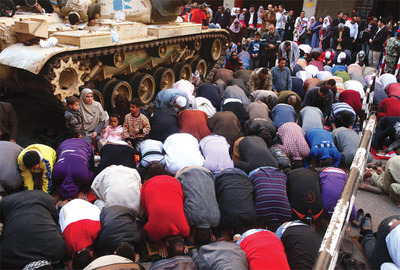
The allied Orientalist idea that Arabs are culturally lacking social consciousness cannot survive the spontaneous creation of an ad hoc social order under the most difficult circumstances in Cairo’s Tahrir Square and elsewhere in Egypt and Tunisia. Demonstrators banded together to protect one another—especially Muslims and Christians at prayer. They also joined forces to defend institutions such as the National Museum, create neighborhood-watch committees to prevent looting and banditry, provide medical care, and so forth. After the ouster of President Hosni Mubarak and a night of delirious celebrations, the Egyptian protesters even returned to the square and cleaned it up, handing it over to the country’s provisional new military authorities in almost pristine condition.

Consider, by contrast, how events in Egypt might have unfolded had the Western stereotype of the Arab street possessed any real explanatory power: The demonstrations in Cairo would have been violent and chaotic—and driven by religious fanaticism. But Islamism and religious identity played almost no role in the Egyptian and Tunisian uprisings; indeed, these supposed prime movers of Arab culture and politics haven’t been particularly evident in the region’s other mass protests, with the exception of Jordan. It wasn’t Islamism that brought millions of Arabs out into the streets to demand change. Rather, these protests were the product—and, just as important, the expression—of national consciousness, uniting Christians and Muslims, the devout and the skeptical, and a range of urban social classes, from the upper middle class to the working poor.

Islamists may be hoping to gain from new political openness and elections, but their rhetoric and symbolism have been almost absent from the Arab uprisings. Orientalist stereotypes have long discounted the importance of national identity and sentiment—and social consciousness more generally—in the Arab world. But the recent secular and ecumenical agitations for political reforms have shown the true, unsuspected reach of nationalist movements in the region—and their ability to motivate millions of ordinary Arabs across the urban social spectrum to risk all for change.

Nor have the demonstrations been anti-Western, even though most of the governments being challenged are US client states. Indeed, in a subordinate irony no Orientalist text could ever account for, anti-American, anti-Western, and anti-Semitic sentiments have been almost entirely the provenance of beleaguered pro-Western governments. The Mubarak regime blamed “foreign elements” for the Egyptian unrest, implying that Iranian, Israeli, and American forces were secretly at work, and Yemeni president Ali Abdullah Saleh has accused Israel and the United States of orchestrating the demonstrations in his country. The uprisings were not driven by, but did utilize, Western social media and ideals about democracy, and the protestors did issue many appeals for Western action and support, as well as some expressions of disappointment. Thus far, these Arab revolutionary movements have been for themselves and not against anyone, other than the autocrats in their own countries.

However, Arab protestors do share one central grievance that should be of urgent concern to Western policy makers: resistance to the Israeli occupation of Palestine that began in 1967. Some Western commentators seem determined to juxtapose the movement for self-determination within autocratic Arab states with the struggle against the occupation—and to argue, nonsensically, that because Arabs are willing to demand their own freedom, this somehow means they don’t care about the Palestinian cause. Israeli right-wingers and their American neoconservative allies have been flailing away vigorously at this straw man—but either they’re being deliberately deceptive or they’re not paying attention to what the protesters and Arab public opinion are saying about Israel and the Palestinians. There is no question that the Israeli occupation is still the prism of pain through which most Arabs view international relations—and that they are passionate about the cause of Palestinian freedom. The rash of Palestinian denialism on the right also doesn’t logically square with concomitant anxieties about the future of Israel’s peace treaty with Egypt. There is no indication of any plausible future Egyptian government abrogating the treaty—but as the frequent alarums of hard-line Likud leaders demonstrate, the Israeli right knows very well that even though the Arab peoples are proving they’re willing to fight for their own freedom with great bravery, that doesn’t mean they withhold support from the cause of Palestinian independence and the campaign to end the occupation.

Old myths die hard, when they die at all, but important correctives were on offer to American readers even before the wave of Arab protests ignited. Indeed, one such reappraisal came from an impeccably neoconservative source, Joshua Muravchik in the 2009 book The Next Founders: Voices of Democracy in the Middle East, a revealing set of profiles of next-wave and reformist Arab leaders. Not all of the subjects featured in Muravchik’s case studies are necessarily the cream of the crop, but The Next Founders raised the critical point that beyond the myths and before the uprisings, serious liberal reform was afoot in Arab political thought and life.

Probably the most significant work explaining how Arab reformers were gaining momentum (and helping to set the stage for the current uprisings) was Marwan Muasher’s 2008 The Arab Center: The Promise of Moderation. Muasher, a former foreign minister and deputy prime minister of Jordan, deftly laid out the essential conundrum facing Arab reformers, one that may bedevil the process of change into the future. He rightly observed that Arab societies require two essential principles: peace, in terms of resolving both internal disputes and regional struggles such as the Palestinian-Israeli conflict; and reform, based on inclusivity, accountability, and the rights of citizens, women, and minorities. As Muasher noted, the problem is that governments and elites committed to peace are typically afraid of reform—while opposition groups in favor of reform are often opposed to peace. Whether the current uprisings can unite these two principles remains to be seen, but Muasher invaluably aided that intellectual reckoning by laying out its fundamental terms.

The uprisings should portend an Arab social and political renaissance, and the popular spirit for such a rebirth is plainly evident. But there are still plenty of hazards ahead for Arab reform, including threats of military dictatorships, fragmented or failed states, and the emergence of tyrannical majorities in unrestrained parliamentary democracies. There is nothing to be gained by rushing to replace dystopian and alarmist myths about the menacing Arab street with utopian and triumphalist celebrations of it. But surely serious observers in the West can find the time to let the image of a secular, reform-minded—and, above all, peaceful—Arab street sink in. Once the old myth of the Arab street, with all its stereotyped connotations, is retired, we can look ahead to a time when mainstream thinkers in the West no longer get rewarded for casually pathologizing, demonizing, dismissing, and denigrating Arabs and their culture. After all, meaningful reform takes time—as the new generation of Arab reformers, the ordinary citizens themselves, can well attest.

When Islamophobia becomes legit

https://now.mmedia.me/lb/en/commentaryanalysis/when_islamophobia_becomes_legit

With the 10-year anniversary of the 9/11 terrorist attacks coming up this September, there are very disturbing indications that Islamophobia is reaching dangerous, even epidemic proportions in American culture and political life.

The most disturbing incident took place in California where right-wing Tea Party activists hurled abuse at Muslim-Americans attending a fundraiser. This outrageous behavior was exacerbated by hate-filled comments from a local councilwoman, Deborah Pauly, who told the protestors, “I know quite a few Marines who would be happy to help these terrorists to a, uh, early meeting in paradise.” Republican Congressmen Ed Royce, who claimed that “multiculturalism … has paralyzed” American society, and Gary Miller, who said, “I’m proud of what you are doing,” irresponsibly egged them on.

The organizers of the fundraiser didn’t help by including as one of the speakers the self-styled Oakland “Imam” Amir Abdel Malik-Ali, who has a history of extremist sentiments. The Muslim-American leadership in California and nationally has not yet taken sufficient steps to make it clear that people like Malik-Ali must be kept very firmly on the margins, not given platforms at events that aspire to respectability. But none of that excuses the conduct of the protesters or, worse, the opportunistic hatred of local politicians.

Meanwhile, the new chairman of the House Homeland Security Committee, New York Representative Peter King, is set this week to hold a hearing on the threat of homegrown Muslim terrorism in the United States. This is a serious subject, but King has a long history of making wild accusations against the Muslim-American community generally. In advance of the hearings, he repeated his assertion that Muslim-Americans did not cooperate with law enforcement. In fact, many of the most significant counterterrorism cases cited by the government have involved precisely such cooperation.

In response, the deputy national security adviser, Denis McDonough, spoke before a Muslim audience outside Washington DC on Sunday and insisted that Muslim-Americans were part of the solution, not the problem. The Obama administration has strongly rejected King’s allegations. For his part, King, who was once a passionate supporter of the Irish Republican Army, insists there is no disagreement.

Given that the most disturbing recent case of domestic terrorism was an attack on an event featuring Democratic congresswoman Gabrielle Giffords by an apparently deranged extremist, Jared Lee Loughner, the idea that Muslim extremism is the only serious threat to American domestic security has become harder than ever to defend. At the same time, simply dismissing the prospect of homegrown Muslim extremism isn’t realistic either. The problem with the King hearings is that they are narrowly focused on a single identity group rather than the broader challenges of political extremism and security.

Not only is Islamophobic hate-speech entering the American political mainstream, especially on the right, vandalism and other attacks have been increasingly focused on mosques and Islamic centers around the country. The irony is that while there have been disturbing incidents, there have been no repetitions of the 9/11 attacks, or anything remotely like them, in the past decade. Nonetheless, Islamophobic sentiment has been steadily increasing, and is much worse now than it was in the first couple of years following those attacks.

The reason for this is that since 2001, the Islamophobic narrative has become coherent and unified, and has been steadily drummed into the heads of far too many Americans. In other words, Islamophobia functions as a powerful instrument of political mobilization not because of the real degree of terrorist threat or level of Muslim extremism, but because the narrative has functioned independently of any verifiable reality. This highlights the difficulty of fighting such a narrative with facts or logic. It has a malevolent life of its own.

There are, of course, many on the political right who vocally oppose such hatred. They include small-government activist Grover Norquist, former Bush administration official Suhail Khan, former Secretary of State Colin Powell, and many others. But it appears that in recent years the voices of reason have been fighting a losing battle on the right. Islamophobic sentiments were on display at the recent Conservative Political Action Conference, the largest annual gathering of American conservatives. And the rallying of right-wing voices against the Park 51 New York City Islamic Center project showed how deeply these ideas have penetrated mainstream conservative thinking.

There is money to be made in such hatred, and shameless bigots like Pamela Geller, Robert Spencer, David Horowitz and Brigitte Gabriel have turned it into a cottage industry. There are also, even more alarmingly, votes to be had, as Allen West, a retired African-American military officer, demonstrated when he made anti-Muslim rhetoric a centerpiece of his recent successful Florida congressional campaign.

As long as people get rewarded for spewing Islamophobic hatred, and American-Muslim organizations keep making stupid mistakes, the situation in the United States is likely to get worse before it gets better. The onus is on both American conservative and Muslim leaders to act responsibly and display courageous leadership to prevent the situation from deteriorating further in the coming years.

A new Arab morning… for America

https://now.mmedia.me/lb/en/commentaryanalysis/a_new_arab_morning_for_america

It’s hard to think of a type of crisis the Obama administration has not faced during the past two years.

President Barack Obama inherited a pair of difficult wars and a financial meltdown from the Bush administration. Toss in a major environmental disaster in the Gulf of Mexico, with the Deepwater Horizon oil spill, and you get a sense of the kind of chaos a young, relatively inexperienced president has had to cope with in the first half of his term. However, Obama has been successful in drawing down the Iraq war and redefining the strategy in Afghanistan, and the American economy appears to be slowly clawing itself away from the abyss.

But now, with the entire Arab world aflame, Obama has just been handed the most far-reaching foreign policy challenge – and opportunity – the United States has faced since the end of the Cold War. Anti-government protests are underway in Libya, Yemen, Bahrain, Oman, Jordan, Mauritania, Djibouti and Morocco. There are rumblings in Kuwait, Saudi Arabia and elsewhere in the Gulf. And things are starting to heat up again in Egypt and Tunisia, where it all began.

For decades the US has based its foreign policy in the Middle East on maintaining stability, above all, and preserving the status quo. Washington has been guided by perceived core interests: ensuring that the US remains the sole regional superpower, securing the flow and pricing of energy resources, and a commitment to Israel’s security. The George W. Bush administration toyed with the idea of introducing a “freedom agenda” into US policy toward the Arab world, even releasing a “Greater Middle East Initiative” document outlining this.

But the Bush administration’s approach was badly flawed. The Greater Middle East Initiative was drafted without Arab input, and was slated to be unveiled at a multilateral meeting at which no Arab state would have been present. Even Arab reformers for the most part viewed the document with deep suspicion. It smacked too much of a neocolonial dictate, was premised on an unrealistic one-size-fits-all model, and ignored the Israeli occupation of Palestinian territory. This occupation has created as undemocratic an order as can be imagined – involving the rule of millions of noncitizens by a foreign army. As long as it persists, the US will be unable to lecture Arabs credibly on democracy.

The Greater Middle East Initiative was more than anything else a product of the intoxication of the short “mission accomplished” period before the Iraqi insurgency began in earnest. The chaos that ensued in Iraq ended any possibility that policies would be based on the freedom agenda or the stillborn initiative. Even under the Bush administration, tension between the short-term interests of the US in energy, stability and Israeli security; and long-term interests through the promotion of democracy, human rights and better relations with Arab populations rather than regimes, was, as always, decided in favor of the former.

Now the Obama administration – which has placed enormous emphasis on repairing relations with governments, promoting stability and seeking regional agreements – is confronted with a sudden, unexpected and uncontrolled outpouring of popular Arab anger and rejection of the status quo, both domestically and regionally. The problem is that American interests haven’t changed, but American calculations have to, and quickly. The US will have to deal with the outcome of a wave of popularly-driven demands for change that could be threatening to its short-term interests, but should very well serve the long-term interests.

The challenge for the US is to be seen as unequivocally taking the side of the Arab peoples even when it comes to pressuring long-standing allies. Otherwise, there is every danger that change will be both out of American control and hostile to American interests.

In truth, the US has a limited ability to influence what happens in most Arab states. However, the wisest course for Washington is to issue bold statements and use whatever leverage it has, even when this is more symbolic than practical, to demonstrate a real commitment to Arab democracy and reform in spite of potential risks to short-term American interests. This is happening, whether the US or the West likes it or not. It is futile to try holding back the waves like an impotent King Canute, or stand on the sidelines issuing vague statements to the effect of, “We may or may not be trying to have it both ways.”

Obviously, American interests haven’t changed, and they still center on energy, stability, American power and influence, and Israeli security. But the best way to secure these interests is to do everything possible to avoid being seen as the guarantor of domestic and regional orders that are plainly anathema to the Arab peoples in general.

American influence can no longer be secured through military might alone, and the US is hardly in a position to start writing checks either. The best approach for the US to secure its interests in the long-term and ensure that the new Arab order is as friendly as possible to American concerns is to embrace Arab change. Washington must place itself squarely on the side of the Arab peoples’ demands for democracy, inclusivity, good governance and accountability.

Act. Now. The world must do more than watch the Libyan bloodletting.

http://www.foreignpolicy.com/articles/2011/02/24/act_now?page=full

The unfolding catastrophe in Libya has forced the world to once again grapple with the conundrum of international humanitarian intervention. However, recent efforts at intervention — notably the humiliating episode in Somalia and the terrible failure to act in Rwanda — have revealed both the risks of action and the costs of inaction.

Muammar al-Qaddafi’s bloodcurdling speech on Feb. 22 should force even skeptics of international intervention to think twice. In his defiant remarks, the Libyan dictator vowed to “cleanse Libya house by house” in order to stay in power. Qaddafi also insisted that he has not begun to crack down in earnest — despite sketchy reports that his effort to quell the protests has already left hundreds, possibly thousands, of unarmed people dead — and approvingly cited other uses of state security forces to quell unrest, such as the Chinese assault on Tiananmen Square and the U.S. actions in Waco and Fallujah.

Neither the United States nor the international community should be under any illusions about the extraordinary costs of humanitarian intervention. However, it is becoming increasingly clear that these difficulties are outweighed by the risks of standing by and watching events unfold without taking any meaningful action.

Let’s start with the arguments against a full-throated intervention: There is little the United States can do on its own, and the scope of any potential engagement will have to be based on a broad-based international consensus. Even basic options, such as economic sanctions and the freezing of regime assets, will require support from countries such as Russia and China to have an effect. But these economic measures take time to make their impact felt, and they will certainly not produce, and probably won’t seriously accelerate, regime change. Nor will they come quickly enough to stop Qaddafi’s bloodletting of his own population.

Dissident Libyan diplomats, including the former deputy ambassador to the United Nations, have called for the more ambitious proposal of establishing a no-fly zone throughout the country. This would prevent the Qaddafi regime from continuing its use of warplanes and helicopters against the protesters. It might also inhibit the regime’s ability to ferry in foreign mercenaries, on whom it appears to be relying in the face of growing military defections. And, of course, it would undermine the regime’s ability to control the country at large.

Senior U.S. and NATO officials have so far not expressed any serious interest in becoming embroiled in the crisis in Libya, though the White House has refused to definitively take any option off the table. There are legitimate concerns about the long-term impact and short-term efficacy of aggressive intervention. Establishing a no-fly zone might place Americans and other Westerners still in Libya at risk, and compromise important Western economic interests. It could provide “evidence” for regime accusations that the rebellion is essentially an American plot, undermining the opposition movement in some people’s eyes. Moreover, the international community may also feel that it simply lacks sufficient information about the forces at work within Libya to be entirely certain about what kind of outcome even a limited no-fly zone intervention would be promoting.

Even more ominously, if the regime holds on to power in Tripoli and some other regions for an extended period of time, a no-fly zone might set the stage for the long-term fragmentation of the country by consolidating the rule of various factions, including the government, in different parts of the country. If Libya is fractured between local groups, it may be very difficult to reunite the country — possibly encouraging the development of a Somalia-style failed state in a strategic area of North Africa. The most significant concern, however, must be that a no-fly zone will simply be ineffective in preventing the escalation of the already enormous humanitarian crisis. As Qaddafi’s use of mercenaries and loyal military units has shown, air power is not necessary to commit atrocities on the ground, especially against unarmed or lightly armed demonstrators.

And then there’s the issue of escalation: Once the United States or the international community commits to protecting the Libyan people from their own government, it could prove very difficult to justify persisting with a no-fly zone policy when only intervention on the ground would stop the carnage. The example of the establishment of a no-fly zone over southern Iraq following the Gulf War — which did nothing, of course, to stop Saddam Hussein from deploying his troops to crush the incipient revolt — still looms large as a shameful incident in U.S. policy. Fear of being sucked into the use of ground forces — with far greater potential blowback, internal and international opposition, and unintended consequences — is also undoubtedly driving international caution.

But U.S. policymakers must not only consider the risks of intervention — they, and the rest of the international community, also need to contemplate the grave risks of doing nothing. The United States and its allies are now forced to deal with an emerging new order in the Middle East; it is squarely in their interest to place themselves on the side of popular demands for reform, democratization, and the removal of unaccountable leaders who have held power for decades. It’s not too late for the United States to be perceived as a positive force for change rather than a guardian of the old regional order, but standing idle while Libya burns would send the wrong message to the people of the region. Forging a broad international consensus for strong actions on Libya would be the wisest political and strategic course for the United States.

Symbolic actions such as freezing assets and economic sanctions are already overdue. A no-fly zone, in spite of its obvious limitations, should be organized as quickly as possible. Its creation will imply a commitment to protect the Libyan people from serious, sustained mass atrocities, and if it comes to that, the international community should be prepared to live up to its responsibilities — in spite of the present risks. The dangers of escalation shouldn’t be overblown: The regime’s unpopularity, its loss of control of much of the country and growing military, bureaucratic, and diplomatic defections suggest that Western boots on the ground could well be unnecessary.

The international community not only has solid practical reasons to intervene in Libya — it has a legal obligation. The invocation of the principle of the “responsibility to protect,” which was developed post-Rwanda and endorsed by the U.N. Security Council in 2006, may become unavoidable if the situation in Libya continues to deteriorate. The doctrine commits the international community to taking timely and decisive action to stop mass atrocities when states are either committing, or unable to stop, them. Can anyone seriously doubt that this is becoming increasingly applicable to Libya?

International action in Libya also provides the United States and its allies with an opportunity to make an important and positive contribution to the upheaval currently under way across the Middle East. The widespread alarm in the Arab world about the Qaddafi regime’s brutal tactics against the Libyan people means that aggressive international action would almost certainly be welcomed by the Arab public. Unlike other Western interventions in the region, humanitarian action in Libya would place the United States and the West on the side of the aspirations of millions of ordinary Arabs — and on the right side of history and the wave of democratization sweeping the region.