Category Archives: Article

Obama’s “non-doctrine” explained

https://now.mmedia.me/lb/en/commentaryanalysis/obamas_non-doctrine_explained

US President Barack Obama, explaining his Libya policy last week, resisted the temptation to define a fatuous “doctrine” for international intervention. Instead Obama laid out a set of coherent criteria to justify military action. By avoiding any “Obama doctrine” he also emphasized the flexibility required for deploying what is still unique, but decreasing, American power in a world in dramatic flux.

Obama began by asserting that the president will act without hesitation when the security of the United States is directly threatened, an uncontested axiom of American policy. Obama’s gloss on the deployment of American military power internationally was his focus on the convergence of values and interests. The operative sentence of his speech was: “There will be times, though, when our safety is not directly threatened, but our interests and our values are.” And, he added, “In such cases, we should not be afraid to act.”

Obama’s criteria for considering military action when the security of the United States is not directly threatened involve a fairly subtle interplay between what he presented as “values” and what are agreed to be “interests.” Because he was trying to justify a risky and expensive military operation to an American public generally opposed to intervention in Libya, Obama wisely emphasized the “values” element of the equation. He suggested that as Libyan forces advanced toward the rebel stronghold of Benghazi, he “refused to wait for the images of slaughter and mass graves before taking action.”

The White House reportedly anticipated “another Srebrenica,” recalling the massacre in 1995 of thousands of Bosnian Muslims in eastern Bosnia – as United Nations forces stood by powerlessly. No one could have seriously dismissed that prospect given Moammar al-Qaddafi’s own words and deeds as his forces threatened to recapture Benghazi.

However, the “interests” argument was there too, although downplayed. What Obama was trying to communicate was that for the United States, its Arab allies and the international community, the prospect of Benghazi falling and Qaddafi’s reemergence as a vengeful, bloodied, oil-rich and re-empowered menace stalking the region and the globe was simply an unacceptable outcome. The West and the Arabs might be able to live with a prolonged civil war in Libya, and maybe even a stalemate, but not a decisive Qaddafi victory and its consequences, especially given the Libyan leader’s track record.

So, Obama’s speech didn’t simply answer the question: “Why Libya?” It also answered the equally pointed “Why not Ivory Coast or Congo; why not Bahrain, Yemen or Syria?” Why act here, and not elsewhere?

This notion of the confluence of values and interests explains exactly why. American, and indeed universal, values may be affronted in the Ivory Coast and Congo, but fundamental Americans interests are not at stake. American interests in Bahrain – such as its hosting of the Fifth Fleet and apparent Iranian designs on the island kingdom – won’t allow for the overthrow of the royal family, although transition to a constitutional monarchy is undoubtedly desirable.

The situation in Yemen is so volatile and complex it’s almost impossible to imagine how military intervention would advance American interests there. And as for Syria, although regime change might be welcomed in Washington and many other capitals, highly influential Israeli and Saudi voices have warned strongly against the likely alternatives. There are many other examples in which American interests and values simply aren’t converging as in the Libyan case.

In Libya Obama identified this convergence and decided to act. I’ve argued that the hesitation in what was an inevitable intervention has been politically and strategically costly, but Obama powerfully argued that the United States had to act in concert with other states and with international legitimacy. What I still see as hesitation, he suggested was in fact the development of a broad coalition including NATO and Arab forces, and the passage of UN Security Council and Arab League resolutions authorizing the no-fly zone.

Obama’s conditions suggest that under his leadership the United States is not looking for opportunities to act but will be attuned to situations in which action is unavoidable, and inaction more costly or simply unacceptable. He explained these conditions masterfully and persuasively, but explicitly avoided any kind of formulaic “doctrine” that locks the United States into any future interventions.

Most importantly, Obama explicitly recognized that the Libyan action decisively shows the United States standing with Arabs seeking freedom from dictatorship. After all, if it really were about stability and oil, the most logical thing would’ve been to intervene on the side of Qaddafi, who has imposed ruthless stability and provided cheap petroleum. However, this robust intervention in one corner of the developing “Arab Spring” shows Washington clearly making a choice on behalf of dramatic and revolutionary change.

How to include Islamists in real Arab democracies

https://now.mmedia.me/lb/en/commentaryanalysis/who_will_be_the_brothers_keepers

The passage in late March of constitutional amendments allowing for early parliamentary and presidential elections in Egypt has revived concerns about the impact of likely major electoral successes for Islamist parties in emerging Arab democracies.

Some Egyptian reformers had warned that at least a year was needed to allow new political parties to begin to function. As things stand, there are only two well-organized parties in Egypt: the discredited former ruling National Democratic Party and the Muslim Brotherhood. The NDP probably still has some constituency and could remain a presence in the new parliament. But the deeper concern is that the only opposition group well positioned at this early stage to launch an effective nationwide campaign is the Brotherhood.

The demonstrations that ousted President Hosni Mubarak were not driven by Islamist rhetoric or ideology; they were secular, ecumenical and patriotic. However, the Muslim Brotherhood has the national infrastructure to campaign village by village, and it has a history of providing basic social services like health and education that the government has often failed to secure.

Because they have never held power anywhere outside of Gaza, Arab Sunni Islamists can claim the mantle of good governance, invoking the silly but commonplace idea that the devout are, by definition, honest. And while Islamist ideology didn’t carry much sway with the urban demonstrators in Tahrir Square, it might have much broader appeal in villages generally not part of the anti-Mubarak uprising.

So, there is every indication that the Muslim Brotherhood is poised to perform extremely well in early Egyptian elections. But is that a reason for alarm? After all, the religious right will have to be a part of any genuinely democratic order, as long as it is unarmed and plays by constitutional rules. Like all other parties, it has every right to stand for elections and seek a popular mandate for governance.

Some American observers such as Robert Satloff of the Washington Institute for Near East Policy advocate “discriminate democracy,” which he has defined as a “democracy for all but the Islamists.” Washington Post columnist Richard Cohen has bluntly written that the prospect of Islamists coming to power might threaten Israel and therefore Egyptian democracy is to be feared and rejected.

These are ridiculous arguments. There is a robust religious right in Israel, heavily represented in the current Israeli cabinet, that has propagated perfectly outrageous policies regarding the Palestinians, peace and Israeli minority groups. Is that a reason to reject democracy in Israel? There is also a robust and pernicious religious right in the United States, represented by demagogues such as Sarah Palin and Mike Huckabee, but their presence is hardly an argument for scrapping the Constitution.

The concern about Islamists and democracy is wrongly framed as the threat of “one man, one vote, one time,” as if Islamists generally intended to hold only one election, seize power and then shut down the process altogether. I think this is a serious misreading of the actual strategy of the Egyptian Muslim Brotherhood. It appears that most Arabs, including Islamists, have understood that governmental legitimacy requires elections, and that can’t be based on only one election. On the contrary, the Brotherhood seems to have a quiet confidence that it can consistently do well in elections over time, and that this is sufficient to pursue its agenda, at least at this stage.

The real challenge is very different: it is that the other side of the democratic coin – the need to restrain the power of democratically-elected majorities – is far less well understood or accepted. The Muslim Brotherhood, for example, is currently embroiled in a ridiculous debate about whether a woman or a Christian might one day serve as Egyptian president. Other than ruling parties and families, Arabs generally seem to have embraced the idea that elections are essential for legitimacy. But the need to protect the rights of individuals, minorities, women and others from potentially tyrannous majorities has not penetrated sufficiently.

Should democracies featuring regular, free and fair elections take hold in key Arab states such as Egypt, the challenge will probably not be a shutting down of the electoral process. It will be maintaining and enforcing restraint on the powers of potentially tyrannous majorities over individuals, women and minorities. Democracy promotion work in the Arab world, both internal and external, should move quickly away from an already established consensus in favor of elections, and begin to focus on the equally vital need to put clear limitations on the powers of democratically-elected majorities.

Under such circumstances, with strong constitutional limitations on the power of democratically-elected governments in place, backed up by neutral militaries committed to defending the Constitution rather than the regime, it should be possible to reconcile robust Islamist parties with real, functional democracy in the Arab world.

Can a no-fly zone still fly?

https://now.mmedia.me/lb/en/commentaryanalysis/can_a_no-fly_zone_still_fly_today

Call me born-again cautious, but after several weeks of calling for an international no-fly zone over Libya – and as an international consensus for one continues to grow – I find myself wondering if the most important benefits from such an intervention are still actually available. In such matters “if it were done when ‘tis done, then ‘twere well it were done quickly” (to borrow fromMacbeth), and in some important ways it may already be too late.

A no-fly zone imposed weeks ago would have placed the United States and the West squarely on the side not only of the Libyan rebellion, but Arab change in general. It would have made it virtually impossible for anyone to argue with a straight face that the West was so addicted to securing oil supplies and regional stability that it viewed dramatic or revolutionary change in the Arab order as undesirable.

The moment of maximum opportunity to achieve this objective came in the immediate aftermath of Moammar al-Qaddafi’s first televised address to the Libyan people, in which he denounced the revolt as a joint Al-Qaeda-American plot and threatened to cleanse Libya “house by house.” It was a psychotic performance that raised the deepest fears throughout the Arab world about the regime’s willingness to unleash massive force to quell the uprising. Swift action then would have been received among Arabs as a legitimate rescue operation, a humanitarian intervention born of alarm about the potential bloodbath threatened by a mad tyrant and his state apparatus.

Instead of repeating the ill-will generated by the no-fly zones over Iraq, a Libyan no-fly zone imposed at that time would have constituted an implicit American apology for having promoted rebellion in southern Iraq in 1991, only to let it to be crushed by Saddam Hussein’s air power before a no-fly zone was belatedly imposed.

However, now, after so much hesitation, an international no-fly zone will seem calculated, tentative and self-interested, and will come across much more like an intervention in a civil war rather than a humanitarian rescue operation. The Arab League endorsement of the idea does not make it more palatable to most Arabs. On the contrary, the body brings together the regimes that are most threatened by regional change. It may be that concern about the transformations that might be triggered through such intervention has made the option less desirable, and that this hesitation has had the contrary effect of reducing the ability of the West to influence outcomes in Libya.

A few weeks ago, momentum on the battlefield and in Libyan political life seemed to be entirely with the rebellion. A no-fly zone at that stage might have contributed to shaking the confidence of the regime and hindering its ability to counterattack, operate its air power and ferry mercenaries in and out of Libya. Now, the momentum has shifted markedly toward the regime, and Qaddafi’s downfall looks much less imminent, or even likely, than before. Meanwhile, the most dangerous Islamist extremists have either escaped from prison or have been released by the regime, adding a dangerous Salafist-Jihadist element to the mix that was not present a few weeks ago.

Not only does all of this change the political and psychological impact of a no-fly zone project, it greatly strengthens the possibility that such a zone would bring about a protracted civil conflict that leads to the de facto division of Libya into various fiefdoms. One of the greatest threats facing the process of Arab change is the dissolution of some Arab societies into Somalia-style failed states. Yemen is the most likely to head in that direction, but Libya is a candidate as well, presenting a dystopian scenario nobody wants to help promote. The longer the international community hesitates, the more likely a no-fly zone will simply impose a deadlock that assures Libya’s disintegration.

In and of itself, a no-fly zone would never have produced regime change. Part of its appeal was that it would not have undermined the Libyans’ ability to shape their own future. But it did raise the possibility of international boots being deployed on the ground (a very bad idea) if the regime survived over the long-term. Introducing a no-fly zone now will come across as more a strategic than a humanitarian decision, and will raise the same possibility about a foreign military presence, certainly more than it would have weeks ago.

A no-fly zone is still probably the best option. But its benefits would have been infinitely greater had it been introduced at the right moment rather than at this stage – belatedly and with visible reluctance.

Under Western Lies

http://www.bookforum.com/inprint/018_01/7265

The popular uprisings in Arab nations should bury some long-standing Orientalist myths.

Click to enlarge


With the recent wave of popular uprisings in the Middle East, Western observers have had the chance to face up to an important realization: that the oldest of clichés about Middle Eastern politics, “the Arab street,” is both a pernicious myth and a dynamic reality. For decades, Orientalist stereotypes about Arab culture and attitudes imbued this so-called street—a crude and monolithic metaphor for Arab public opinion and popular political sentiment—with almost uniformly negative connotations, which would then segue into dire warnings about the consequences of its eruption. Now the uprisings in Tunisia and Egypt and antigovernment protests in many other Arab states have demonstrated that the Arab street most certainly does exist—but it bears no resemblance to the bogeyman so long cultivated in the Western imagination.

Western commentators supplemented their hand-wringing about the Arab street with anxiety about “our Arab allies,” generally autocrats whose rule was considered vital to American interests in the region: the maximization of US power and influence, the control and pricing of energy, Israeli security, and regional stability. It’s true, of course, that the future complexion of the Arab political landscape remains uncertain, but the character of the rebellions has already been the strongest possible refutation of this traditional calculus and the mythology that misinformed it.

From the moment the Western imagination conjured the Arab street into being, it was populated by mobs of enraged, irrational, violent, and anti-Western religious fanatics, all bent on mayhem. This mythology has deep roots in Western misconceptions about the Arab world, as Edward Said famously demonstrated in his seminal 1978 study, Orientalism. Drawing on Michel Foucault’s investigation of the nexus between knowledge and power, Said argued that there exists an intimate connection between the presumed authority to define a subject and the assumed authority to rule that subject. Said explained that a key “dogma” of Orientalist thought “is that the Orient is at bottom something either to be feared . . . or to be controlled.” Under a carefully tended network of colonial oil fiefdoms and client states, Western strategists have essentially outsourced the task of control to autocratic but US-allied Arab governments. And in turn, these pro-Western autocrats have exploited the mythology of the Arab street to their own ends; the specter of a dangerous mass population barely held at bay helped them to cultivate their own claims to political legitimacy, while underwriting a decadent atmosphere of “Après moi, le déluge.”

Beyond the fairly recent myths of “realist” foreign policy, the Western image of the dangerous Arab masses actually harks back to the Middle Ages—in particular, the era’s religious and political competition between Christendom (the precursor to modern Europe) and Dâr al-Islam (from which the Arab world derives its identity), as Norman Daniel showed in his pioneering 1960 book, Islam and the West: The Making of an Image. Daniel’s thesis was more recently taken up by John Tolan in the 2002 study Saracens: Islam in the Medieval European Imagination, which traced the centuries-old religious origins of an incorrigible “sentiment of Western superiority over Muslims and over Arabs.”

Such traditional attitudes have routinely received new glosses in the Orientalist literature on what is purported to be a closed and rigidly change-averse “Arab mind.” This body of work usually bears the appearance of dispassionate cultural inquiry—but its authors are expressing essentially medieval anxieties about the mortal threat that Arab or Muslim power presents to the West. The Israeli right, in particular, has been adept at stoking such Western fears—most notoriously in the outrageous caricatures that Raphael Patai advanced in his 1973 study, The Arab Mind. This absurd and insulting book has been continuously reprinted and, more disturbing still, has been used for “cultural training” by the US military, most disastrously in connection with the war in Iraq. David Pryce-Jones’s influential 1989 tract The Closed Circle: An Interpretation of the Arabs, meanwhile, reproduced much of Patai’s patronizing hostility; Pryce-Jones pathologized all Arab culture indiscriminately, suggesting that it dooms its unfortunate adherents to suffer self-inflicted oppression and exploitation. Similarly, Lee Smith’s dreadful 2010 misreading of Arab politics, The Strong Horse: Power, Politics, and the Clash of Arab Civilizations, unapologetically asserted that in Arab culture, might makes right, and that since “violence is central to the politics, society and culture” of the Arabs, not only will brutality always prevail but “Bin Ladenism . . . represents the political and social norm.”

Irshad Manji’s militantly ignorant screed The Trouble with Islam Today: A Muslim’s Call for Reform in Her Faith (2004) actually argued that Arabs played virtually no role in the golden age of Islamic civilization—a position akin to asserting that the peoples of Italy played no role in Roman culture. New York Times columnist Nicholas Kristof picked up on her obsession with sand, contending that there is a distinction between the Middle East’s “desert Islam,” which he says is a problem, and Southeast Asia’s “riverine or coastal Islam,” which supposedly is not. This line of thinking grows out of a misguided tendency to rescue Islam from the Arabs, when in fact Islam sprang from Arab culture, an Arab “prophet,” and a “holy book” in Arabic. Islam itself, these people argue, is not the problem—it’s the Arab progenitors of the faith and their sandy, impoverished, nasty culture.

The uprisings in Egypt and Tunisia should put paid to such rubbish once and for all. Any serious, honest appraisal of what is spreading throughout the Arab world refutes every aspect of this pernicious mythology. Certainly, the size, scope, and bravery of the demonstrations for democracy, good governance, and accountability mean that no one can continue flogging the Orientalist shibboleth that Arabs are inherently resistant to change—at least not with a straight face. Likewise, the idea that Arab political culture is inherently violent has been most eloquently debunked by the extraordinarily self-disciplined nonviolence of the protesters in Egypt and Tunisia—in spite of extreme provocation and abuses by the police and government-paid hooligans.

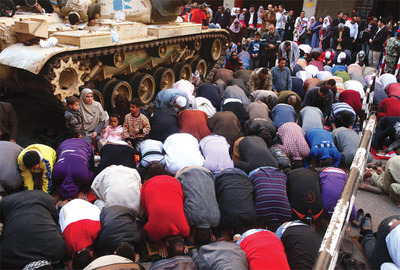
The allied Orientalist idea that Arabs are culturally lacking social consciousness cannot survive the spontaneous creation of an ad hoc social order under the most difficult circumstances in Cairo’s Tahrir Square and elsewhere in Egypt and Tunisia. Demonstrators banded together to protect one another—especially Muslims and Christians at prayer. They also joined forces to defend institutions such as the National Museum, create neighborhood-watch committees to prevent looting and banditry, provide medical care, and so forth. After the ouster of President Hosni Mubarak and a night of delirious celebrations, the Egyptian protesters even returned to the square and cleaned it up, handing it over to the country’s provisional new military authorities in almost pristine condition.

Consider, by contrast, how events in Egypt might have unfolded had the Western stereotype of the Arab street possessed any real explanatory power: The demonstrations in Cairo would have been violent and chaotic—and driven by religious fanaticism. But Islamism and religious identity played almost no role in the Egyptian and Tunisian uprisings; indeed, these supposed prime movers of Arab culture and politics haven’t been particularly evident in the region’s other mass protests, with the exception of Jordan. It wasn’t Islamism that brought millions of Arabs out into the streets to demand change. Rather, these protests were the product—and, just as important, the expression—of national consciousness, uniting Christians and Muslims, the devout and the skeptical, and a range of urban social classes, from the upper middle class to the working poor.

Islamists may be hoping to gain from new political openness and elections, but their rhetoric and symbolism have been almost absent from the Arab uprisings. Orientalist stereotypes have long discounted the importance of national identity and sentiment—and social consciousness more generally—in the Arab world. But the recent secular and ecumenical agitations for political reforms have shown the true, unsuspected reach of nationalist movements in the region—and their ability to motivate millions of ordinary Arabs across the urban social spectrum to risk all for change.

Nor have the demonstrations been anti-Western, even though most of the governments being challenged are US client states. Indeed, in a subordinate irony no Orientalist text could ever account for, anti-American, anti-Western, and anti-Semitic sentiments have been almost entirely the provenance of beleaguered pro-Western governments. The Mubarak regime blamed “foreign elements” for the Egyptian unrest, implying that Iranian, Israeli, and American forces were secretly at work, and Yemeni president Ali Abdullah Saleh has accused Israel and the United States of orchestrating the demonstrations in his country. The uprisings were not driven by, but did utilize, Western social media and ideals about democracy, and the protestors did issue many appeals for Western action and support, as well as some expressions of disappointment. Thus far, these Arab revolutionary movements have been for themselves and not against anyone, other than the autocrats in their own countries.

However, Arab protestors do share one central grievance that should be of urgent concern to Western policy makers: resistance to the Israeli occupation of Palestine that began in 1967. Some Western commentators seem determined to juxtapose the movement for self-determination within autocratic Arab states with the struggle against the occupation—and to argue, nonsensically, that because Arabs are willing to demand their own freedom, this somehow means they don’t care about the Palestinian cause. Israeli right-wingers and their American neoconservative allies have been flailing away vigorously at this straw man—but either they’re being deliberately deceptive or they’re not paying attention to what the protesters and Arab public opinion are saying about Israel and the Palestinians. There is no question that the Israeli occupation is still the prism of pain through which most Arabs view international relations—and that they are passionate about the cause of Palestinian freedom. The rash of Palestinian denialism on the right also doesn’t logically square with concomitant anxieties about the future of Israel’s peace treaty with Egypt. There is no indication of any plausible future Egyptian government abrogating the treaty—but as the frequent alarums of hard-line Likud leaders demonstrate, the Israeli right knows very well that even though the Arab peoples are proving they’re willing to fight for their own freedom with great bravery, that doesn’t mean they withhold support from the cause of Palestinian independence and the campaign to end the occupation.

Old myths die hard, when they die at all, but important correctives were on offer to American readers even before the wave of Arab protests ignited. Indeed, one such reappraisal came from an impeccably neoconservative source, Joshua Muravchik in the 2009 book The Next Founders: Voices of Democracy in the Middle East, a revealing set of profiles of next-wave and reformist Arab leaders. Not all of the subjects featured in Muravchik’s case studies are necessarily the cream of the crop, but The Next Founders raised the critical point that beyond the myths and before the uprisings, serious liberal reform was afoot in Arab political thought and life.

Probably the most significant work explaining how Arab reformers were gaining momentum (and helping to set the stage for the current uprisings) was Marwan Muasher’s 2008 The Arab Center: The Promise of Moderation. Muasher, a former foreign minister and deputy prime minister of Jordan, deftly laid out the essential conundrum facing Arab reformers, one that may bedevil the process of change into the future. He rightly observed that Arab societies require two essential principles: peace, in terms of resolving both internal disputes and regional struggles such as the Palestinian-Israeli conflict; and reform, based on inclusivity, accountability, and the rights of citizens, women, and minorities. As Muasher noted, the problem is that governments and elites committed to peace are typically afraid of reform—while opposition groups in favor of reform are often opposed to peace. Whether the current uprisings can unite these two principles remains to be seen, but Muasher invaluably aided that intellectual reckoning by laying out its fundamental terms.

The uprisings should portend an Arab social and political renaissance, and the popular spirit for such a rebirth is plainly evident. But there are still plenty of hazards ahead for Arab reform, including threats of military dictatorships, fragmented or failed states, and the emergence of tyrannical majorities in unrestrained parliamentary democracies. There is nothing to be gained by rushing to replace dystopian and alarmist myths about the menacing Arab street with utopian and triumphalist celebrations of it. But surely serious observers in the West can find the time to let the image of a secular, reform-minded—and, above all, peaceful—Arab street sink in. Once the old myth of the Arab street, with all its stereotyped connotations, is retired, we can look ahead to a time when mainstream thinkers in the West no longer get rewarded for casually pathologizing, demonizing, dismissing, and denigrating Arabs and their culture. After all, meaningful reform takes time—as the new generation of Arab reformers, the ordinary citizens themselves, can well attest.
When Islamophobia becomes legit

https://now.mmedia.me/lb/en/commentaryanalysis/when_islamophobia_becomes_legit

With the 10-year anniversary of the 9/11 terrorist attacks coming up this September, there are very disturbing indications that Islamophobia is reaching dangerous, even epidemic proportions in American culture and political life.

The most disturbing incident took place in California where right-wing Tea Party activists hurled abuse at Muslim-Americans attending a fundraiser. This outrageous behavior was exacerbated by hate-filled comments from a local councilwoman, Deborah Pauly, who told the protestors, “I know quite a few Marines who would be happy to help these terrorists to a, uh, early meeting in paradise.” Republican Congressmen Ed Royce, who claimed that “multiculturalism … has paralyzed” American society, and Gary Miller, who said, “I’m proud of what you are doing,” irresponsibly egged them on.

The organizers of the fundraiser didn’t help by including as one of the speakers the self-styled Oakland “Imam” Amir Abdel Malik-Ali, who has a history of extremist sentiments. The Muslim-American leadership in California and nationally has not yet taken sufficient steps to make it clear that people like Malik-Ali must be kept very firmly on the margins, not given platforms at events that aspire to respectability. But none of that excuses the conduct of the protesters or, worse, the opportunistic hatred of local politicians.

Meanwhile, the new chairman of the House Homeland Security Committee, New York Representative Peter King, is set this week to hold a hearing on the threat of homegrown Muslim terrorism in the United States. This is a serious subject, but King has a long history of making wild accusations against the Muslim-American community generally. In advance of the hearings, he repeated his assertion that Muslim-Americans did not cooperate with law enforcement. In fact, many of the most significant counterterrorism cases cited by the government have involved precisely such cooperation.

In response, the deputy national security adviser, Denis McDonough, spoke before a Muslim audience outside Washington DC on Sunday and insisted that Muslim-Americans were part of the solution, not the problem. The Obama administration has strongly rejected King’s allegations. For his part, King, who was once a passionate supporter of the Irish Republican Army, insists there is no disagreement.

Given that the most disturbing recent case of domestic terrorism was an attack on an event featuring Democratic congresswoman Gabrielle Giffords by an apparently deranged extremist, Jared Lee Loughner, the idea that Muslim extremism is the only serious threat to American domestic security has become harder than ever to defend. At the same time, simply dismissing the prospect of homegrown Muslim extremism isn’t realistic either. The problem with the King hearings is that they are narrowly focused on a single identity group rather than the broader challenges of political extremism and security.

Not only is Islamophobic hate-speech entering the American political mainstream, especially on the right, vandalism and other attacks have been increasingly focused on mosques and Islamic centers around the country. The irony is that while there have been disturbing incidents, there have been no repetitions of the 9/11 attacks, or anything remotely like them, in the past decade. Nonetheless, Islamophobic sentiment has been steadily increasing, and is much worse now than it was in the first couple of years following those attacks.

The reason for this is that since 2001, the Islamophobic narrative has become coherent and unified, and has been steadily drummed into the heads of far too many Americans. In other words, Islamophobia functions as a powerful instrument of political mobilization not because of the real degree of terrorist threat or level of Muslim extremism, but because the narrative has functioned independently of any verifiable reality. This highlights the difficulty of fighting such a narrative with facts or logic. It has a malevolent life of its own.

There are, of course, many on the political right who vocally oppose such hatred. They include small-government activist Grover Norquist, former Bush administration official Suhail Khan, former Secretary of State Colin Powell, and many others. But it appears that in recent years the voices of reason have been fighting a losing battle on the right. Islamophobic sentiments were on display at the recent Conservative Political Action Conference, the largest annual gathering of American conservatives. And the rallying of right-wing voices against the Park 51 New York City Islamic Center project showed how deeply these ideas have penetrated mainstream conservative thinking.

There is money to be made in such hatred, and shameless bigots like Pamela Geller, Robert Spencer, David Horowitz and Brigitte Gabriel have turned it into a cottage industry. There are also, even more alarmingly, votes to be had, as Allen West, a retired African-American military officer, demonstrated when he made anti-Muslim rhetoric a centerpiece of his recent successful Florida congressional campaign.

As long as people get rewarded for spewing Islamophobic hatred, and American-Muslim organizations keep making stupid mistakes, the situation in the United States is likely to get worse before it gets better. The onus is on both American conservative and Muslim leaders to act responsibly and display courageous leadership to prevent the situation from deteriorating further in the coming years.

A new Arab morning… for America

https://now.mmedia.me/lb/en/commentaryanalysis/a_new_arab_morning_for_america

It’s hard to think of a type of crisis the Obama administration has not faced during the past two years.

President Barack Obama inherited a pair of difficult wars and a financial meltdown from the Bush administration. Toss in a major environmental disaster in the Gulf of Mexico, with the Deepwater Horizon oil spill, and you get a sense of the kind of chaos a young, relatively inexperienced president has had to cope with in the first half of his term. However, Obama has been successful in drawing down the Iraq war and redefining the strategy in Afghanistan, and the American economy appears to be slowly clawing itself away from the abyss.

But now, with the entire Arab world aflame, Obama has just been handed the most far-reaching foreign policy challenge – and opportunity – the United States has faced since the end of the Cold War. Anti-government protests are underway in Libya, Yemen, Bahrain, Oman, Jordan, Mauritania, Djibouti and Morocco. There are rumblings in Kuwait, Saudi Arabia and elsewhere in the Gulf. And things are starting to heat up again in Egypt and Tunisia, where it all began.

For decades the US has based its foreign policy in the Middle East on maintaining stability, above all, and preserving the status quo. Washington has been guided by perceived core interests: ensuring that the US remains the sole regional superpower, securing the flow and pricing of energy resources, and a commitment to Israel’s security. The George W. Bush administration toyed with the idea of introducing a “freedom agenda” into US policy toward the Arab world, even releasing a “Greater Middle East Initiative” document outlining this.

But the Bush administration’s approach was badly flawed. The Greater Middle East Initiative was drafted without Arab input, and was slated to be unveiled at a multilateral meeting at which no Arab state would have been present. Even Arab reformers for the most part viewed the document with deep suspicion. It smacked too much of a neocolonial dictate, was premised on an unrealistic one-size-fits-all model, and ignored the Israeli occupation of Palestinian territory. This occupation has created as undemocratic an order as can be imagined – involving the rule of millions of noncitizens by a foreign army. As long as it persists, the US will be unable to lecture Arabs credibly on democracy.

The Greater Middle East Initiative was more than anything else a product of the intoxication of the short “mission accomplished” period before the Iraqi insurgency began in earnest. The chaos that ensued in Iraq ended any possibility that policies would be based on the freedom agenda or the stillborn initiative. Even under the Bush administration, tension between the short-term interests of the US in energy, stability and Israeli security; and long-term interests through the promotion of democracy, human rights and better relations with Arab populations rather than regimes, was, as always, decided in favor of the former.

Now the Obama administration – which has placed enormous emphasis on repairing relations with governments, promoting stability and seeking regional agreements – is confronted with a sudden, unexpected and uncontrolled outpouring of popular Arab anger and rejection of the status quo, both domestically and regionally. The problem is that American interests haven’t changed, but American calculations have to, and quickly. The US will have to deal with the outcome of a wave of popularly-driven demands for change that could be threatening to its short-term interests, but should very well serve the long-term interests.

The challenge for the US is to be seen as unequivocally taking the side of the Arab peoples even when it comes to pressuring long-standing allies. Otherwise, there is every danger that change will be both out of American control and hostile to American interests.

In truth, the US has a limited ability to influence what happens in most Arab states. However, the wisest course for Washington is to issue bold statements and use whatever leverage it has, even when this is more symbolic than practical, to demonstrate a real commitment to Arab democracy and reform in spite of potential risks to short-term American interests. This is happening, whether the US or the West likes it or not. It is futile to try holding back the waves like an impotent King Canute, or stand on the sidelines issuing vague statements to the effect of, “We may or may not be trying to have it both ways.”

Obviously, American interests haven’t changed, and they still center on energy, stability, American power and influence, and Israeli security. But the best way to secure these interests is to do everything possible to avoid being seen as the guarantor of domestic and regional orders that are plainly anathema to the Arab peoples in general.

American influence can no longer be secured through military might alone, and the US is hardly in a position to start writing checks either. The best approach for the US to secure its interests in the long-term and ensure that the new Arab order is as friendly as possible to American concerns is to embrace Arab change. Washington must place itself squarely on the side of the Arab peoples’ demands for democracy, inclusivity, good governance and accountability.

Act. Now. The world must do more than watch the Libyan bloodletting.

http://www.foreignpolicy.com/articles/2011/02/24/act_now?page=full

The unfolding catastrophe in Libya has forced the world to once again grapple with the conundrum of international humanitarian intervention. However, recent efforts at intervention — notably the humiliating episode in Somalia and the terrible failure to act in Rwanda — have revealed both the risks of action and the costs of inaction.

Muammar al-Qaddafi’s bloodcurdling speech on Feb. 22 should force even skeptics of international intervention to think twice. In his defiant remarks, the Libyan dictator vowed to “cleanse Libya house by house” in order to stay in power. Qaddafi also insisted that he has not begun to crack down in earnest — despite sketchy reports that his effort to quell the protests has already left hundreds, possibly thousands, of unarmed people dead — and approvingly cited other uses of state security forces to quell unrest, such as the Chinese assault on Tiananmen Square and the U.S. actions in Waco and Fallujah.

Neither the United States nor the international community should be under any illusions about the extraordinary costs of humanitarian intervention. However, it is becoming increasingly clear that these difficulties are outweighed by the risks of standing by and watching events unfold without taking any meaningful action.

Let’s start with the arguments against a full-throated intervention: There is little the United States can do on its own, and the scope of any potential engagement will have to be based on a broad-based international consensus. Even basic options, such as economic sanctions and the freezing of regime assets, will require support from countries such as Russia and China to have an effect. But these economic measures take time to make their impact felt, and they will certainly not produce, and probably won’t seriously accelerate, regime change. Nor will they come quickly enough to stop Qaddafi’s bloodletting of his own population.

Dissident Libyan diplomats, including the former deputy ambassador to the United Nations, have called for the more ambitious proposal of establishing a no-fly zone throughout the country. This would prevent the Qaddafi regime from continuing its use of warplanes and helicopters against the protesters. It might also inhibit the regime’s ability to ferry in foreign mercenaries, on whom it appears to be relying in the face of growing military defections. And, of course, it would undermine the regime’s ability to control the country at large.

Senior U.S. and NATO officials have so far not expressed any serious interest in becoming embroiled in the crisis in Libya, though the White House has refused to definitively take any option off the table. There are legitimate concerns about the long-term impact and short-term efficacy of aggressive intervention. Establishing a no-fly zone might place Americans and other Westerners still in Libya at risk, and compromise important Western economic interests. It could provide “evidence” for regime accusations that the rebellion is essentially an American plot, undermining the opposition movement in some people’s eyes. Moreover, the international community may also feel that it simply lacks sufficient information about the forces at work within Libya to be entirely certain about what kind of outcome even a limited no-fly zone intervention would be promoting.

Even more ominously, if the regime holds on to power in Tripoli and some other regions for an extended period of time, a no-fly zone might set the stage for the long-term fragmentation of the country by consolidating the rule of various factions, including the government, in different parts of the country. If Libya is fractured between local groups, it may be very difficult to reunite the country — possibly encouraging the development of a Somalia-style failed state in a strategic area of North Africa. The most significant concern, however, must be that a no-fly zone will simply be ineffective in preventing the escalation of the already enormous humanitarian crisis. As Qaddafi’s use of mercenaries and loyal military units has shown, air power is not necessary to commit atrocities on the ground, especially against unarmed or lightly armed demonstrators.

And then there’s the issue of escalation: Once the United States or the international community commits to protecting the Libyan people from their own government, it could prove very difficult to justify persisting with a no-fly zone policy when only intervention on the ground would stop the carnage. The example of the establishment of a no-fly zone over southern Iraq following the Gulf War — which did nothing, of course, to stop Saddam Hussein from deploying his troops to crush the incipient revolt — still looms large as a shameful incident in U.S. policy. Fear of being sucked into the use of ground forces — with far greater potential blowback, internal and international opposition, and unintended consequences — is also undoubtedly driving international caution.

But U.S. policymakers must not only consider the risks of intervention — they, and the rest of the international community, also need to contemplate the grave risks of doing nothing. The United States and its allies are now forced to deal with an emerging new order in the Middle East; it is squarely in their interest to place themselves on the side of popular demands for reform, democratization, and the removal of unaccountable leaders who have held power for decades. It’s not too late for the United States to be perceived as a positive force for change rather than a guardian of the old regional order, but standing idle while Libya burns would send the wrong message to the people of the region. Forging a broad international consensus for strong actions on Libya would be the wisest political and strategic course for the United States.

Symbolic actions such as freezing assets and economic sanctions are already overdue. A no-fly zone, in spite of its obvious limitations, should be organized as quickly as possible. Its creation will imply a commitment to protect the Libyan people from serious, sustained mass atrocities, and if it comes to that, the international community should be prepared to live up to its responsibilities — in spite of the present risks. The dangers of escalation shouldn’t be overblown: The regime’s unpopularity, its loss of control of much of the country and growing military, bureaucratic, and diplomatic defections suggest that Western boots on the ground could well be unnecessary.

The international community not only has solid practical reasons to intervene in Libya — it has a legal obligation. The invocation of the principle of the “responsibility to protect,” which was developed post-Rwanda and endorsed by the U.N. Security Council in 2006, may become unavoidable if the situation in Libya continues to deteriorate. The doctrine commits the international community to taking timely and decisive action to stop mass atrocities when states are either committing, or unable to stop, them. Can anyone seriously doubt that this is becoming increasingly applicable to Libya?

International action in Libya also provides the United States and its allies with an opportunity to make an important and positive contribution to the upheaval currently under way across the Middle East. The widespread alarm in the Arab world about the Qaddafi regime’s brutal tactics against the Libyan people means that aggressive international action would almost certainly be welcomed by the Arab public. Unlike other Western interventions in the region, humanitarian action in Libya would place the United States and the West on the side of the aspirations of millions of ordinary Arabs — and on the right side of history and the wave of democratization sweeping the region.

Secularism is what the Arab world needs

https://now.mmedia.me/lb/en/commentaryanalysis/secularism_is_what_the_arab_world_needs

The wave of anti-government protests sweeping through the Arab world, which has already toppled governments in Tunisia and Egypt, raises very serious questions about religion and politics in the Middle East, and reinforces the need for Arab secularism.

The most fascinating thing about the largest and most important of the protests, in Egypt and Tunisia, is that the animating spirit that brought millions of ordinary Arab citizens out into the streets was not religion or any version of religious politics, but nationalism and a broad-based social consciousness. The country-specific and broader Arab nationalist sentiments that brought such huge crowds together had long been considered dead, or at least moribund, by many observers. Had one predicted the outpouring of anti-government anger across the region six or eight months ago, most observers would have anticipated an Islamist ideological tinge to the revolts.

The governments, of course, have all tried to blame the uprisings on Islamist plots (as well as that old stand-by “foreign meddling”), but the symbolism and rhetoric behind the protest movements have disproved these allegations irrefutably. In Tunisia, one of the most powerful chants was “Tunis huwa al-hal” (Tunisia is the answer), a clear-cut retort to the Muslim Brotherhood slogan “Islam huwa al-hal” (Islam is the answer). In Egypt, a striking feature of the protests was not only its secular but also ecumenical character, with Muslims and Christians joining and protecting each other during prayer, and the devout mingling comfortably with the skeptical.

That Egyptians came together across these potential or presumed dividing lines was a clear recognition that in order for the society to be united, in this case against the presidency of Hosni Mubarak, it had no choice but to push religious identity into the background. In other words, the diversity of Egyptian society meant that the Islamist approach, ideology and symbolic repertoire would have been more of an obstacle to than a vehicle of success against the regime.

It’s true that the Muslim Brotherhood is the largest and best organized opposition party in Egypt, and that Islamists are the key opposition parties in most Arab states. It’s true that they participated, in some cases significantly, in the protest movements, and that they are no doubt counting on being primary beneficiaries of an opening up of Arab political space, especially through elections. The Egyptian Brotherhood, for example, was wise not to overplay its hand by thrusting itself and its ideology into the forefront of a movement for which it was not responsible and which gained its power by bringing a huge number of people together across religious and other divides.

The Islamist message is, by definition, divisive. By staying in the background its adherents have implicitly recognized that it has deep limitations when the entire society needs to be mobilized – in this case for purposes of overthrowing the government. That means the same limitations apply any time an Arab society needs to be successfully mobilized, although this obvious point will probably remain largely unarticulated. So while Islamists may be looking forward to trying to exploit new Arab political openness, they must have noted with dismay that it was not their ideology but a secular and ecumenical nationalism that animated the most important of the Arab revolts.

The Bahraini case also demonstrates the dangers of Arab sectarianism and the need to move quickly toward a secular order in which the state is neutral on matters of religion, and religious constituencies are treated equally by the government. In the kingdom, a ruling Sunni minority royal family and elite are facing what they, probably correctly, perceive as the latest round of efforts by the Shia majority to confront its marginalization and disenfranchisement.

In Egypt, the secular and ecumenical nature of the protests was a major factor in its size, power and success, whereas in Bahrain sectarian divisions are at the heart of the instability of the government and the anger of the disempowered majority.

All societies are heterogeneous, and therefore only a secular approach involving government neutrality on religious matters can have any chance of producing fairness and equality. Most Arab societies are strikingly heterogeneous – in many cases a mosaic of sectarian, cultural, ethnic and other diversity. Only secular governance can genuinely express the legitimate rights of a majority while successfully protecting the rights of minorities and individual citizens.

Even though they have not been at the forefront of the most important Arab protest movements, Islamists are no doubt waiting on the sidelines, hoping and preparing to benefit from new political space. But the new Arab order, especially since it is being born in such a strikingly secular and ecumenical spirit – and if it is to have any hope of providing democracy, good governance, equity and human rights – cannot be defined by religious politics. As the Iranian experience so bitterly shows, such a definition would only set the stage for more oppression, division and civil conflict down the road.

More Arab democracy, Palestinian this time

https://now.mmedia.me/lb/en/commentaryanalysis/more_arab_democracy_palestinian_this_time

In what is probably a long-overdue move, the Palestinian leadership in Ramallah has called for new local, presidential and parliamentary elections before September.

The leadership of the Palestine Liberation Organization and the Palestinian Authority are finally beginning to proactively tackle the crisis of legitimacy that resulted from the split within the Palestinian national movement between the PLO and Hamas after 1997. Many Palestinians have been elected to many offices in recent years, but everyone’s term has expired, and rivalry between the different factions has prevented new elections from resolving this crisis of legitimacy.

The recent unrest in Egypt, like the new sense throughout the Arab world that political leadership must be legitimate and based on the consent of the governed through elections, may well have added to the sense of urgency among Palestinian leaders.

Domestically and internationally, the lack of elections has been used consistently as a cudgel with which to attack everything the mainstream Palestinian leadership has been doing, most notably negotiations with Israel and state-building in the West Bank. The critics have argued that the absence of recent elections means that what the PLO and the Palestinian Authority do is subject to serious doubt, although the same standard is rarely applied to Hamas.

In fact the onus for the lack of elections lies with Hamas, which most predictably has rejected the new election plans as “a conspiracy against the Palestinian people.” Hamas rejected plans for elections in January 2010 under Palestinian law and an Egyptian proposal that would have allowed for elections last July. Its position was that national reconciliation had to precede elections. This was a ploy designed to cover up for the fact that the organization, quite reasonably, feared the results of Palestinian voting under the present circumstances.

The logic was tortured, since there are no other means to clarify the will of the Palestinian people or to set the stage for national reconciliation and define on whose terms reconciliation will largely be based. It was a dodge, designed to avoid elections whose results would almost certainly have been unfavorable to Hamas, following more than two years of freefalling political credibility, at least among Palestinians.

But Fatah also bears its share of the responsibility. Last summer the Palestinian Authority was planning local elections in the West Bank. These were called off at the last minute, apparently because, even though Fatah was largely, or at least formally, unopposed in many races, it seemingly was unable to organize itself sufficiently. The local elections would have been a very good step forward, and their sudden cancellation was a considerable embarrassment.

However, the current plans offer one of the few obvious ways for the Palestinians to reunite amicably, and for the Palestinian people to make their preferences about national leadership and policy clear. It is, of course, vital that elections actually be held. It will also be important to give opposition groups, including Hamas, a serious opportunity to put forward candidates and campaign. Palestinians have proven with the presidential elections in 2005 and the parliamentary elections in 2006 that they are more than capable of holding free and fair elections.

If elections are called for and then abandoned or indefinitely postponed, or held under dubious circumstances with real questions about their legitimacy, it would be better not to hold them in the first place. Since Hamas is likely to oppose the election plans and fare poorly, it can and should have to bear the political price for this.

The biggest question mark is over the future of President Mahmoud Abbas. He has repeatedly said he would not stand in future elections, but there is no clear successor to him in Fatah or the PLO. But politicians change their minds, and standing in a free and fair election would not be illegitimate for Abbas. On the other hand, the president seems genuinely to have had enough of national leadership.

No doubt there will be efforts to convince Abbas that since there are no clear, plausible alternatives at this stage, he should reconsider his earlier pronouncements. That is especially true since it is not clear what kind of leadership and policies might emerge otherwise.

Egypt’s case demonstrates that change can be both necessary and risky, and the Palestinian leadership is wise to seek to manage change by calling for new elections. If it holds them and abides by the results, with or without Hamas cooperation, it will be a significant step bolstering both the leadership’s legitimacy and the Palestinian national project.

A New American Strategy for the Middle East Is a Must (with Prof. Saliba Sarsar)

http://www.huffingtonpost.com/saliba-sarsar/post_1703_b_820841.html

The United States stands at the horns of a dilemma in its relationships with the Middle East. The hesitant or on-the-boundary response of the Obama administration to the frozen Palestinian-Israeli peace talks, the ouster of authoritarian Tunisian President Zein al-Abidin Ben Ali, the people’s uprising in Egypt against President Hosni Mubarak (another autocrat), and opposition protests in Jordan, Yemen, and elsewhere around the Arab World — all point toward the need for a new American strategy for the Middle East.

Historically, the United States advanced its interests in the region by reducing or eliminating Soviet influence during the Cold War; securing access to natural resources, especially oil; cultivating military and other alliances with key states; and cultivating its special relationship with the State of Israel. In most cases, business as usual was conducted, with the US investing much in dictatorships, while paying little attention to the aspirations and needs of the general populace. A classic example is the American close alliance with the Shah of Iran, which ultimately ushered the theocratic rule of first the Mullahs and now the Revolutionary Guards, the speeding up of Iran’s nuclear ambitions, and the recent decline in American influence in the Gulf.

In response to the 9/11 terrorist attacks and claims about “the presence of weapons of mass destruction in Iraq,” the United States shifted gears by invading Iraq in 2003 and ousting its dictator Saddam Hussein, proclaiming our commitment to opposing tyrants and promoting democracy. Yet business as usual continued with other Arab countries continued, at a time when none of them had a passing grade on democracy. This is has been framed as either a contradiction between aspirational rhetoric and actual policies, or between the “short term interests” in stability, oil resources and Israeli security versus “long term interests” that include promoting American values of freedom and democracy in the Arab world in practice. Either way, there is a long and universally recognized gap between American policies towards governments and governance in the Arab world and our traditional ideals that has not served our interests well or enhanced our reputation with the peoples of the region.

The administration of George W. Bush rhetorically recognized this dilemma with frequent calls for the development of a “freedom agenda” in the Middle East. However, this agenda was noticeably absent from any major policy changes. And the main product of it, the “Greater Middle East Initiative,” proposal was poorly conceptualized, composed without any Arab input to speak of, slated for presentation at an international meeting at which neither Arab governments nor civil society would be present, and ultimately faded into memory. Its one-size-fits-all approach and aura of outside intervention without consultation doomed the approach and interest in its ideas in Washington seemed to vanish with the rise of the insurgency in Iraq and its implications for the administration’s assumptions about how best to promote change in the region.

President Barack Obama’s Cairo speech in 2009 was significant as it raised the hopes of Muslims, Arabs, and others by calling for greater understanding between peoples, rejection of extremist violence, respect for basic human rights, elimination of nuclear weapons, and mutual recognition between Israel and the Palestinians. Words might inspire for a time, but can also ring hollow if not backed by policies reflecting a real desire for positive change and that promote that goal through actions. In apparent contrast to Bush administration rhetoric about a “freedom agenda,” the Obama administration has emphasized rebuilding alliances, out-stretched hands, diplomacy, ending rather than starting wars, and, above all, the quest for stability and conflict resolution (especially between Israel and the Palestinians). As events in Tunisia, Egypt and elsewhere are showing, this approach has not proved any more successful in placing the United States on the side of the Arab peoples and their aspirations or in securing either well-managed reforms or regional stability.

While continuing to promote its vital interests in the Middle East, our country clearly needs to develop a new American strategy, which will hopefully help engender a new, more democratic and stable Arab world and Middle East. The following principles should be central to this new approach, if events are not to overtake us completely and make it much more difficult for the United States to promote both our interests and our values in the region:

• Communicate American intentions and policies accurately and clearly, and avoid reserving pressure for real reforms to private meetings, out of the public perception. Conveying a consistent message on American expectation of its allies would counteract widespread misconceptions, misunderstandings, and conspiracy theories about the US role in the region. Leaks, too, would thereby be rendered largely irrelevant.

• Balance principles with pragmatism by imparting a vision for a better tomorrow and simultaneously serving in practice to bring freedom and hope to peoples who have been stuck in conflict, corruption, oppression, and poverty for generations. This must apply not only to the Arab states, Turkey and Iran, but also to Israeli policies, especially in the occupied Palestinian territories. Even-handedness will be a key perception if our country is to play a more positive and effective role in coming years.

• Put forward a broad conception of democracy, one that includes fair, free, and frequent elections, in addition to the other essential building blocks: good governance, transparency and separation of power within governments; freedom of speech, press, and religion; basic human rights for individual citizens, minority groups and women; human development; and economic freedom.

• Emphasize human security rather than military prowess. When unimpeded, human security makes possible freedom from want, freedom from fear, and freedom to live in dignity.

• Link economic assistance and military aid to the ability of governments to achieve country-specific goals, mainly concrete and transparent democratic improvements and economic measures aimed at improving the quality of life and opportunities for the general public. Ensure that our economic assistance reaches its intended target and is heavily complemented by public diplomacy and cultural outreach that also impact people’s daily lives.

• Create an international consensus and a coalition for moderation and peace, one that is perceived, insofar as possible, to serve the interests of all parties as they themselves define those interests. Dictates or dominance, not to mention invasions, will likely backfire in reform and democracy promotion, and are more likely promote disintegration and instability.

• Press hard to resolve the region’s endemic issues, particularly the Palestinian-Israeli conflict, based on two sovereign states, Israel and Palestine, living side by side in security, peace, and prosperity. Ending this conflict, as the American Task Force on Palestine has repeatedly argued, will enhance American national security and strike a powerful blow at the ideology of terrorism and extremism, improve American ability to further democracy and other American values in the region and around the world, and provide significant economic opportunities for both Americans and the region. Arabs and Muslims around the world will be far more likely to see the United States as a force that takes their interests, and their dignity, seriously, and that is sincere in urging the promotion of democracy, if the onerous and long-standing occupation that began in 1967 is finally ended, especially if our country is seen as playing the key role in achieving that long-sought goal.

Vacillation between principles and pragmatism leads to confusion and inconsistency in foreign policy application, and, even more, to perceptions of our intentions and our commitment to our founding values of freedom and democracy. Untempered, seemingly unconditional and purely pragmatic, alliances with regimes that dehumanize their citizens creates a loss of credibility, as does our special relationship with Israel as long as the occupation continues with no clear end in sight. Lest we forget: leaders are transitory, citizens are permanent. It is, ultimately, the Arab and other Middle Eastern peoples with whom we must develop truly lasting alliances and friendships.

If the United States is to have a more effective and consistent foreign policy in the Middle East, our strategy should be anchored in basic American values and in equity, symmetry, and transparency, and be both people-centered and performance-based. Only then will President Obama’s statement, “The people of Egypt have rights that are universal… [and] the United States will stand up for them everywhere” ring as true, and produce as much trust, as it needs to.